

28
2 Discharges in Current Large Tokamaks
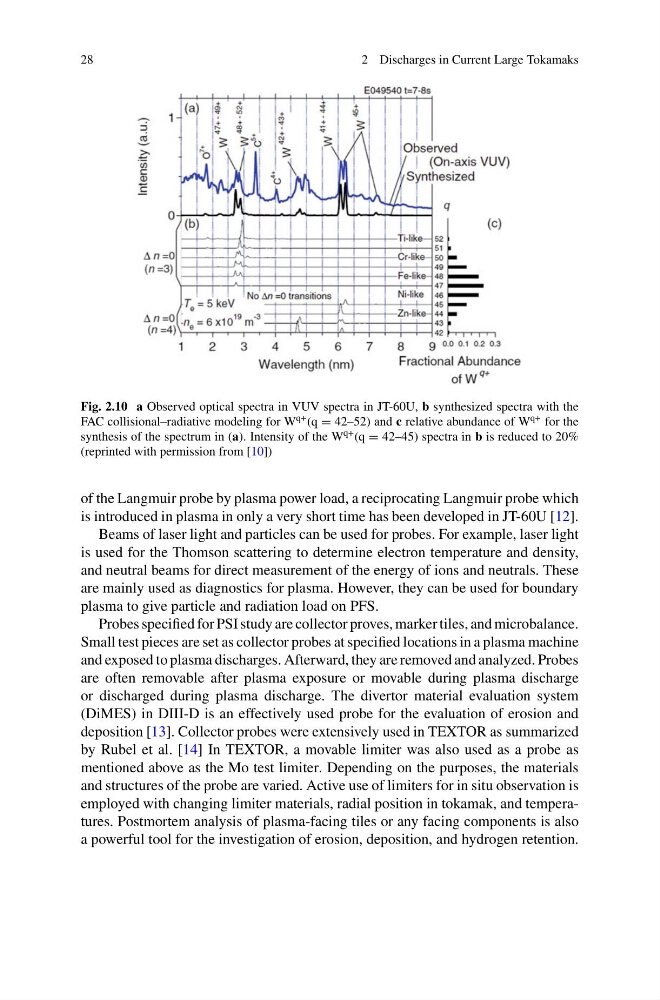
Fig. 2.10 a Observed optical spectra in VUV spectra in JT-60U, b synthesized spectra with the
FAC collisional–radiative modeling for W q+ (q = 42–52) and c relative abundance of W q+ for the
synthesis of the spectrum in (a). Intensity of the W q+ (q = 42–45) spectra in b is reduced to 20%
(reprinted with permission from [10])
of the Langmuir probe by plasma power load, a reciprocating Langmuir probe which
is introduced in plasma in only a very short time has been developed in JT-60U [12].
Beams of laser light and particles can be used for probes. For example, laser light
is used for the Thomson scattering to determine electron temperature and density,
and neutral beams for direct measurement of the energy of ions and neutrals. These
are mainly used as diagnostics for plasma. However, they can be used for boundary
plasma to give particle and radiation load on PFS.
Probes specified for PSI study are collector proves, marker tiles, and microbalance.
Small test pieces are set as collector probes at specified locations in a plasma machine
and exposed to plasma discharges. Afterward, they are removed and analyzed. Probes
are often removable after plasma exposure or movable during plasma discharge
or discharged during plasma discharge. The divertor material evaluation system
(DiMES) in DIII-D is an effectively used probe for the evaluation of erosion and
deposition [13]. Collector probes were extensively used in TEXTOR as summarized
by Rubel et al. [14] In TEXTOR, a movable limiter was also used as a probe as
mentioned above as the Mo test limiter. Depending on the purposes, the materials
and structures of the probe are varied. Active use of limiters for in situ observation is
employed with changing limiter materials, radial position in tokamak, and temperatures. Postmortem analysis of plasma-facing tiles or any facing components is also
a powerful tool for the investigation of erosion, deposition, and hydrogen retention.
2 Discharges in Current Large Tokamaks
Fig. 2.10 a Observed optical spectra in VUV spectra in JT-60U, b synthesized spectra with the
FAC collisional–radiative modeling for W q+ (q = 42–52) and c relative abundance of W q+ for the
synthesis of the spectrum in (a). Intensity of the W q+ (q = 42–45) spectra in b is reduced to 20%
(reprinted with permission from [10])
of the Langmuir probe by plasma power load, a reciprocating Langmuir probe which
is introduced in plasma in only a very short time has been developed in JT-60U [12].
Beams of laser light and particles can be used for probes. For example, laser light
is used for the Thomson scattering to determine electron temperature and density,
and neutral beams for direct measurement of the energy of ions and neutrals. These
are mainly used as diagnostics for plasma. However, they can be used for boundary
plasma to give particle and radiation load on PFS.
Probes specified for PSI study are collector proves, marker tiles, and microbalance.
Small test pieces are set as collector probes at specified locations in a plasma machine
and exposed to plasma discharges. Afterward, they are removed and analyzed. Probes
are often removable after plasma exposure or movable during plasma discharge
or discharged during plasma discharge. The divertor material evaluation system
(DiMES) in DIII-D is an effectively used probe for the evaluation of erosion and
deposition [13]. Collector probes were extensively used in TEXTOR as summarized
by Rubel et al. [14] In TEXTOR, a movable limiter was also used as a probe as
mentioned above as the Mo test limiter. Depending on the purposes, the materials
and structures of the probe are varied. Active use of limiters for in situ observation is
employed with changing limiter materials, radial position in tokamak, and temperatures. Postmortem analysis of plasma-facing tiles or any facing components is also
a powerful tool for the investigation of erosion, deposition, and hydrogen retention.