

14
1 Introduction
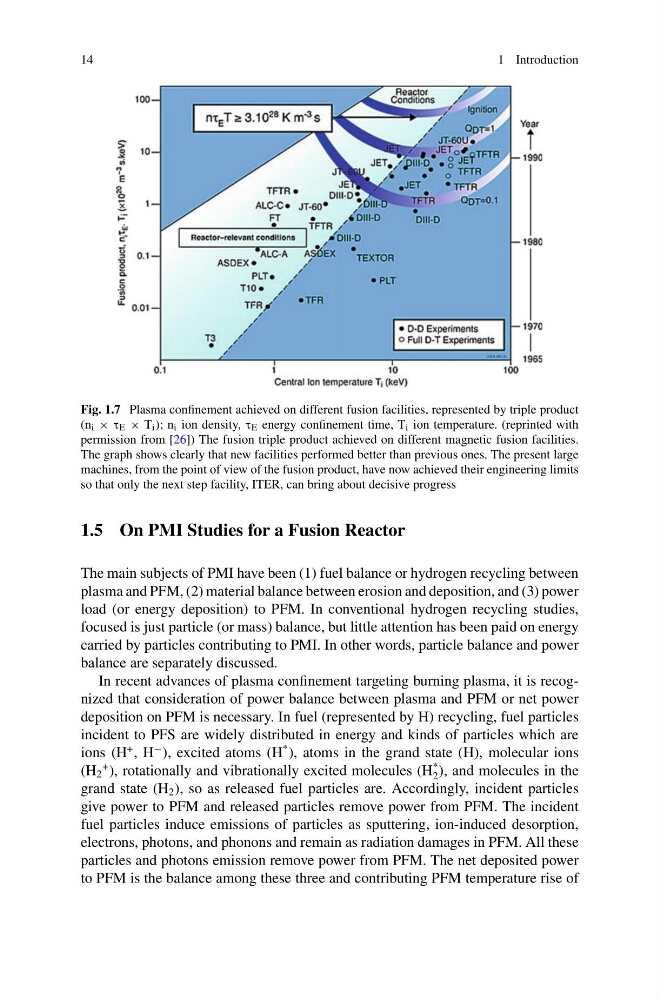
Fig. 1.7 Plasma confinement achieved on different fusion facilities, represented by triple product
(n i × τ E × T i ); n i ion density, τ E energy confinement time, T i ion temperature. (reprinted with
permission from [26]) The fusion triple product achieved on different magnetic fusion facilities.
The graph shows clearly that new facilities performed better than previous ones. The present large
machines, from the point of view of the fusion product, have now achieved their engineering limits
so that only the next step facility, ITER, can bring about decisive progress
1.5 On PMI Studies for a Fusion Reactor
The main subjects of PMI have been (1) fuel balance or hydrogen recycling between
plasma and PFM, (2) material balance between erosion and deposition, and (3) power
load (or energy deposition) to PFM. In conventional hydrogen recycling studies,
focused is just particle (or mass) balance, but little attention has been paid on energy
carried by particles contributing to PMI. In other words, particle balance and power
balance are separately discussed.
In recent advances of plasma confinement targeting burning plasma, it is recognized that consideration of power balance between plasma and PFM or net power
deposition on PFM is necessary. In fuel (represented by H) recycling, fuel particles
incident to PFS are widely distributed in energy and kinds of particles which are
ions (H
+ , H
− ), excited atoms (H
* ), atoms in the grand state (H), molecular ions
(H 2
+ ), rotationally and vibrationally excited molecules (H
*
2 ), and molecules in the
grand state (H 2 ), so as released fuel particles are. Accordingly, incident particles
give power to PFM and released particles remove power from PFM. The incident
fuel particles induce emissions of particles as sputtering, ion-induced desorption,
electrons, photons, and phonons and remain as radiation damages in PFM. All these
particles and photons emission remove power from PFM. The net deposited power
to PFM is the balance among these three and contributing PFM temperature rise of
1 Introduction
Fig. 1.7 Plasma confinement achieved on different fusion facilities, represented by triple product
(n i × τ E × T i ); n i ion density, τ E energy confinement time, T i ion temperature. (reprinted with
permission from [26]) The fusion triple product achieved on different magnetic fusion facilities.
The graph shows clearly that new facilities performed better than previous ones. The present large
machines, from the point of view of the fusion product, have now achieved their engineering limits
so that only the next step facility, ITER, can bring about decisive progress
1.5 On PMI Studies for a Fusion Reactor
The main subjects of PMI have been (1) fuel balance or hydrogen recycling between
plasma and PFM, (2) material balance between erosion and deposition, and (3) power
load (or energy deposition) to PFM. In conventional hydrogen recycling studies,
focused is just particle (or mass) balance, but little attention has been paid on energy
carried by particles contributing to PMI. In other words, particle balance and power
balance are separately discussed.
In recent advances of plasma confinement targeting burning plasma, it is recognized that consideration of power balance between plasma and PFM or net power
deposition on PFM is necessary. In fuel (represented by H) recycling, fuel particles
incident to PFS are widely distributed in energy and kinds of particles which are
ions (H
+ , H
− ), excited atoms (H
* ), atoms in the grand state (H), molecular ions
(H 2
+ ), rotationally and vibrationally excited molecules (H
*
2 ), and molecules in the
grand state (H 2 ), so as released fuel particles are. Accordingly, incident particles
give power to PFM and released particles remove power from PFM. The incident
fuel particles induce emissions of particles as sputtering, ion-induced desorption,
electrons, photons, and phonons and remain as radiation damages in PFM. All these
particles and photons emission remove power from PFM. The net deposited power
to PFM is the balance among these three and contributing PFM temperature rise of