

1.3 Energy Conversion from Nuclear to Thermal for Electric Power Generation
9
There is one more important energy conversion process, which occurs at PFS.
For sustaining burning plasma, fusion plasma shall be confined in the magnetic field.
Confinement times of fuels and energy in the burning plasma are quite short, only
a few seconds or less. That means fuels and energy are supplied and exhausted
simultaneously to keep the input and output balance of fuel and power, which are
quite hard to realize. The fuel balance has been discussed in a separate book [17]
and will not be discussed here. To start up the burning plasma, energy is supplied
from outside by various techniques, such as ohmic heating, neutral beam injection,
electron cyclotron heating, ion cyclotron heating, and so on, while at the steady
state, self-heating by 3.7 MeV He is expected in addition to the ohmic heating. Since
plasma temperature is around 10–20 keV, 3.7 MeV He collides with fuel ions and
electrons in plasma to give its energy to them through either the Coulomb collision
or nuclear collisions. If the burning plasma does not contain impurity other than He,
the Bremsstrahlung photon emission caused by motions of electrons, fuel ions, and
He ions in the magnetic field gives energy loss from the plasma core.
Real plasma includes various impurities, in particular, atoms consisting of plasmafacing materials, and impurities included in them are easily released by collisions
with plasma particles escaping from the plasma. Once these impurities enter in
plasma, they are immediately ionized. Then they capture electrons and emit photons
with energy corresponding to energy levels of binding electrons in impurity atoms.
Together with the Bremsstrahlung emission, radiation from the impurities reduces
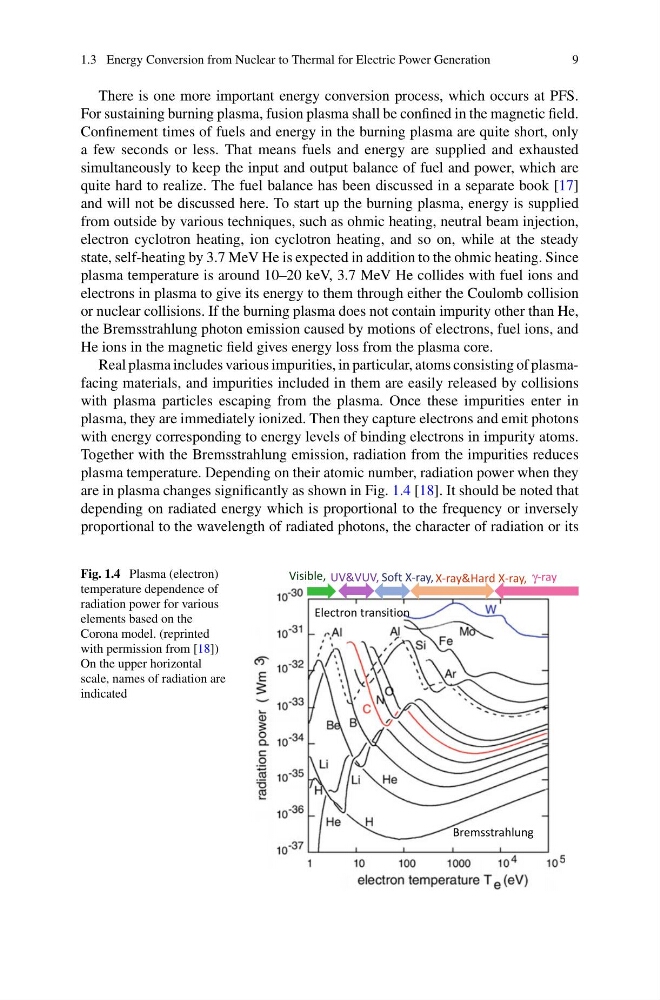
plasma temperature. Depending on their atomic number, radiation power when they
are in plasma changes significantly as shown in Fig. 1.4 [18]. It should be noted that
depending on radiated energy which is proportional to the frequency or inversely
proportional to the wavelength of radiated photons, the character of radiation or its
Fig. 1.4 Plasma (electron)
temperature dependence of
radiation power for various
elements based on the
Corona model. (reprinted
with permission from [18])
On the upper horizontal
scale, names of radiation are
indicated
Bremsstrahlung
Visible, UV&VUV, Soft X-ray, X-ray&Hard X-ray, γ-ray
Electron transition
9
There is one more important energy conversion process, which occurs at PFS.
For sustaining burning plasma, fusion plasma shall be confined in the magnetic field.
Confinement times of fuels and energy in the burning plasma are quite short, only
a few seconds or less. That means fuels and energy are supplied and exhausted
simultaneously to keep the input and output balance of fuel and power, which are
quite hard to realize. The fuel balance has been discussed in a separate book [17]
and will not be discussed here. To start up the burning plasma, energy is supplied
from outside by various techniques, such as ohmic heating, neutral beam injection,
electron cyclotron heating, ion cyclotron heating, and so on, while at the steady
state, self-heating by 3.7 MeV He is expected in addition to the ohmic heating. Since
plasma temperature is around 10–20 keV, 3.7 MeV He collides with fuel ions and
electrons in plasma to give its energy to them through either the Coulomb collision
or nuclear collisions. If the burning plasma does not contain impurity other than He,
the Bremsstrahlung photon emission caused by motions of electrons, fuel ions, and
He ions in the magnetic field gives energy loss from the plasma core.
Real plasma includes various impurities, in particular, atoms consisting of plasmafacing materials, and impurities included in them are easily released by collisions
with plasma particles escaping from the plasma. Once these impurities enter in
plasma, they are immediately ionized. Then they capture electrons and emit photons
with energy corresponding to energy levels of binding electrons in impurity atoms.
Together with the Bremsstrahlung emission, radiation from the impurities reduces
plasma temperature. Depending on their atomic number, radiation power when they
are in plasma changes significantly as shown in Fig. 1.4 [18]. It should be noted that
depending on radiated energy which is proportional to the frequency or inversely
proportional to the wavelength of radiated photons, the character of radiation or its
Fig. 1.4 Plasma (electron)
temperature dependence of
radiation power for various
elements based on the
Corona model. (reprinted
with permission from [18])
On the upper horizontal
scale, names of radiation are
indicated
Bremsstrahlung
Visible, UV&VUV, Soft X-ray, X-ray&Hard X-ray, γ-ray
Electron transition