

8
1 Introduction
with atoms consisting of the blanket. Neutron collision with Li in the blanket produces
tritium (T). Both recoil atoms and produced T are in high-energy states (MeV to keV
range). Succeedingly, they lose their energy with either electric or nuclear collision
processes, and finally converted to heat (thermal energy) that is carried by vibration
and rotation of atoms and molecules and collective motions of atoms consisting of the
blanket, i.e. phonons with the energy of several tens meV (several hundred Kelvin).
During the collision processes, secondary electrons and photons are produced by
ionization and relaxation of atoms. The secondary particles lose their energy in
a similar way until particle energy becomes smaller than the energy required for
ionization or electron excitation. Most of these energy conversions are done in the
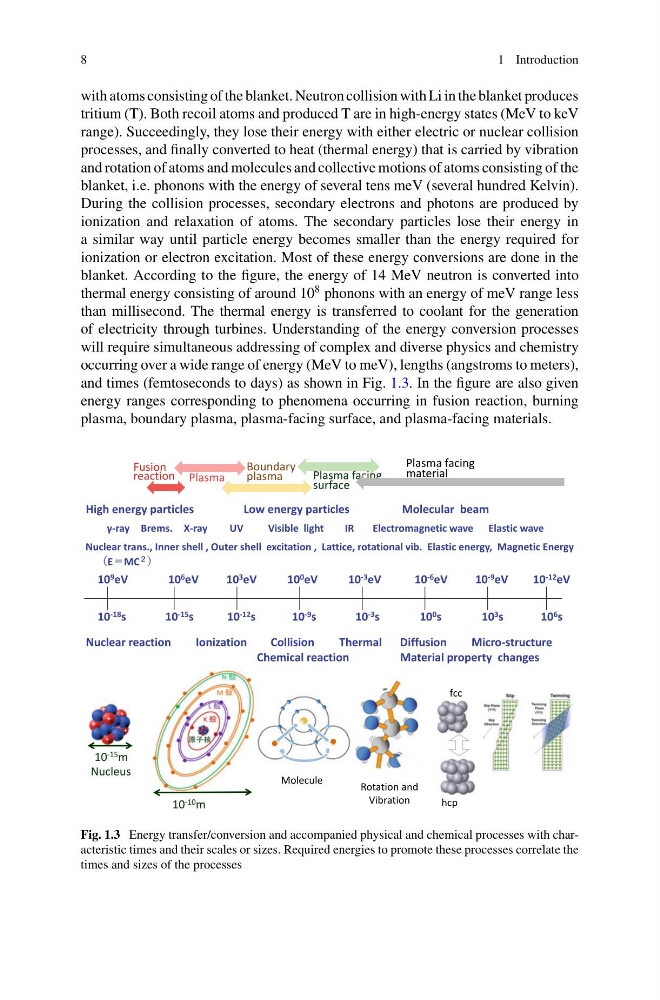
blanket. According to the figure, the energy of 14 MeV neutron is converted into
thermal energy consisting of around 10
8 phonons with an energy of meV range less
than millisecond. The thermal energy is transferred to coolant for the generation
of electricity through turbines. Understanding of the energy conversion processes
will require simultaneous addressing of complex and diverse physics and chemistry
occurring over a wide range of energy (MeV to meV), lengths (angstroms to meters),
and times (femtoseconds to days) as shown in Fig. 1.3. In the figure are also given
energy ranges corresponding to phenomena occurring in fusion reaction, burning
plasma, boundary plasma, plasma-facing surface, and plasma-facing materials.
Molecule
Nucleus
10 -15 m
10 -10 m
fcc
hcp
Rotation and
Vibration
High energy particles
Low energy particles
Molecular beam
γ-ray Brems. X-ray
UV
Visible light
IR
Electromagnetic wave Elastic wave
Nuclear trans., Inner shell , Outer shell excitation , Lattice, rotational vib. Elastic energy, Magnetic Energy
Nuclear reaction
Ionization
Collision
Thermal Diffusion
Micro-structure
Chemical reaction
Material property changes
10 9 eV
10 6 eV
10 3 eV
10 0 eV
10 -3 eV
10 -6 eV
10 -9 eV
10 -12 eV
10 -18 s
1 0 -15 s
10 -12 s
1 0 -9 s
1 0 -3 s
1 0 0 s
1 0 3 s
1 0 6 s
Fusion
reaction Plasma
Boundary
plasma
Plasma facing
surface
Plasma facing
material
Fig. 1.3 Energy transfer/conversion and accompanied physical and chemical processes with characteristic times and their scales or sizes. Required energies to promote these processes correlate the
times and sizes of the processes
1 Introduction
with atoms consisting of the blanket. Neutron collision with Li in the blanket produces
tritium (T). Both recoil atoms and produced T are in high-energy states (MeV to keV
range). Succeedingly, they lose their energy with either electric or nuclear collision
processes, and finally converted to heat (thermal energy) that is carried by vibration
and rotation of atoms and molecules and collective motions of atoms consisting of the
blanket, i.e. phonons with the energy of several tens meV (several hundred Kelvin).
During the collision processes, secondary electrons and photons are produced by
ionization and relaxation of atoms. The secondary particles lose their energy in
a similar way until particle energy becomes smaller than the energy required for
ionization or electron excitation. Most of these energy conversions are done in the
blanket. According to the figure, the energy of 14 MeV neutron is converted into
thermal energy consisting of around 10
8 phonons with an energy of meV range less
than millisecond. The thermal energy is transferred to coolant for the generation
of electricity through turbines. Understanding of the energy conversion processes
will require simultaneous addressing of complex and diverse physics and chemistry
occurring over a wide range of energy (MeV to meV), lengths (angstroms to meters),
and times (femtoseconds to days) as shown in Fig. 1.3. In the figure are also given
energy ranges corresponding to phenomena occurring in fusion reaction, burning
plasma, boundary plasma, plasma-facing surface, and plasma-facing materials.
Molecule
Nucleus
10 -15 m
10 -10 m
fcc
hcp
Rotation and
Vibration
High energy particles
Low energy particles
Molecular beam
γ-ray Brems. X-ray
UV
Visible light
IR
Electromagnetic wave Elastic wave
Nuclear trans., Inner shell , Outer shell excitation , Lattice, rotational vib. Elastic energy, Magnetic Energy
Nuclear reaction
Ionization
Collision
Thermal Diffusion
Micro-structure
Chemical reaction
Material property changes
10 9 eV
10 6 eV
10 3 eV
10 0 eV
10 -3 eV
10 -6 eV
10 -9 eV
10 -12 eV
10 -18 s
1 0 -15 s
10 -12 s
1 0 -9 s
1 0 -3 s
1 0 0 s
1 0 3 s
1 0 6 s
Fusion
reaction Plasma
Boundary
plasma
Plasma facing
surface
Plasma facing
material
Fig. 1.3 Energy transfer/conversion and accompanied physical and chemical processes with characteristic times and their scales or sizes. Required energies to promote these processes correlate the
times and sizes of the processes