

10.3 Use of Carbon Materials as PFM
193
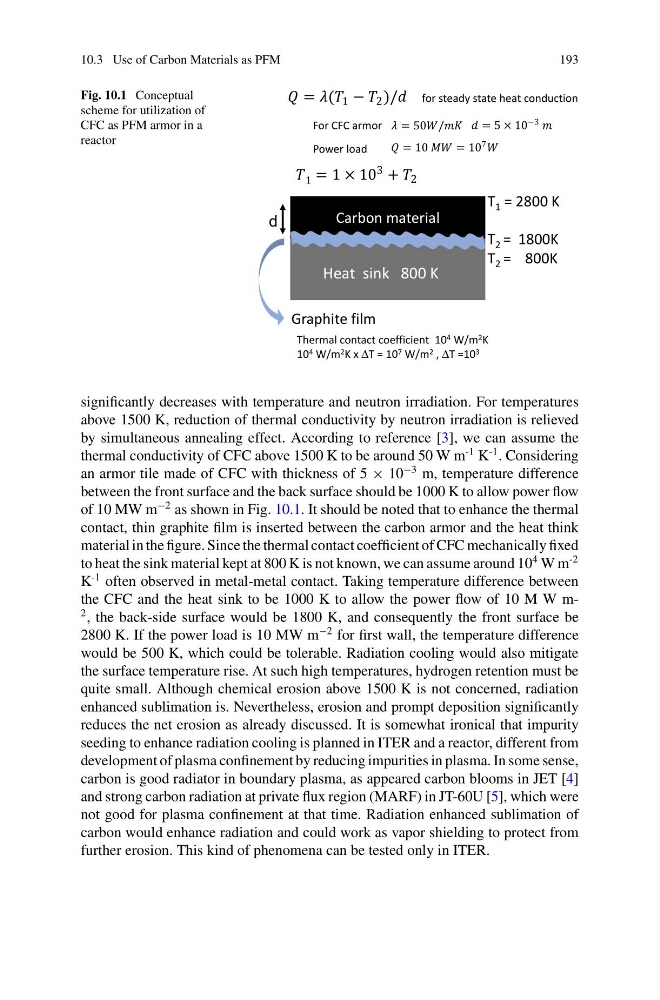
Fig. 10.1 Conceptual
scheme for utilization of
CFC as PFM armor in a
reactor
Heat sink 800 K
Carbon material
d
Thermal contact coefficient 10 4 W/m 2 K
10 4 W/m 2 K x ΔT = 10 7 W/m 2 , ΔT =10 3
T 1 = 2800 K
T 2 = 1800K
T 2 = 800K
Graphite film
for steady state heat conduction
For CFC armor
Power load
significantly decreases with temperature and neutron irradiation. For temperatures
above 1500 K, reduction of thermal conductivity by neutron irradiation is relieved
by simultaneous annealing effect. According to reference [3], we can assume the
thermal conductivity of CFC above 1500 K to be around 50 W m
-1 K
-1 . Considering
an armor tile made of CFC with thickness of 5 × 10
−3 m, temperature difference
between the front surface and the back surface should be 1000 K to allow power flow
of 10 MW m
−2 as shown in Fig. 10.1. It should be noted that to enhance the thermal
contact, thin graphite film is inserted between the carbon armor and the heat think
material in the figure. Since the thermal contact coefficient of CFC mechanically fixed
to heat the sink material kept at 800 K is not known, we can assume around 10
4 W m
-2
K
-1 often observed in metal-metal contact. Taking temperature difference between
the CFC and the heat sink to be 1000 K to allow the power flow of 10 M W m2 , the back-side surface would be 1800 K, and consequently the front surface be
2800 K. If the power load is 10 MW m
−2 for first wall, the temperature difference
would be 500 K, which could be tolerable. Radiation cooling would also mitigate
the surface temperature rise. At such high temperatures, hydrogen retention must be
quite small. Although chemical erosion above 1500 K is not concerned, radiation
enhanced sublimation is. Nevertheless, erosion and prompt deposition significantly
reduces the net erosion as already discussed. It is somewhat ironical that impurity
seeding to enhance radiation cooling is planned in ITER and a reactor, different from
development of plasma confinement by reducing impurities in plasma. In some sense,
carbon is good radiator in boundary plasma, as appeared carbon blooms in JET [4]
and strong carbon radiation at private flux region (MARF) in JT-60U [5], which were
not good for plasma confinement at that time. Radiation enhanced sublimation of
carbon would enhance radiation and could work as vapor shielding to protect from
further erosion. This kind of phenomena can be tested only in ITER.
193
Fig. 10.1 Conceptual
scheme for utilization of
CFC as PFM armor in a
reactor
Heat sink 800 K
Carbon material
d
Thermal contact coefficient 10 4 W/m 2 K
10 4 W/m 2 K x ΔT = 10 7 W/m 2 , ΔT =10 3
T 1 = 2800 K
T 2 = 1800K
T 2 = 800K
Graphite film
for steady state heat conduction
For CFC armor
Power load
significantly decreases with temperature and neutron irradiation. For temperatures
above 1500 K, reduction of thermal conductivity by neutron irradiation is relieved
by simultaneous annealing effect. According to reference [3], we can assume the
thermal conductivity of CFC above 1500 K to be around 50 W m
-1 K
-1 . Considering
an armor tile made of CFC with thickness of 5 × 10
−3 m, temperature difference
between the front surface and the back surface should be 1000 K to allow power flow
of 10 MW m
−2 as shown in Fig. 10.1. It should be noted that to enhance the thermal
contact, thin graphite film is inserted between the carbon armor and the heat think
material in the figure. Since the thermal contact coefficient of CFC mechanically fixed
to heat the sink material kept at 800 K is not known, we can assume around 10
4 W m
-2
K
-1 often observed in metal-metal contact. Taking temperature difference between
the CFC and the heat sink to be 1000 K to allow the power flow of 10 M W m2 , the back-side surface would be 1800 K, and consequently the front surface be
2800 K. If the power load is 10 MW m
−2 for first wall, the temperature difference
would be 500 K, which could be tolerable. Radiation cooling would also mitigate
the surface temperature rise. At such high temperatures, hydrogen retention must be
quite small. Although chemical erosion above 1500 K is not concerned, radiation
enhanced sublimation is. Nevertheless, erosion and prompt deposition significantly
reduces the net erosion as already discussed. It is somewhat ironical that impurity
seeding to enhance radiation cooling is planned in ITER and a reactor, different from
development of plasma confinement by reducing impurities in plasma. In some sense,
carbon is good radiator in boundary plasma, as appeared carbon blooms in JET [4]
and strong carbon radiation at private flux region (MARF) in JT-60U [5], which were
not good for plasma confinement at that time. Radiation enhanced sublimation of
carbon would enhance radiation and could work as vapor shielding to protect from
further erosion. This kind of phenomena can be tested only in ITER.