

192
10 Selection of Plasma-Facing Materials
In conclusion, carbon materials can be a good PFM in a fusion reactor, if they are
used as armor tiles mechanically fixed to heat sink allowing possible temperature
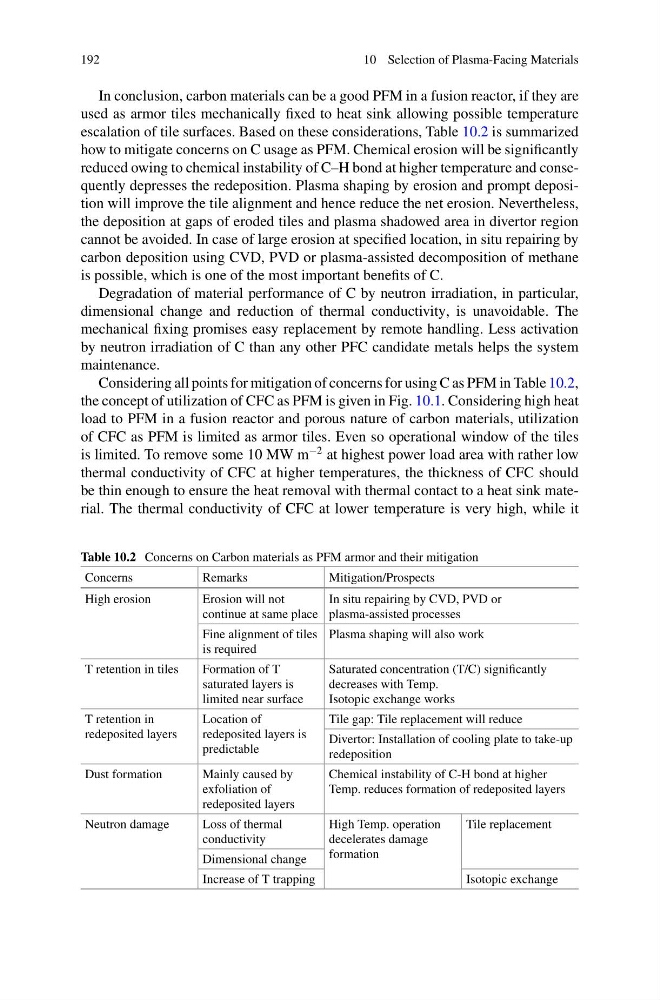
escalation of tile surfaces. Based on these considerations, Table 10.2 is summarized
how to mitigate concerns on C usage as PFM. Chemical erosion will be significantly
reduced owing to chemical instability of C–H bond at higher temperature and consequently depresses the redeposition. Plasma shaping by erosion and prompt deposition will improve the tile alignment and hence reduce the net erosion. Nevertheless,
the deposition at gaps of eroded tiles and plasma shadowed area in divertor region
cannot be avoided. In case of large erosion at specified location, in situ repairing by
carbon deposition using CVD, PVD or plasma-assisted decomposition of methane
is possible, which is one of the most important benefits of C.
Degradation of material performance of C by neutron irradiation, in particular,
dimensional change and reduction of thermal conductivity, is unavoidable. The
mechanical fixing promises easy replacement by remote handling. Less activation
by neutron irradiation of C than any other PFC candidate metals helps the system
maintenance.
Considering all points for mitigation of concerns for using C as PFM in Table 10.2,
the concept of utilization of CFC as PFM is given in Fig. 10.1. Considering high heat
load to PFM in a fusion reactor and porous nature of carbon materials, utilization
of CFC as PFM is limited as armor tiles. Even so operational window of the tiles
is limited. To remove some 10 MW m
−2 at highest power load area with rather low
thermal conductivity of CFC at higher temperatures, the thickness of CFC should
be thin enough to ensure the heat removal with thermal contact to a heat sink material. The thermal conductivity of CFC at lower temperature is very high, while it
Table 10.2 Concerns on Carbon materials as PFM armor and their mitigation
Concerns
Remarks
Mitigation/Prospects
High erosion
Erosion will not
continue at same place
In situ repairing by CVD, PVD or
plasma-assisted processes
Fine alignment of tiles
is required
Plasma shaping will also work
T retention in tiles
Formation of T
saturated layers is
limited near surface
Saturated concentration (T/C) significantly
decreases with Temp.
Isotopic exchange works
T retention in
redeposited layers
Location of
redeposited layers is
predictable
Tile gap: Tile replacement will reduce
Divertor: Installation of cooling plate to take-up
redeposition
Dust formation
Mainly caused by
exfoliation of
redeposited layers
Chemical instability of C-H bond at higher
Temp. reduces formation of redeposited layers
Neutron damage
Loss of thermal
conductivity
High Temp. operation
decelerates damage
formation
Tile replacement
Dimensional change
Increase of T trapping
Isotopic exchange
10 Selection of Plasma-Facing Materials
In conclusion, carbon materials can be a good PFM in a fusion reactor, if they are
used as armor tiles mechanically fixed to heat sink allowing possible temperature
escalation of tile surfaces. Based on these considerations, Table 10.2 is summarized
how to mitigate concerns on C usage as PFM. Chemical erosion will be significantly
reduced owing to chemical instability of C–H bond at higher temperature and consequently depresses the redeposition. Plasma shaping by erosion and prompt deposition will improve the tile alignment and hence reduce the net erosion. Nevertheless,
the deposition at gaps of eroded tiles and plasma shadowed area in divertor region
cannot be avoided. In case of large erosion at specified location, in situ repairing by
carbon deposition using CVD, PVD or plasma-assisted decomposition of methane
is possible, which is one of the most important benefits of C.
Degradation of material performance of C by neutron irradiation, in particular,
dimensional change and reduction of thermal conductivity, is unavoidable. The
mechanical fixing promises easy replacement by remote handling. Less activation
by neutron irradiation of C than any other PFC candidate metals helps the system
maintenance.
Considering all points for mitigation of concerns for using C as PFM in Table 10.2,
the concept of utilization of CFC as PFM is given in Fig. 10.1. Considering high heat
load to PFM in a fusion reactor and porous nature of carbon materials, utilization
of CFC as PFM is limited as armor tiles. Even so operational window of the tiles
is limited. To remove some 10 MW m
−2 at highest power load area with rather low
thermal conductivity of CFC at higher temperatures, the thickness of CFC should
be thin enough to ensure the heat removal with thermal contact to a heat sink material. The thermal conductivity of CFC at lower temperature is very high, while it
Table 10.2 Concerns on Carbon materials as PFM armor and their mitigation
Concerns
Remarks
Mitigation/Prospects
High erosion
Erosion will not
continue at same place
In situ repairing by CVD, PVD or
plasma-assisted processes
Fine alignment of tiles
is required
Plasma shaping will also work
T retention in tiles
Formation of T
saturated layers is
limited near surface
Saturated concentration (T/C) significantly
decreases with Temp.
Isotopic exchange works
T retention in
redeposited layers
Location of
redeposited layers is
predictable
Tile gap: Tile replacement will reduce
Divertor: Installation of cooling plate to take-up
redeposition
Dust formation
Mainly caused by
exfoliation of
redeposited layers
Chemical instability of C-H bond at higher
Temp. reduces formation of redeposited layers
Neutron damage
Loss of thermal
conductivity
High Temp. operation
decelerates damage
formation
Tile replacement
Dimensional change
Increase of T trapping
Isotopic exchange