

162
9 Fuel Retention in a Rector with Full …
of the T retention is based on the retention data on H and D assuming the number
of each isotope is equivalent. Since the estimated fuel retention rate is so large that
the recovery of retained fuel is mandatory to keep the fuel self-sufficiency and the
T safety. In the aspect of T fuel self-sufficiency, easy T recovery would be a new
criterion for the selection of PMI as discussed in the next Chapter.
9.2 Present Estimation of Fuel Retention in ITER
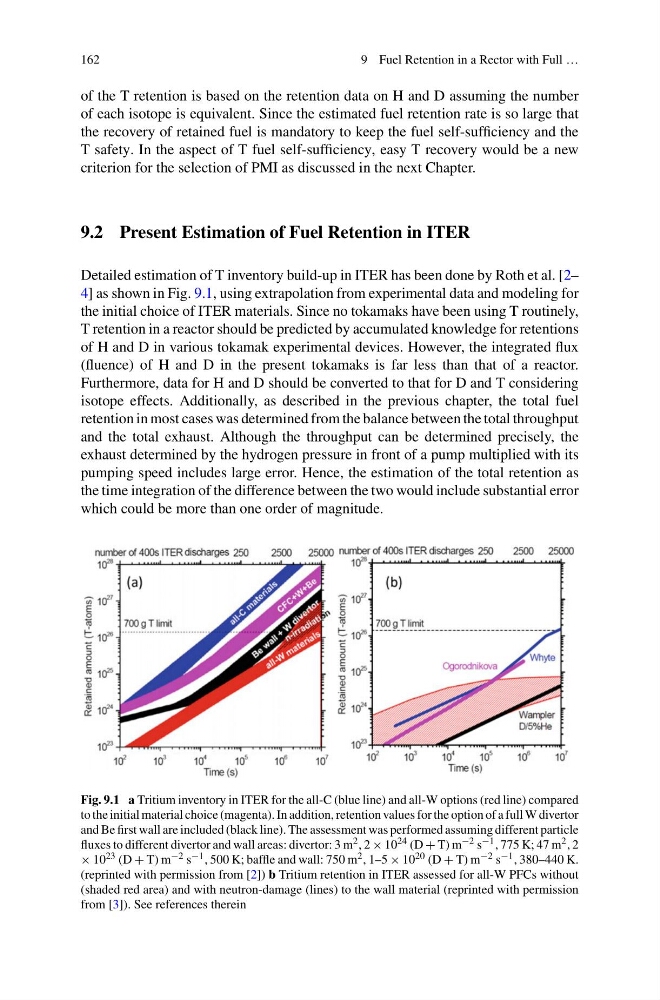
Detailed estimation of T inventory build-up in ITER has been done by Roth et al. [2–
4] as shown in Fig. 9.1, using extrapolation from experimental data and modeling for
the initial choice of ITER materials. Since no tokamaks have been using T routinely,
T retention in a reactor should be predicted by accumulated knowledge for retentions
of H and D in various tokamak experimental devices. However, the integrated flux
(fluence) of H and D in the present tokamaks is far less than that of a reactor.
Furthermore, data for H and D should be converted to that for D and T considering
isotope effects. Additionally, as described in the previous chapter, the total fuel
retention in most cases was determined from the balance between the total throughput
and the total exhaust. Although the throughput can be determined precisely, the
exhaust determined by the hydrogen pressure in front of a pump multiplied with its
pumping speed includes large error. Hence, the estimation of the total retention as
the time integration of the difference between the two would include substantial error
which could be more than one order of magnitude.
Fig. 9.1 a Tritium inventory in ITER for the all-C (blue line) and all-W options (red line) compared
to the initial material choice (magenta). In addition, retention values for the option of a full W divertor
and Be first wall are included (black line). The assessment was performed assuming different particle
fluxes to different divertor and wall areas: divertor: 3 m 2 , 2 × 10 24 (D + T) m −2 s −1 , 775 K; 47 m 2 , 2
× 10 23 (D + T) m −2 s −1 , 500 K; baffle and wall: 750 m 2 , 1–5 × 10 20 (D + T) m −2 s −1 , 380–440 K.
(reprinted with permission from [2]) b Tritium retention in ITER assessed for all-W PFCs without
(shaded red area) and with neutron-damage (lines) to the wall material (reprinted with permission
from [3]). See references therein
9 Fuel Retention in a Rector with Full …
of the T retention is based on the retention data on H and D assuming the number
of each isotope is equivalent. Since the estimated fuel retention rate is so large that
the recovery of retained fuel is mandatory to keep the fuel self-sufficiency and the
T safety. In the aspect of T fuel self-sufficiency, easy T recovery would be a new
criterion for the selection of PMI as discussed in the next Chapter.
9.2 Present Estimation of Fuel Retention in ITER
Detailed estimation of T inventory build-up in ITER has been done by Roth et al. [2–
4] as shown in Fig. 9.1, using extrapolation from experimental data and modeling for
the initial choice of ITER materials. Since no tokamaks have been using T routinely,
T retention in a reactor should be predicted by accumulated knowledge for retentions
of H and D in various tokamak experimental devices. However, the integrated flux
(fluence) of H and D in the present tokamaks is far less than that of a reactor.
Furthermore, data for H and D should be converted to that for D and T considering
isotope effects. Additionally, as described in the previous chapter, the total fuel
retention in most cases was determined from the balance between the total throughput
and the total exhaust. Although the throughput can be determined precisely, the
exhaust determined by the hydrogen pressure in front of a pump multiplied with its
pumping speed includes large error. Hence, the estimation of the total retention as
the time integration of the difference between the two would include substantial error
which could be more than one order of magnitude.
Fig. 9.1 a Tritium inventory in ITER for the all-C (blue line) and all-W options (red line) compared
to the initial material choice (magenta). In addition, retention values for the option of a full W divertor
and Be first wall are included (black line). The assessment was performed assuming different particle
fluxes to different divertor and wall areas: divertor: 3 m 2 , 2 × 10 24 (D + T) m −2 s −1 , 775 K; 47 m 2 , 2
× 10 23 (D + T) m −2 s −1 , 500 K; baffle and wall: 750 m 2 , 1–5 × 10 20 (D + T) m −2 s −1 , 380–440 K.
(reprinted with permission from [2]) b Tritium retention in ITER assessed for all-W PFCs without
(shaded red area) and with neutron-damage (lines) to the wall material (reprinted with permission
from [3]). See references therein