

8.4 Recycling and Retention of Fuels
151
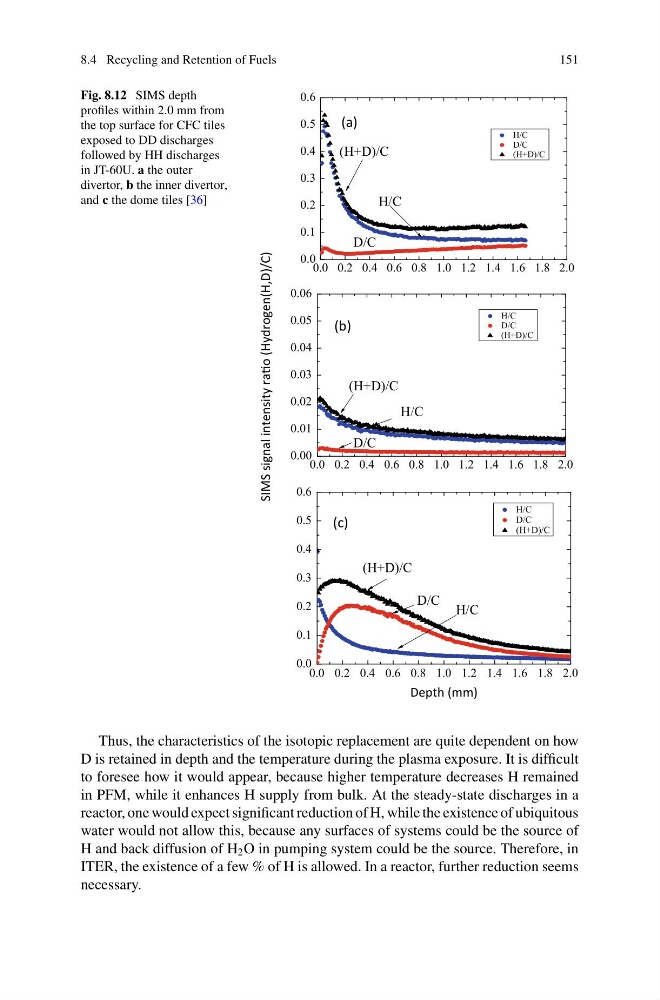
Fig. 8.12 SIMS depth
profiles within 2.0 mm from
the top surface for CFC tiles
exposed to DD discharges
followed by HH discharges
in JT-60U. a the outer
divertor, b the inner divertor,
and c the dome tiles [36]
0.0 0.2 0.4 0.6 0.8 1.0 1.2 1.4 1.6 1.8 2.0
0.0
0.1
0.2
0.3
0.4
0.5
0.6
D/C H/C
H/C
D/C
(H+D)/C
(H+D)/C
0.0 0.2 0.4 0.6 0.8 1.0 1.2 1.4 1.6 1.8 2.0
0.00
0.01
0.02
0.03
0.04
0.05
0.06
D/C
H/C
H/C
D/C
(H+D)/C
(H+D)/C
0.0 0.2 0.4 0.6 0.8 1.0 1.2 1.4 1.6 1.8 2.0
0.0
0.1
0.2
0.3
0.4
0.5
0.6
H/C
D/C
H/C
D/C
(H+D)/C
(H+D)/C
(a)
(b)
(c)
Depth (mm)
SIMS signal intensity raƟo (Hydrogen(H,D)/C)
Thus, the characteristics of the isotopic replacement are quite dependent on how
D is retained in depth and the temperature during the plasma exposure. It is difficult
to foresee how it would appear, because higher temperature decreases H remained
in PFM, while it enhances H supply from bulk. At the steady-state discharges in a
reactor, one would expect significant reduction of H, while the existence of ubiquitous
water would not allow this, because any surfaces of systems could be the source of
H and back diffusion of H 2 O in pumping system could be the source. Therefore, in
ITER, the existence of a few % of H is allowed. In a reactor, further reduction seems
necessary.
151
Fig. 8.12 SIMS depth
profiles within 2.0 mm from
the top surface for CFC tiles
exposed to DD discharges
followed by HH discharges
in JT-60U. a the outer
divertor, b the inner divertor,
and c the dome tiles [36]
0.0 0.2 0.4 0.6 0.8 1.0 1.2 1.4 1.6 1.8 2.0
0.0
0.1
0.2
0.3
0.4
0.5
0.6
D/C H/C
H/C
D/C
(H+D)/C
(H+D)/C
0.0 0.2 0.4 0.6 0.8 1.0 1.2 1.4 1.6 1.8 2.0
0.00
0.01
0.02
0.03
0.04
0.05
0.06
D/C
H/C
H/C
D/C
(H+D)/C
(H+D)/C
0.0 0.2 0.4 0.6 0.8 1.0 1.2 1.4 1.6 1.8 2.0
0.0
0.1
0.2
0.3
0.4
0.5
0.6
H/C
D/C
H/C
D/C
(H+D)/C
(H+D)/C
(a)
(b)
(c)
Depth (mm)
SIMS signal intensity raƟo (Hydrogen(H,D)/C)
Thus, the characteristics of the isotopic replacement are quite dependent on how
D is retained in depth and the temperature during the plasma exposure. It is difficult
to foresee how it would appear, because higher temperature decreases H remained
in PFM, while it enhances H supply from bulk. At the steady-state discharges in a
reactor, one would expect significant reduction of H, while the existence of ubiquitous
water would not allow this, because any surfaces of systems could be the source of
H and back diffusion of H 2 O in pumping system could be the source. Therefore, in
ITER, the existence of a few % of H is allowed. In a reactor, further reduction seems
necessary.