

8.3 Dust
143
8.3 Dust
Various kind of dusts are produced in a reactor vessel, for example, exfoliation
of deposited layers, fracture erosion of modified surfaces by high power loaded
(recrystallized or re-solidified melt layers), droplet of the melt layers, and so on.
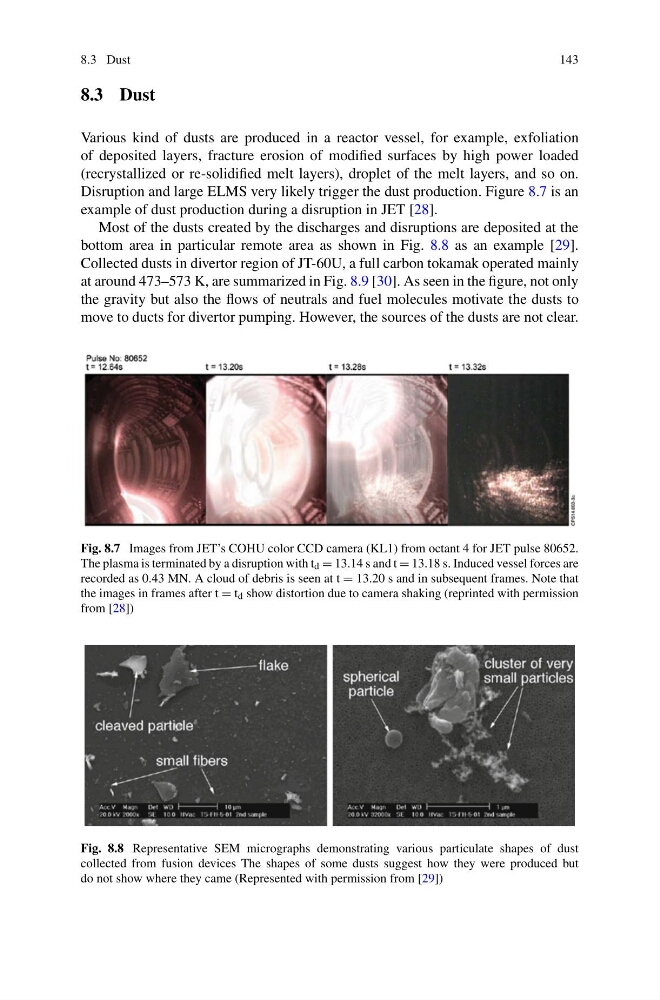
Disruption and large ELMS very likely trigger the dust production. Figure 8.7 is an
example of dust production during a disruption in JET [28].
Most of the dusts created by the discharges and disruptions are deposited at the
bottom area in particular remote area as shown in Fig. 8.8 as an example [29].
Collected dusts in divertor region of JT-60U, a full carbon tokamak operated mainly
at around 473–573 K, are summarized in Fig. 8.9 [30]. As seen in the figure, not only
the gravity but also the flows of neutrals and fuel molecules motivate the dusts to
move to ducts for divertor pumping. However, the sources of the dusts are not clear.
Fig. 8.7 Images from JET’s COHU color CCD camera (KL1) from octant 4 for JET pulse 80652.
The plasma is terminated by a disruption with t d = 13.14 s and t = 13.18 s. Induced vessel forces are
recorded as 0.43 MN. A cloud of debris is seen at t = 13.20 s and in subsequent frames. Note that
the images in frames after t = t d show distortion due to camera shaking (reprinted with permission
from [28])
Fig. 8.8 Representative SEM micrographs demonstrating various particulate shapes of dust
collected from fusion devices The shapes of some dusts suggest how they were produced but
do not show where they came (Represented with permission from [29])
143
8.3 Dust
Various kind of dusts are produced in a reactor vessel, for example, exfoliation
of deposited layers, fracture erosion of modified surfaces by high power loaded
(recrystallized or re-solidified melt layers), droplet of the melt layers, and so on.
Disruption and large ELMS very likely trigger the dust production. Figure 8.7 is an
example of dust production during a disruption in JET [28].
Most of the dusts created by the discharges and disruptions are deposited at the
bottom area in particular remote area as shown in Fig. 8.8 as an example [29].
Collected dusts in divertor region of JT-60U, a full carbon tokamak operated mainly
at around 473–573 K, are summarized in Fig. 8.9 [30]. As seen in the figure, not only
the gravity but also the flows of neutrals and fuel molecules motivate the dusts to
move to ducts for divertor pumping. However, the sources of the dusts are not clear.
Fig. 8.7 Images from JET’s COHU color CCD camera (KL1) from octant 4 for JET pulse 80652.
The plasma is terminated by a disruption with t d = 13.14 s and t = 13.18 s. Induced vessel forces are
recorded as 0.43 MN. A cloud of debris is seen at t = 13.20 s and in subsequent frames. Note that
the images in frames after t = t d show distortion due to camera shaking (reprinted with permission
from [28])
Fig. 8.8 Representative SEM micrographs demonstrating various particulate shapes of dust
collected from fusion devices The shapes of some dusts suggest how they were produced but
do not show where they came (Represented with permission from [29])