

8.1 Power Load
135
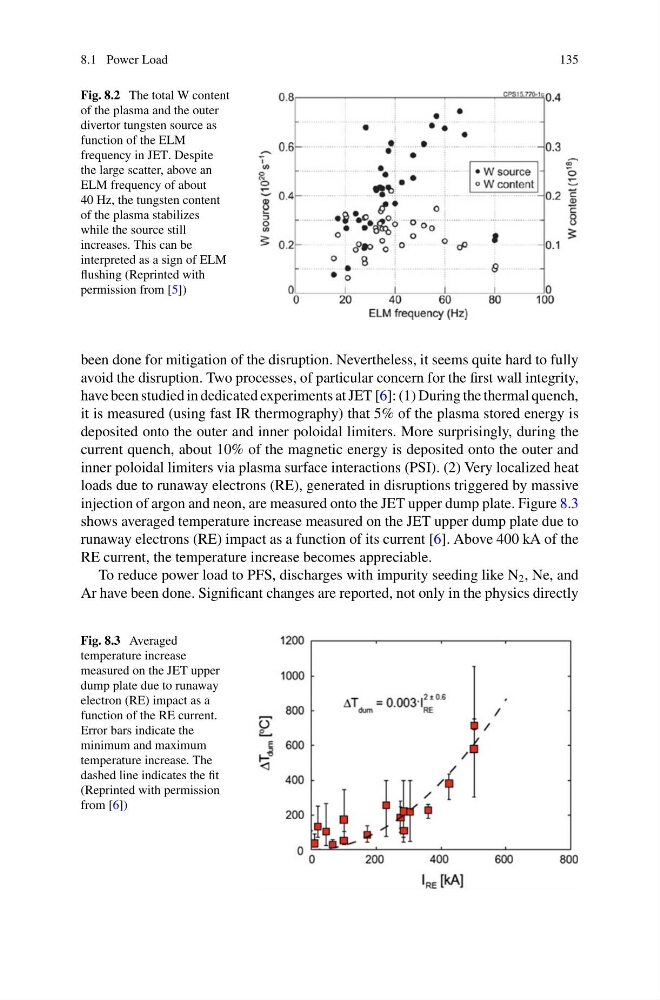
Fig. 8.2 The total W content
of the plasma and the outer
divertor tungsten source as
function of the ELM
frequency in JET. Despite
the large scatter, above an
ELM frequency of about
40 Hz, the tungsten content
of the plasma stabilizes
while the source still
increases. This can be
interpreted as a sign of ELM
flushing (Reprinted with
permission from [5])
been done for mitigation of the disruption. Nevertheless, it seems quite hard to fully
avoid the disruption. Two processes, of particular concern for the first wall integrity,
have been studied in dedicated experiments at JET [6]: (1) During the thermal quench,
it is measured (using fast IR thermography) that 5% of the plasma stored energy is
deposited onto the outer and inner poloidal limiters. More surprisingly, during the
current quench, about 10% of the magnetic energy is deposited onto the outer and
inner poloidal limiters via plasma surface interactions (PSI). (2) Very localized heat
loads due to runaway electrons (RE), generated in disruptions triggered by massive
injection of argon and neon, are measured onto the JET upper dump plate. Figure 8.3
shows averaged temperature increase measured on the JET upper dump plate due to
runaway electrons (RE) impact as a function of its current [6]. Above 400 kA of the
RE current, the temperature increase becomes appreciable.
To reduce power load to PFS, discharges with impurity seeding like N 2 , Ne, and
Ar have been done. Significant changes are reported, not only in the physics directly
Fig. 8.3 Averaged
temperature increase
measured on the JET upper
dump plate due to runaway
electron (RE) impact as a
function of the RE current.
Error bars indicate the
minimum and maximum
temperature increase. The
dashed line indicates the fit
(Reprinted with permission
from [6])
135
Fig. 8.2 The total W content
of the plasma and the outer
divertor tungsten source as
function of the ELM
frequency in JET. Despite
the large scatter, above an
ELM frequency of about
40 Hz, the tungsten content
of the plasma stabilizes
while the source still
increases. This can be
interpreted as a sign of ELM
flushing (Reprinted with
permission from [5])
been done for mitigation of the disruption. Nevertheless, it seems quite hard to fully
avoid the disruption. Two processes, of particular concern for the first wall integrity,
have been studied in dedicated experiments at JET [6]: (1) During the thermal quench,
it is measured (using fast IR thermography) that 5% of the plasma stored energy is
deposited onto the outer and inner poloidal limiters. More surprisingly, during the
current quench, about 10% of the magnetic energy is deposited onto the outer and
inner poloidal limiters via plasma surface interactions (PSI). (2) Very localized heat
loads due to runaway electrons (RE), generated in disruptions triggered by massive
injection of argon and neon, are measured onto the JET upper dump plate. Figure 8.3
shows averaged temperature increase measured on the JET upper dump plate due to
runaway electrons (RE) impact as a function of its current [6]. Above 400 kA of the
RE current, the temperature increase becomes appreciable.
To reduce power load to PFS, discharges with impurity seeding like N 2 , Ne, and
Ar have been done. Significant changes are reported, not only in the physics directly
Fig. 8.3 Averaged
temperature increase
measured on the JET upper
dump plate due to runaway
electron (RE) impact as a
function of the RE current.
Error bars indicate the
minimum and maximum
temperature increase. The
dashed line indicates the fit
(Reprinted with permission
from [6])