

134
8 PMI in Large Tokamaks
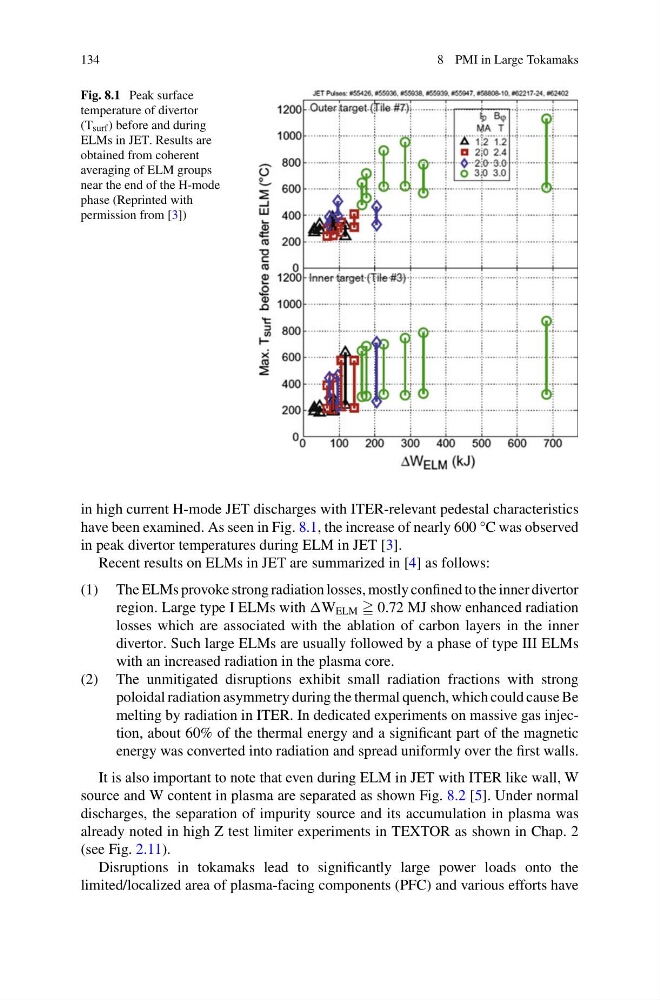
Fig. 8.1 Peak surface
temperature of divertor
(T surf ) before and during
ELMs in JET. Results are
obtained from coherent
averaging of ELM groups
near the end of the H-mode
phase (Reprinted with
permission from [3])
in high current H-mode JET discharges with ITER-relevant pedestal characteristics
have been examined. As seen in Fig. 8.1, the increase of nearly 600 °C was observed
in peak divertor temperatures during ELM in JET [3].
Recent results on ELMs in JET are summarized in [4] as follows:
(1) The ELMs provoke strong radiation losses, mostly confined to the inner divertor
region. Large type I ELMs with W ELM 0.72 MJ show enhanced radiation
losses which are associated with the ablation of carbon layers in the inner
divertor. Such large ELMs are usually followed by a phase of type III ELMs
with an increased radiation in the plasma core.
(2) The unmitigated disruptions exhibit small radiation fractions with strong
poloidal radiation asymmetry during the thermal quench, which could cause Be
melting by radiation in ITER. In dedicated experiments on massive gas injection, about 60% of the thermal energy and a significant part of the magnetic
energy was converted into radiation and spread uniformly over the first walls.
It is also important to note that even during ELM in JET with ITER like wall, W
source and W content in plasma are separated as shown Fig. 8.2 [5]. Under normal
discharges, the separation of impurity source and its accumulation in plasma was
already noted in high Z test limiter experiments in TEXTOR as shown in Chap. 2
(see Fig. 2.11).
Disruptions in tokamaks lead to significantly large power loads onto the
limited/localized area of plasma-facing components (PFC) and various efforts have
8 PMI in Large Tokamaks
Fig. 8.1 Peak surface
temperature of divertor
(T surf ) before and during
ELMs in JET. Results are
obtained from coherent
averaging of ELM groups
near the end of the H-mode
phase (Reprinted with
permission from [3])
in high current H-mode JET discharges with ITER-relevant pedestal characteristics
have been examined. As seen in Fig. 8.1, the increase of nearly 600 °C was observed
in peak divertor temperatures during ELM in JET [3].
Recent results on ELMs in JET are summarized in [4] as follows:
(1) The ELMs provoke strong radiation losses, mostly confined to the inner divertor
region. Large type I ELMs with W ELM 0.72 MJ show enhanced radiation
losses which are associated with the ablation of carbon layers in the inner
divertor. Such large ELMs are usually followed by a phase of type III ELMs
with an increased radiation in the plasma core.
(2) The unmitigated disruptions exhibit small radiation fractions with strong
poloidal radiation asymmetry during the thermal quench, which could cause Be
melting by radiation in ITER. In dedicated experiments on massive gas injection, about 60% of the thermal energy and a significant part of the magnetic
energy was converted into radiation and spread uniformly over the first walls.
It is also important to note that even during ELM in JET with ITER like wall, W
source and W content in plasma are separated as shown Fig. 8.2 [5]. Under normal
discharges, the separation of impurity source and its accumulation in plasma was
already noted in high Z test limiter experiments in TEXTOR as shown in Chap. 2
(see Fig. 2.11).
Disruptions in tokamaks lead to significantly large power loads onto the
limited/localized area of plasma-facing components (PFC) and various efforts have