

104
6 Material Modification by High-Power Load …
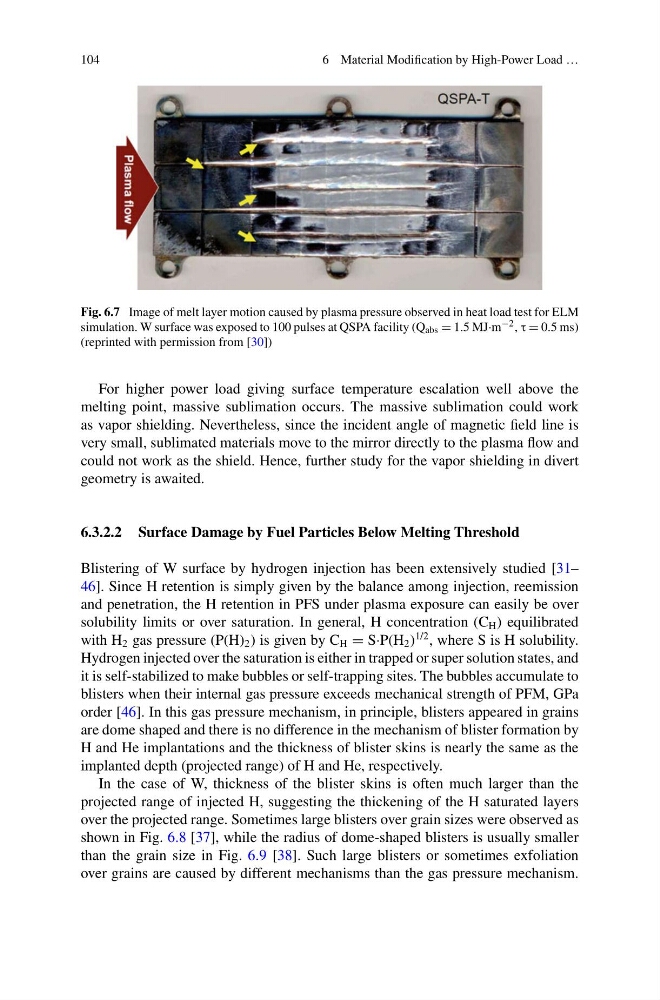
Fig. 6.7 Image of melt layer motion caused by plasma pressure observed in heat load test for ELM
simulation. W surface was exposed to 100 pulses at QSPA facility (Q abs = 1.5 MJ·m −2 , τ = 0.5 ms)
(reprinted with permission from [30])
For higher power load giving surface temperature escalation well above the
melting point, massive sublimation occurs. The massive sublimation could work
as vapor shielding. Nevertheless, since the incident angle of magnetic field line is
very small, sublimated materials move to the mirror directly to the plasma flow and
could not work as the shield. Hence, further study for the vapor shielding in divert
geometry is awaited.
6.3.2.2 Surface Damage by Fuel Particles Below Melting Threshold
Blistering of W surface by hydrogen injection has been extensively studied [31–
46]. Since H retention is simply given by the balance among injection, reemission
and penetration, the H retention in PFS under plasma exposure can easily be over
solubility limits or over saturation. In general, H concentration (C H ) equilibrated
with H 2 gas pressure (P(H) 2 ) is given by C H = S·P(H 2 )
1/2 , where S is H solubility.
Hydrogen injected over the saturation is either in trapped or super solution states, and
it is self-stabilized to make bubbles or self-trapping sites. The bubbles accumulate to
blisters when their internal gas pressure exceeds mechanical strength of PFM, GPa
order [46]. In this gas pressure mechanism, in principle, blisters appeared in grains
are dome shaped and there is no difference in the mechanism of blister formation by
H and He implantations and the thickness of blister skins is nearly the same as the
implanted depth (projected range) of H and He, respectively.
In the case of W, thickness of the blister skins is often much larger than the
projected range of injected H, suggesting the thickening of the H saturated layers
over the projected range. Sometimes large blisters over grain sizes were observed as
shown in Fig. 6.8 [37], while the radius of dome-shaped blisters is usually smaller
than the grain size in Fig. 6.9 [38]. Such large blisters or sometimes exfoliation
over grains are caused by different mechanisms than the gas pressure mechanism.
6 Material Modification by High-Power Load …
Fig. 6.7 Image of melt layer motion caused by plasma pressure observed in heat load test for ELM
simulation. W surface was exposed to 100 pulses at QSPA facility (Q abs = 1.5 MJ·m −2 , τ = 0.5 ms)
(reprinted with permission from [30])
For higher power load giving surface temperature escalation well above the
melting point, massive sublimation occurs. The massive sublimation could work
as vapor shielding. Nevertheless, since the incident angle of magnetic field line is
very small, sublimated materials move to the mirror directly to the plasma flow and
could not work as the shield. Hence, further study for the vapor shielding in divert
geometry is awaited.
6.3.2.2 Surface Damage by Fuel Particles Below Melting Threshold
Blistering of W surface by hydrogen injection has been extensively studied [31–
46]. Since H retention is simply given by the balance among injection, reemission
and penetration, the H retention in PFS under plasma exposure can easily be over
solubility limits or over saturation. In general, H concentration (C H ) equilibrated
with H 2 gas pressure (P(H) 2 ) is given by C H = S·P(H 2 )
1/2 , where S is H solubility.
Hydrogen injected over the saturation is either in trapped or super solution states, and
it is self-stabilized to make bubbles or self-trapping sites. The bubbles accumulate to
blisters when their internal gas pressure exceeds mechanical strength of PFM, GPa
order [46]. In this gas pressure mechanism, in principle, blisters appeared in grains
are dome shaped and there is no difference in the mechanism of blister formation by
H and He implantations and the thickness of blister skins is nearly the same as the
implanted depth (projected range) of H and He, respectively.
In the case of W, thickness of the blister skins is often much larger than the
projected range of injected H, suggesting the thickening of the H saturated layers
over the projected range. Sometimes large blisters over grain sizes were observed as
shown in Fig. 6.8 [37], while the radius of dome-shaped blisters is usually smaller
than the grain size in Fig. 6.9 [38]. Such large blisters or sometimes exfoliation
over grains are caused by different mechanisms than the gas pressure mechanism.