

while CCU produces goods that have an added value. CCS avoids atmospheric CO 2
by putting it somewhere underground or in deep waters, and CCU converts it back
into the products from which it is generated, mimicking the natural continuous
C-Cycle. Building a man-made C-cycle that recycles carbon through CO 2 conversion is for chemistry and biotechnology a challenge that matches in complexity
the fusion of nuclei in physics. Scientists know how to divide the nucleus and how
to use organized matter (biomass, coal, oil) for producing energy; making energy by
nuclear fusion or catching energy in chemical bonds, is much more difficult.
A bottleneck in the conversion of CO 2 into chemicals or materials is that such
process is endoergonic in most cases (vide infra) and may even require hydrogen.
For such conversion of CO 2 , energy cannot be provided by burning fossil-C nor
biomass: both would emit larger amounts of CO 2 than converted [1a–d]. Therefore,
recycling carbon by converting CO 2 into energy-rich species is not feasible within
an energy system based on fossil-C. As we have pointed out long time ago, the
conversion of CO 2 into energy products is possible only if the required energy is
produced from perennial primary energy sources [2]. Chapter 5 has demonstrated
that time is there: now we can! We shall discuss the capture and disposal of CO 2 in
this chapter, and its use in Chaps. 8–11.
6.2 CO 2 Capture from Point Sources: Power Stations
and Industrial Processes
Capture of CO 2 using a basic solution or even water is practiced since long time. In
1863, Ernst Solvay established the Solvay Company for the production of Na 2 CO 3
and NaHCO 3 . The process is based on a series of reactions starting with natural
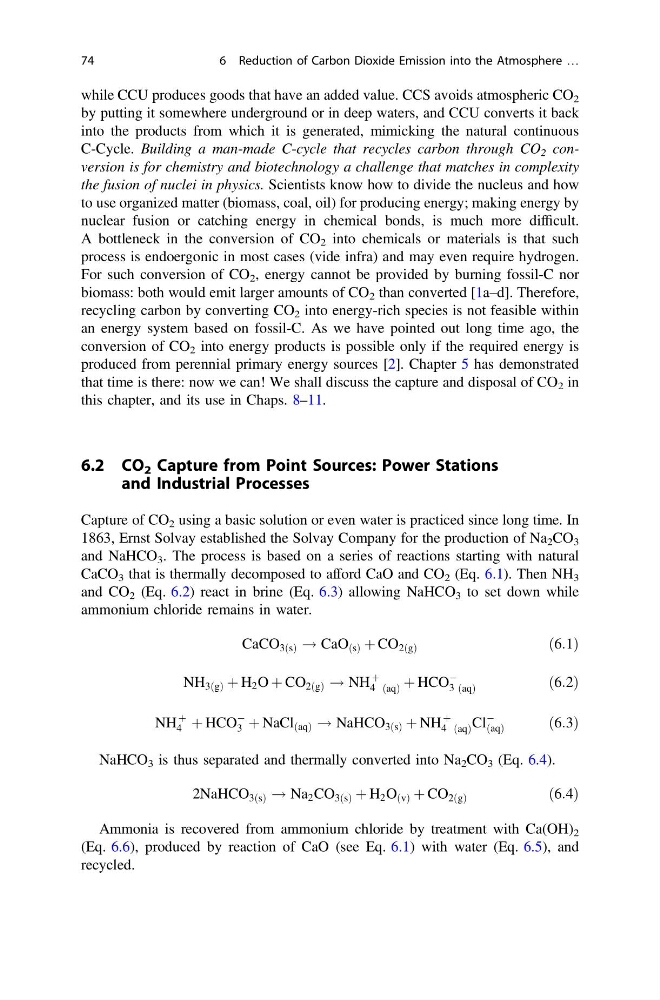
CaCO 3 that is thermally decomposed to afford CaO and CO 2 (Eq. 6.1). Then NH 3
and CO 2 (Eq. 6.2) react in brine (Eq. 6.3) allowing NaHCO 3 to set down while
ammonium chloride remains in water.
CaCO 3ðsÞ ! CaO ðsÞ þ CO 2ðgÞ
ð6:1Þ
NH 3ðgÞ þ H 2 O þ CO 2ðgÞ ! NH
þ
4 ðaqÞ þ HCO
À
3 ðaqÞ
ð6:2Þ
NH
þ
4 þ HCO
À
3 þ NaCl ðaqÞ ! NaHCO 3ðsÞ þ NH
þ
4 aq
ð Þ Cl
À
ðaqÞ
ð6:3Þ
NaHCO 3 is thus separated and thermally converted into Na 2 CO 3 (Eq. 6.4).
2NaHCO 3ðsÞ ! Na 2 CO 3ðsÞ þ H 2 O ðvÞ þ CO 2ðgÞ
ð6:4Þ
Ammonia is recovered from ammonium chloride by treatment with Ca(OH) 2
(Eq. 6.6), produced by reaction of CaO (see Eq. 6.1) with water (Eq. 6.5), and
recycled.
74
6 Reduction of Carbon Dioxide Emission into the Atmosphere …
by putting it somewhere underground or in deep waters, and CCU converts it back
into the products from which it is generated, mimicking the natural continuous
C-Cycle. Building a man-made C-cycle that recycles carbon through CO 2 conversion is for chemistry and biotechnology a challenge that matches in complexity
the fusion of nuclei in physics. Scientists know how to divide the nucleus and how
to use organized matter (biomass, coal, oil) for producing energy; making energy by
nuclear fusion or catching energy in chemical bonds, is much more difficult.
A bottleneck in the conversion of CO 2 into chemicals or materials is that such
process is endoergonic in most cases (vide infra) and may even require hydrogen.
For such conversion of CO 2 , energy cannot be provided by burning fossil-C nor
biomass: both would emit larger amounts of CO 2 than converted [1a–d]. Therefore,
recycling carbon by converting CO 2 into energy-rich species is not feasible within
an energy system based on fossil-C. As we have pointed out long time ago, the
conversion of CO 2 into energy products is possible only if the required energy is
produced from perennial primary energy sources [2]. Chapter 5 has demonstrated
that time is there: now we can! We shall discuss the capture and disposal of CO 2 in
this chapter, and its use in Chaps. 8–11.
6.2 CO 2 Capture from Point Sources: Power Stations
and Industrial Processes
Capture of CO 2 using a basic solution or even water is practiced since long time. In
1863, Ernst Solvay established the Solvay Company for the production of Na 2 CO 3
and NaHCO 3 . The process is based on a series of reactions starting with natural
CaCO 3 that is thermally decomposed to afford CaO and CO 2 (Eq. 6.1). Then NH 3
and CO 2 (Eq. 6.2) react in brine (Eq. 6.3) allowing NaHCO 3 to set down while
ammonium chloride remains in water.
CaCO 3ðsÞ ! CaO ðsÞ þ CO 2ðgÞ
ð6:1Þ
NH 3ðgÞ þ H 2 O þ CO 2ðgÞ ! NH
þ
4 ðaqÞ þ HCO
À
3 ðaqÞ
ð6:2Þ
NH
þ
4 þ HCO
À
3 þ NaCl ðaqÞ ! NaHCO 3ðsÞ þ NH
þ
4 aq
ð Þ Cl
À
ðaqÞ
ð6:3Þ
NaHCO 3 is thus separated and thermally converted into Na 2 CO 3 (Eq. 6.4).
2NaHCO 3ðsÞ ! Na 2 CO 3ðsÞ þ H 2 O ðvÞ þ CO 2ðgÞ
ð6:4Þ
Ammonia is recovered from ammonium chloride by treatment with Ca(OH) 2
(Eq. 6.6), produced by reaction of CaO (see Eq. 6.1) with water (Eq. 6.5), and
recycled.
74
6 Reduction of Carbon Dioxide Emission into the Atmosphere …