

CO 2 is separated by using ethanolamine or membrane technologies and H 2 is
burned with oxygen. CO 2 having been separated before combustion, the flue gases
are made essentially by water vapor that can be eventually condensed and reused.
The collected CO 2 can be purified for the end use.
Such technology produces electricity by driving a high-efficiency gas turbine,
and the exhaust heat is recovered to produce steam to power traditional
high-efficiency steam turbines (Coal Utilization Research Council) [19]. IGCC can
use pulverized coal and natural gas as feed, even bituminous coal and petroleum
coke have been cofed. Even if IGCC has an efficiency which is some 12–14 points
% higher than a conventional upgraded PCC plant, its CAPEX are some 20%
higher and even OPEX are higher than those of conventional plants due to the
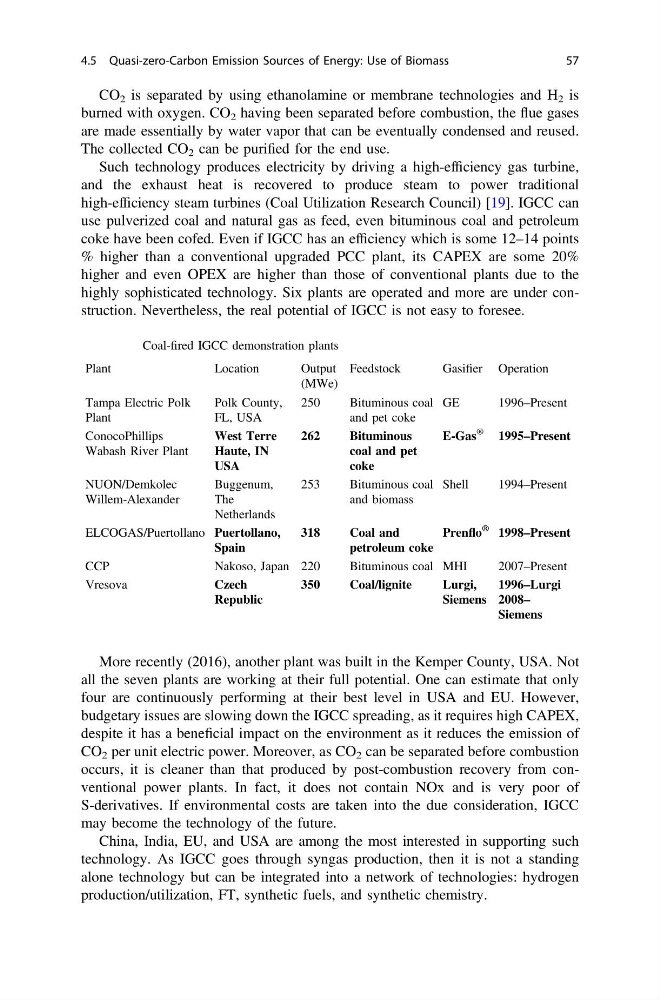
highly sophisticated technology. Six plants are operated and more are under construction. Nevertheless, the real potential of IGCC is not easy to foresee.
Table 4.4 Coal-fired IGCC demonstration plants
Plant
Location
Output
(MWe)
Feedstock
Gasifier Operation
Tampa Electric Polk
Plant
Polk County,
FL, USA
250
Bituminous coal
and pet coke
GE
1996–Present
ConocoPhillips
Wabash River Plant
West Terre
Haute, IN
USA
262
Bituminous
coal and pet
coke
E-Gas
®
1995–Present
NUON/Demkolec
Willem-Alexander
Buggenum,
The
Netherlands
253
Bituminous coal
and biomass
Shell
1994–Present
ELCOGAS/Puertollano Puertollano,
Spain
318
Coal and
petroleum coke
Prenflo
® 1998–Present
CCP
Nakoso, Japan 220
Bituminous coal MHI
2007–Present
Vresova
Czech
Republic
350
Coal/lignite
Lurgi,
Siemens
1996–Lurgi
2008–
Siemens
More recently (2016), another plant was built in the Kemper County, USA. Not
all the seven plants are working at their full potential. One can estimate that only
four are continuously performing at their best level in USA and EU. However,
budgetary issues are slowing down the IGCC spreading, as it requires high CAPEX,
despite it has a beneficial impact on the environment as it reduces the emission of
CO 2 per unit electric power. Moreover, as CO 2 can be separated before combustion
occurs, it is cleaner than that produced by post-combustion recovery from conventional power plants. In fact, it does not contain NOx and is very poor of
S-derivatives. If environmental costs are taken into the due consideration, IGCC
may become the technology of the future.
China, India, EU, and USA are among the most interested in supporting such
technology. As IGCC goes through syngas production, then it is not a standing
alone technology but can be integrated into a network of technologies: hydrogen
production/utilization, FT, synthetic fuels, and synthetic chemistry.
4.5 Quasi-zero-Carbon Emission Sources of Energy: Use of Biomass
57
burned with oxygen. CO 2 having been separated before combustion, the flue gases
are made essentially by water vapor that can be eventually condensed and reused.
The collected CO 2 can be purified for the end use.
Such technology produces electricity by driving a high-efficiency gas turbine,
and the exhaust heat is recovered to produce steam to power traditional
high-efficiency steam turbines (Coal Utilization Research Council) [19]. IGCC can
use pulverized coal and natural gas as feed, even bituminous coal and petroleum
coke have been cofed. Even if IGCC has an efficiency which is some 12–14 points
% higher than a conventional upgraded PCC plant, its CAPEX are some 20%
higher and even OPEX are higher than those of conventional plants due to the
highly sophisticated technology. Six plants are operated and more are under construction. Nevertheless, the real potential of IGCC is not easy to foresee.
Table 4.4 Coal-fired IGCC demonstration plants
Plant
Location
Output
(MWe)
Feedstock
Gasifier Operation
Tampa Electric Polk
Plant
Polk County,
FL, USA
250
Bituminous coal
and pet coke
GE
1996–Present
ConocoPhillips
Wabash River Plant
West Terre
Haute, IN
USA
262
Bituminous
coal and pet
coke
E-Gas
®
1995–Present
NUON/Demkolec
Willem-Alexander
Buggenum,
The
Netherlands
253
Bituminous coal
and biomass
Shell
1994–Present
ELCOGAS/Puertollano Puertollano,
Spain
318
Coal and
petroleum coke
Prenflo
® 1998–Present
CCP
Nakoso, Japan 220
Bituminous coal MHI
2007–Present
Vresova
Czech
Republic
350
Coal/lignite
Lurgi,
Siemens
1996–Lurgi
2008–
Siemens
More recently (2016), another plant was built in the Kemper County, USA. Not
all the seven plants are working at their full potential. One can estimate that only
four are continuously performing at their best level in USA and EU. However,
budgetary issues are slowing down the IGCC spreading, as it requires high CAPEX,
despite it has a beneficial impact on the environment as it reduces the emission of
CO 2 per unit electric power. Moreover, as CO 2 can be separated before combustion
occurs, it is cleaner than that produced by post-combustion recovery from conventional power plants. In fact, it does not contain NOx and is very poor of
S-derivatives. If environmental costs are taken into the due consideration, IGCC
may become the technology of the future.
China, India, EU, and USA are among the most interested in supporting such
technology. As IGCC goes through syngas production, then it is not a standing
alone technology but can be integrated into a network of technologies: hydrogen
production/utilization, FT, synthetic fuels, and synthetic chemistry.
4.5 Quasi-zero-Carbon Emission Sources of Energy: Use of Biomass
57