

Another “on-purpose” route for coal to chemicals is via the production of
acetylene (HCCH), which can be used to produce a variety of chemicals,
including vinyl chloride monomer (CH 2 =CHCl) from which the polymer polyvinyl
chloride (PVC) is derived. The economics for this production becomes attractive as
the crude/coal price spread increases, and this route may prove important in areas
with large coal reserves.
2.2.2 Use of Oil
Oil is used not only for producing gasoline and diesel for the transport sector, but is
also the source of numerous valued chemicals, which are either present as such in
the crude and can be separated or are made upon oil processing. Among them, we
can cite gleaming paints, tough and moldable plastics, pesticides, detergents, cosmetics, pharmaceuticals, and so on. Industrial processes convert sluggish liquids
into beauty products. By breaking the hydrocarbons chains into simpler compounds
(CO) and then assembling those single-C building blocks, chemists have learned to
construct molecules of exquisite complexity. Thus, destructive–reconstructive
approach has been for long time the preferred approach to chemicals, and this
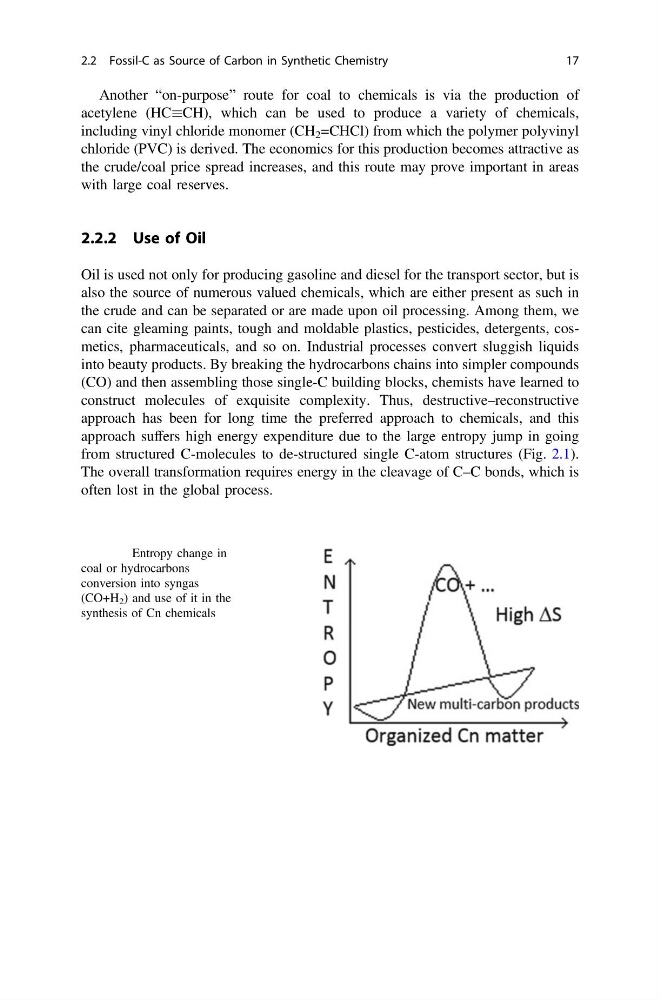
approach suffers high energy expenditure due to the large entropy jump in going
from structured C-molecules to de-structured single C-atom structures (Fig. 2.1).
The overall transformation requires energy in the cleavage of C–C bonds, which is
often lost in the global process.
Fig. 2.1 Entropy change in
coal or hydrocarbons
conversion into syngas
(CO+H 2 ) and use of it in the
synthesis of Cn chemicals
2.2 Fossil-C as Source of Carbon in Synthetic Chemistry
17
acetylene (HCCH), which can be used to produce a variety of chemicals,
including vinyl chloride monomer (CH 2 =CHCl) from which the polymer polyvinyl
chloride (PVC) is derived. The economics for this production becomes attractive as
the crude/coal price spread increases, and this route may prove important in areas
with large coal reserves.
2.2.2 Use of Oil
Oil is used not only for producing gasoline and diesel for the transport sector, but is
also the source of numerous valued chemicals, which are either present as such in
the crude and can be separated or are made upon oil processing. Among them, we
can cite gleaming paints, tough and moldable plastics, pesticides, detergents, cosmetics, pharmaceuticals, and so on. Industrial processes convert sluggish liquids
into beauty products. By breaking the hydrocarbons chains into simpler compounds
(CO) and then assembling those single-C building blocks, chemists have learned to
construct molecules of exquisite complexity. Thus, destructive–reconstructive
approach has been for long time the preferred approach to chemicals, and this
approach suffers high energy expenditure due to the large entropy jump in going
from structured C-molecules to de-structured single C-atom structures (Fig. 2.1).
The overall transformation requires energy in the cleavage of C–C bonds, which is
often lost in the global process.
Fig. 2.1 Entropy change in
coal or hydrocarbons
conversion into syngas
(CO+H 2 ) and use of it in the
synthesis of Cn chemicals
2.2 Fossil-C as Source of Carbon in Synthetic Chemistry
17