

Another point of consideration is that direct burning of biomass is not a clean
process: it has a strong environmental impact in terms of emitted particulate,
unburned materials, N-containing organic pollutants derived from
wood-endogenous-N, dioxins, etc. For the large-scale combustion of biomass,
especially in large cities, clean technologies are needed that prevent atmospheric
pollution.
The benefit is in the fact that biomass is produced from atmospheric CO 2 : the
International Panel on Climate Change (IPCC) estimates that the modern biomass
usage has a large carbon mitigation potential. The mitigation potential for electricity
generation from biomass will reach 1 220 Mt CO2eq for the year 2030; a substantial
fraction of it at costs lower than 19.5 US$ 2005 /t CO2 .
The massive use of pellets for heat generation in urban areas is causing the
formation of heavy smog. In order to reduce the environmental burden, it is necessary to process biomass into clean fuels before using it: this will rise issues about
its economic and energetic cost. Even if the use of renewable sources (biomass) and
perennial energies (solar, wind, geo, hydro-SWGH power) will be expanded, it is
unlike that perennial and renewable sources will cover the need of energy of
humanity. The use of fossil-C use will be progressively reduced up to minimize it,
but will not reach zero. Most likely, fossil-C will still be necessary for feeding
high-density and high-intensity uses, such as heavy electric terrestrial transport,
naval transport and aeronautics, and as raw material for the chemical industry (that
cannot be decarbonized), while perennial and renewable sources will likely be used
for low-density and low-intensity uses (domestic uses and some kind of light
transport). However, the combustion of fossil-C is causing the emission into the
atmosphere of large amounts of CO 2 which accumulates and rises serious concerns
about its putative impact on climate change. Therefore, the reduction of CO 2
emission is a must for our generation.
This urgency is aggravated by the fact that natural resources are not infinite: even if
the availability reported in Table 1.6 can somehow be expanded by discovering new
oil or gas fields or coal mines and by developing technologies that will allow the
exploitation of fields today not reached, it is a matter of ethics to save resources for
next generations, limiting consumption today: they will not last forever. At the actual
rate of consumption, we have enough fossil-C for only 70 years. Our dilemma is that
our society demands more energy, while we should use less C-based primary sources.
How to match, thus, the request of more energy and the need to reduce the use of
fossil-C that provides 81+% of the total energy used today? The most intuitive answer
is: increasing the efficiency in the production and use of energy and exploiting
alternative non-C-based energy sources. This is all? Any other innovative solution?
Yes. A revolutionary approach to problem-solving based on “Carbon Recycling-CR”
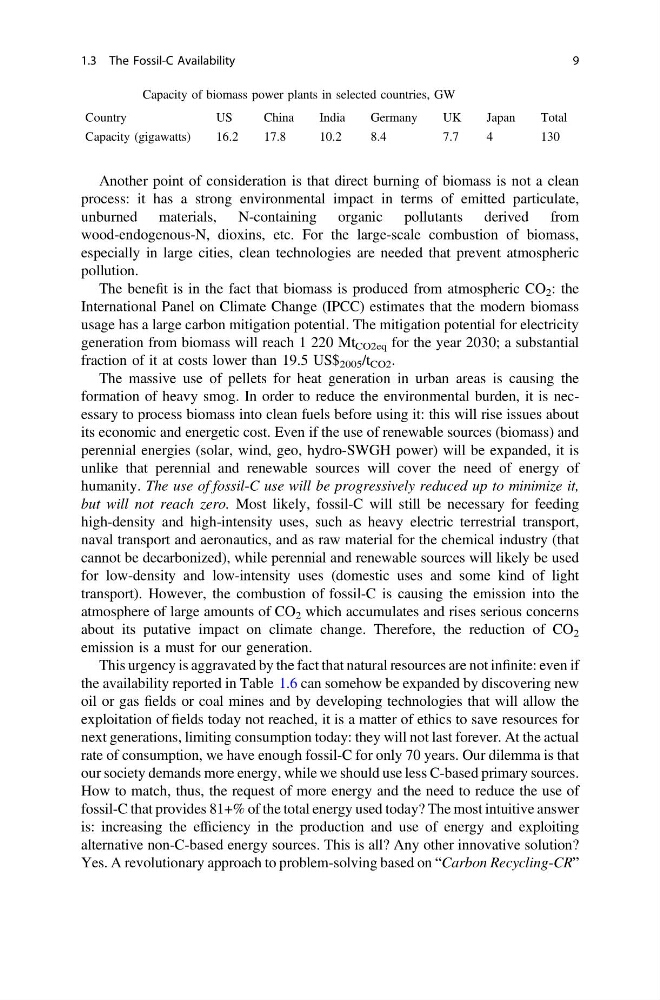
Table 1.8 Capacity of biomass power plants in selected countries, GW
Country
US
China
India
Germany
UK
Japan
Total
Capacity (gigawatts)
16.2
17.8
10.2
8.4
7.7
4
130
1.3 The Fossil-C Availability
9
process: it has a strong environmental impact in terms of emitted particulate,
unburned materials, N-containing organic pollutants derived from
wood-endogenous-N, dioxins, etc. For the large-scale combustion of biomass,
especially in large cities, clean technologies are needed that prevent atmospheric
pollution.
The benefit is in the fact that biomass is produced from atmospheric CO 2 : the
International Panel on Climate Change (IPCC) estimates that the modern biomass
usage has a large carbon mitigation potential. The mitigation potential for electricity
generation from biomass will reach 1 220 Mt CO2eq for the year 2030; a substantial
fraction of it at costs lower than 19.5 US$ 2005 /t CO2 .
The massive use of pellets for heat generation in urban areas is causing the
formation of heavy smog. In order to reduce the environmental burden, it is necessary to process biomass into clean fuels before using it: this will rise issues about
its economic and energetic cost. Even if the use of renewable sources (biomass) and
perennial energies (solar, wind, geo, hydro-SWGH power) will be expanded, it is
unlike that perennial and renewable sources will cover the need of energy of
humanity. The use of fossil-C use will be progressively reduced up to minimize it,
but will not reach zero. Most likely, fossil-C will still be necessary for feeding
high-density and high-intensity uses, such as heavy electric terrestrial transport,
naval transport and aeronautics, and as raw material for the chemical industry (that
cannot be decarbonized), while perennial and renewable sources will likely be used
for low-density and low-intensity uses (domestic uses and some kind of light
transport). However, the combustion of fossil-C is causing the emission into the
atmosphere of large amounts of CO 2 which accumulates and rises serious concerns
about its putative impact on climate change. Therefore, the reduction of CO 2
emission is a must for our generation.
This urgency is aggravated by the fact that natural resources are not infinite: even if
the availability reported in Table 1.6 can somehow be expanded by discovering new
oil or gas fields or coal mines and by developing technologies that will allow the
exploitation of fields today not reached, it is a matter of ethics to save resources for
next generations, limiting consumption today: they will not last forever. At the actual
rate of consumption, we have enough fossil-C for only 70 years. Our dilemma is that
our society demands more energy, while we should use less C-based primary sources.
How to match, thus, the request of more energy and the need to reduce the use of
fossil-C that provides 81+% of the total energy used today? The most intuitive answer
is: increasing the efficiency in the production and use of energy and exploiting
alternative non-C-based energy sources. This is all? Any other innovative solution?
Yes. A revolutionary approach to problem-solving based on “Carbon Recycling-CR”
Table 1.8 Capacity of biomass power plants in selected countries, GW
Country
US
China
India
Germany
UK
Japan
Total
Capacity (gigawatts)
16.2
17.8
10.2
8.4
7.7
4
130
1.3 The Fossil-C Availability
9