

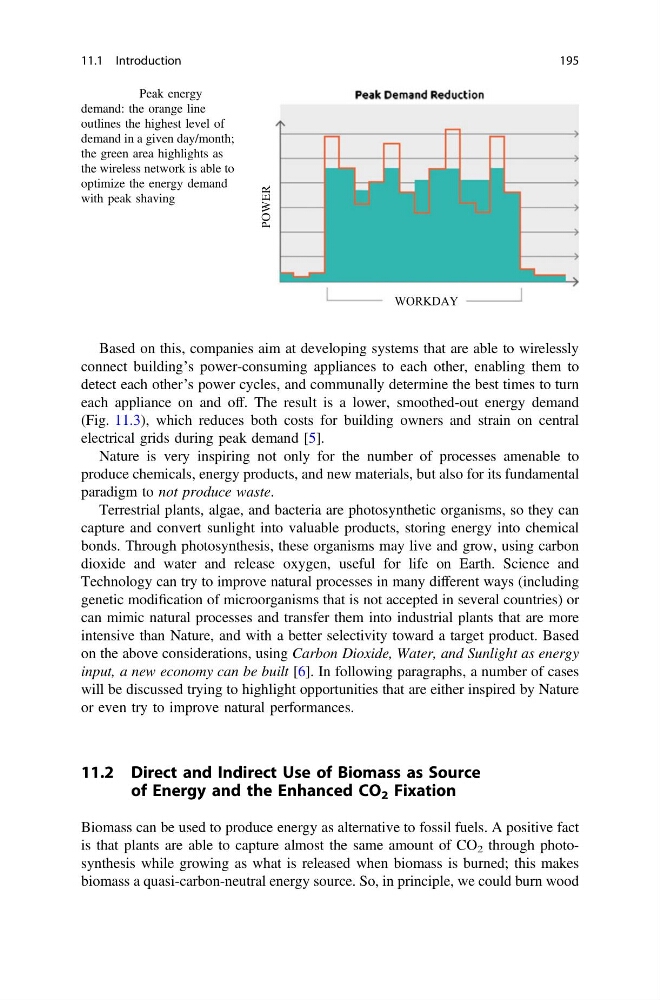
Based on this, companies aim at developing systems that are able to wirelessly
connect building’s power-consuming appliances to each other, enabling them to
detect each other’s power cycles, and communally determine the best times to turn
each appliance on and off. The result is a lower, smoothed-out energy demand
(Fig. 11.3), which reduces both costs for building owners and strain on central
electrical grids during peak demand [5].
Nature is very inspiring not only for the number of processes amenable to
produce chemicals, energy products, and new materials, but also for its fundamental
paradigm to not produce waste.
Terrestrial plants, algae, and bacteria are photosynthetic organisms, so they can
capture and convert sunlight into valuable products, storing energy into chemical
bonds. Through photosynthesis, these organisms may live and grow, using carbon
dioxide and water and release oxygen, useful for life on Earth. Science and
Technology can try to improve natural processes in many different ways (including
genetic modification of microorganisms that is not accepted in several countries) or
can mimic natural processes and transfer them into industrial plants that are more
intensive than Nature, and with a better selectivity toward a target product. Based
on the above considerations, using Carbon Dioxide, Water, and Sunlight as energy
input, a new economy can be built [6]. In following paragraphs, a number of cases
will be discussed trying to highlight opportunities that are either inspired by Nature
or even try to improve natural performances.
11.2 Direct and Indirect Use of Biomass as Source
of Energy and the Enhanced CO 2 Fixation
Biomass can be used to produce energy as alternative to fossil fuels. A positive fact
is that plants are able to capture almost the same amount of CO 2 through photosynthesis while growing as what is released when biomass is burned; this makes
biomass a quasi-carbon-neutral energy source. So, in principle, we could burn wood
POWER
WORKDAY
Fig. 11.3 Peak energy
demand: the orange line
outlines the highest level of
demand in a given day/month;
the green area highlights as
the wireless network is able to
optimize the energy demand
with peak shaving
11.1 Introduction
195
connect building’s power-consuming appliances to each other, enabling them to
detect each other’s power cycles, and communally determine the best times to turn
each appliance on and off. The result is a lower, smoothed-out energy demand
(Fig. 11.3), which reduces both costs for building owners and strain on central
electrical grids during peak demand [5].
Nature is very inspiring not only for the number of processes amenable to
produce chemicals, energy products, and new materials, but also for its fundamental
paradigm to not produce waste.
Terrestrial plants, algae, and bacteria are photosynthetic organisms, so they can
capture and convert sunlight into valuable products, storing energy into chemical
bonds. Through photosynthesis, these organisms may live and grow, using carbon
dioxide and water and release oxygen, useful for life on Earth. Science and
Technology can try to improve natural processes in many different ways (including
genetic modification of microorganisms that is not accepted in several countries) or
can mimic natural processes and transfer them into industrial plants that are more
intensive than Nature, and with a better selectivity toward a target product. Based
on the above considerations, using Carbon Dioxide, Water, and Sunlight as energy
input, a new economy can be built [6]. In following paragraphs, a number of cases
will be discussed trying to highlight opportunities that are either inspired by Nature
or even try to improve natural performances.
11.2 Direct and Indirect Use of Biomass as Source
of Energy and the Enhanced CO 2 Fixation
Biomass can be used to produce energy as alternative to fossil fuels. A positive fact
is that plants are able to capture almost the same amount of CO 2 through photosynthesis while growing as what is released when biomass is burned; this makes
biomass a quasi-carbon-neutral energy source. So, in principle, we could burn wood
POWER
WORKDAY
Fig. 11.3 Peak energy
demand: the orange line
outlines the highest level of
demand in a given day/month;
the green area highlights as
the wireless network is able to
optimize the energy demand
with peak shaving
11.1 Introduction
195