

one mole of carbonate with the release of one mole of respired carbon dioxide.
Fungi also assist in the process, by either breaking down oxalic-rich matter and
depositing calcium oxalate for catabolism by bacteria or by fungal oxalotrophy.
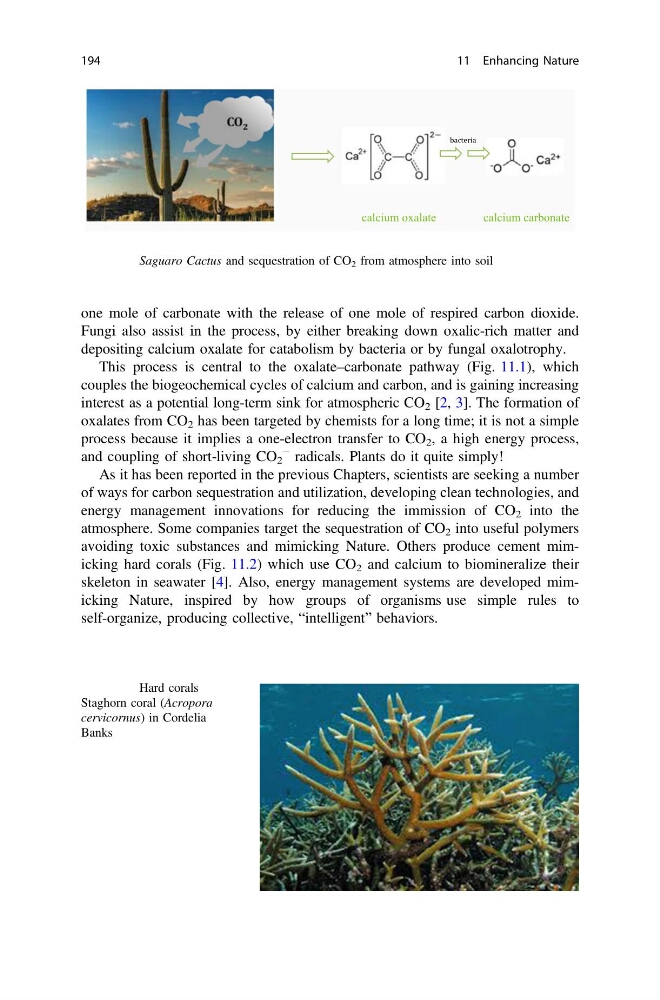
This process is central to the oxalate–carbonate pathway (Fig. 11.1), which
couples the biogeochemical cycles of calcium and carbon, and is gaining increasing
interest as a potential long-term sink for atmospheric CO 2 [2, 3]. The formation of
oxalates from CO 2 has been targeted by chemists for a long time; it is not a simple
process because it implies a one-electron transfer to CO 2 , a high energy process,
and coupling of short-living CO 2
− radicals. Plants do it quite simply!
As it has been reported in the previous Chapters, scientists are seeking a number
of ways for carbon sequestration and utilization, developing clean technologies, and
energy management innovations for reducing the immission of CO 2 into the
atmosphere. Some companies target the sequestration of CO 2 into useful polymers
avoiding toxic substances and mimicking Nature. Others produce cement mimicking hard corals (Fig. 11.2) which use CO 2 and calcium to biomineralize their
skeleton in seawater [4]. Also, energy management systems are developed mimicking Nature, inspired by how groups of organisms use simple rules to
self-organize, producing collective, “intelligent” behaviors.
calcium oxalate
calcium carbonate
bacteria
Fig. 11.1 Saguaro Cactus and sequestration of CO 2 from atmosphere into soil
Fig. 11.2 Hard corals
Staghorn coral (Acropora
cervicornus) in Cordelia
Banks
194
11 Enhancing Nature
Fungi also assist in the process, by either breaking down oxalic-rich matter and
depositing calcium oxalate for catabolism by bacteria or by fungal oxalotrophy.
This process is central to the oxalate–carbonate pathway (Fig. 11.1), which
couples the biogeochemical cycles of calcium and carbon, and is gaining increasing
interest as a potential long-term sink for atmospheric CO 2 [2, 3]. The formation of
oxalates from CO 2 has been targeted by chemists for a long time; it is not a simple
process because it implies a one-electron transfer to CO 2 , a high energy process,
and coupling of short-living CO 2
− radicals. Plants do it quite simply!
As it has been reported in the previous Chapters, scientists are seeking a number
of ways for carbon sequestration and utilization, developing clean technologies, and
energy management innovations for reducing the immission of CO 2 into the
atmosphere. Some companies target the sequestration of CO 2 into useful polymers
avoiding toxic substances and mimicking Nature. Others produce cement mimicking hard corals (Fig. 11.2) which use CO 2 and calcium to biomineralize their
skeleton in seawater [4]. Also, energy management systems are developed mimicking Nature, inspired by how groups of organisms use simple rules to
self-organize, producing collective, “intelligent” behaviors.
calcium oxalate
calcium carbonate
bacteria
Fig. 11.1 Saguaro Cactus and sequestration of CO 2 from atmosphere into soil
Fig. 11.2 Hard corals
Staghorn coral (Acropora
cervicornus) in Cordelia
Banks
194
11 Enhancing Nature