

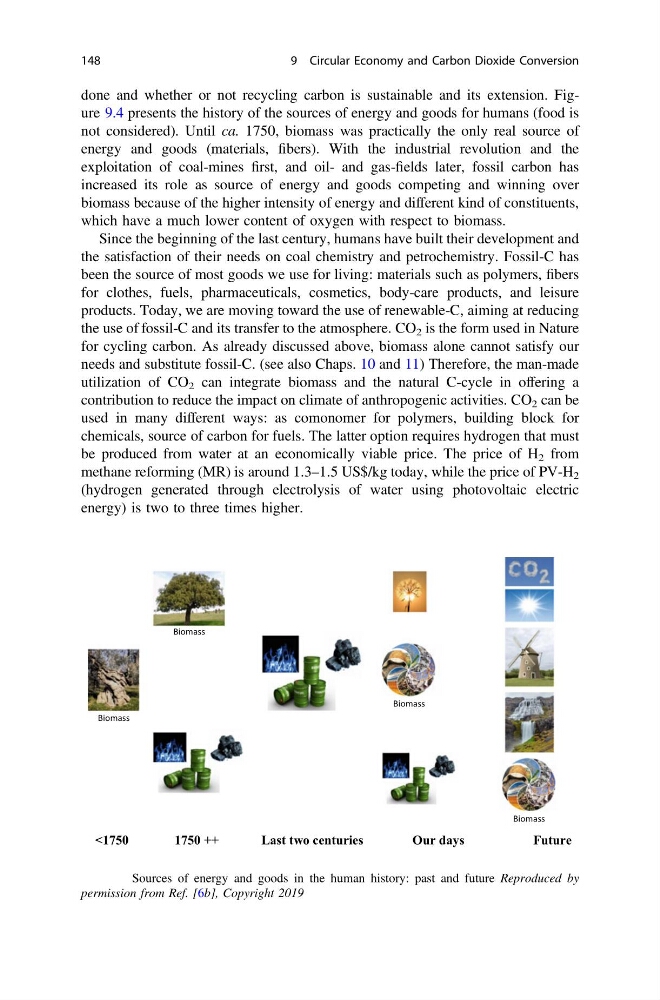
done and whether or not recycling carbon is sustainable and its extension. Figure 9.4 presents the history of the sources of energy and goods for humans (food is
not considered). Until ca. 1750, biomass was practically the only real source of
energy and goods (materials, fibers). With the industrial revolution and the
exploitation of coal-mines first, and oil- and gas-fields later, fossil carbon has
increased its role as source of energy and goods competing and winning over
biomass because of the higher intensity of energy and different kind of constituents,
which have a much lower content of oxygen with respect to biomass.
Since the beginning of the last century, humans have built their development and
the satisfaction of their needs on coal chemistry and petrochemistry. Fossil-C has
been the source of most goods we use for living: materials such as polymers, fibers
for clothes, fuels, pharmaceuticals, cosmetics, body-care products, and leisure
products. Today, we are moving toward the use of renewable-C, aiming at reducing
the use of fossil-C and its transfer to the atmosphere. CO 2 is the form used in Nature
for cycling carbon. As already discussed above, biomass alone cannot satisfy our
needs and substitute fossil-C. (see also Chaps. 10 and 11) Therefore, the man-made
utilization of CO 2 can integrate biomass and the natural C-cycle in offering a
contribution to reduce the impact on climate of anthropogenic activities. CO 2 can be
used in many different ways: as comonomer for polymers, building block for
chemicals, source of carbon for fuels. The latter option requires hydrogen that must
be produced from water at an economically viable price. The price of H 2 from
methane reforming (MR) is around 1.3–1.5 US$/kg today, while the price of PV-H 2
(hydrogen generated through electrolysis of water using photovoltaic electric
energy) is two to three times higher.
<1750
1750 ++
Last two centuries
Our days
Future
Biomass
Biomass
Biomass
Biomass
Fig. 9.4 Sources of energy and goods in the human history: past and future Reproduced by
permission from Ref. [6b], Copyright 2019
148
9 Circular Economy and Carbon Dioxide Conversion
not considered). Until ca. 1750, biomass was practically the only real source of
energy and goods (materials, fibers). With the industrial revolution and the
exploitation of coal-mines first, and oil- and gas-fields later, fossil carbon has
increased its role as source of energy and goods competing and winning over
biomass because of the higher intensity of energy and different kind of constituents,
which have a much lower content of oxygen with respect to biomass.
Since the beginning of the last century, humans have built their development and
the satisfaction of their needs on coal chemistry and petrochemistry. Fossil-C has
been the source of most goods we use for living: materials such as polymers, fibers
for clothes, fuels, pharmaceuticals, cosmetics, body-care products, and leisure
products. Today, we are moving toward the use of renewable-C, aiming at reducing
the use of fossil-C and its transfer to the atmosphere. CO 2 is the form used in Nature
for cycling carbon. As already discussed above, biomass alone cannot satisfy our
needs and substitute fossil-C. (see also Chaps. 10 and 11) Therefore, the man-made
utilization of CO 2 can integrate biomass and the natural C-cycle in offering a
contribution to reduce the impact on climate of anthropogenic activities. CO 2 can be
used in many different ways: as comonomer for polymers, building block for
chemicals, source of carbon for fuels. The latter option requires hydrogen that must
be produced from water at an economically viable price. The price of H 2 from
methane reforming (MR) is around 1.3–1.5 US$/kg today, while the price of PV-H 2
(hydrogen generated through electrolysis of water using photovoltaic electric
energy) is two to three times higher.
<1750
1750 ++
Last two centuries
Our days
Future
Biomass
Biomass
Biomass
Biomass
Fig. 9.4 Sources of energy and goods in the human history: past and future Reproduced by
permission from Ref. [6b], Copyright 2019
148
9 Circular Economy and Carbon Dioxide Conversion