

9.2 Carbon Dioxide Conversion (CCU)
What contribution can CCU give to reducing the putative impact of CO 2 on Climate
Change, how can it improve our life, what is the time to its large-scale exploitation,
what will be its intensity, what technologies must be developed? In this and next
chapters an answer to such questions will be strived.
9.2.1 CCU and Resources Conservation
The utilization of CO 2 as building block or source of carbon means recycling
carbon, mimicking Nature. This is a virtuous practice that reduces the transfer of
fossil-C to the atmosphere, supports the sustainability of the chemical industry (and
transport sector), and preserves fossil-C resources for next generations. Summarizing data reported in Chaps. 1–3, the consumption of fossil-C today ranges around
11.5 [5a]–12.5 Gtoe/y [5b] with a forecast of reaching 25 Gtoe in 2035. In a
Business as Usual (BAU), the CO 2 emission will rise from 37 to over 70 Gt/y! The
daunting figure is that the estimated fossil-C reserves (coal, oil, and gas) are today
quantified at 941 Gtoe. According to the BP forecast, [6] at the actual rate of
consumption of fossil-C, humanity have crude oil available until year 2066, natural
gas until year 2068, and coal until year 2169.
Such figures are impressive! We hope that new reserves are discovered or deeper
sites not reached so far will be exploited. This is a wish, what is the reality?
As for today, the perspective availability of fossil-C of ca. 150 years asks for
immediate action and use of renewable-C (and CO 2 is renewable carbon), for
making chemicals and fuels, mimicking Nature; this is an ethical must with scientific or technical issues. However, one could ask at what cost recycling can be
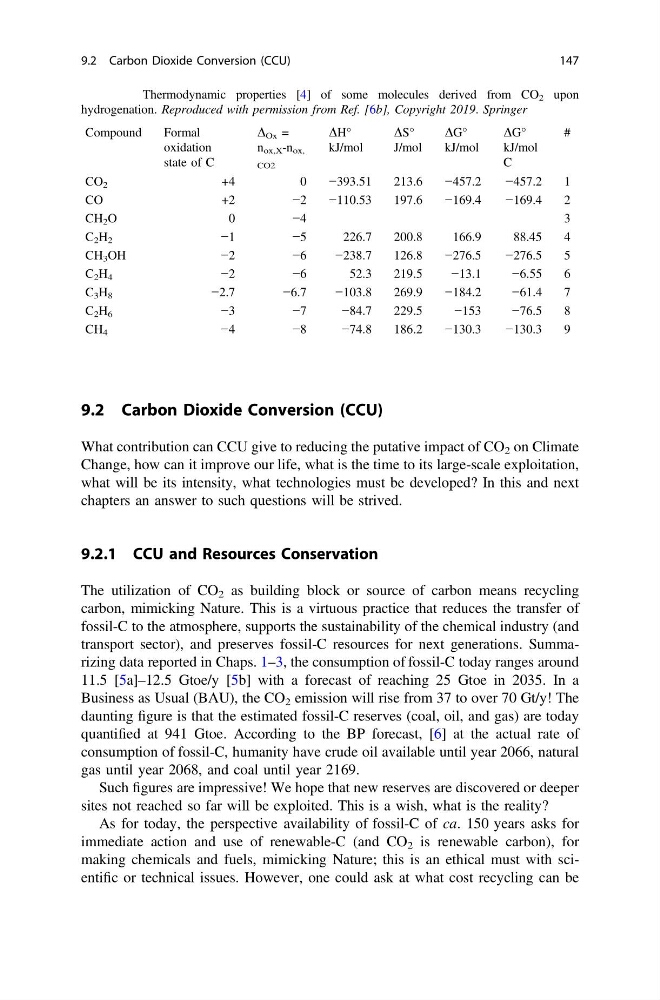
Table 9.3 Thermodynamic properties [4] of some molecules derived from CO 2 upon
hydrogenation. Reproduced with permission from Ref. [6b], Copyright 2019. Springer
Compound
Formal
oxidation
state of C
D Ox =
n ox,X -n ox,
CO2
DH°
kJ/mol
DS°
J/mol
DG°
kJ/mol
DG°
kJ/mol
C
#
CO 2
+4
0
−393.51
213.6
−457.2
−457.2
1
CO
+2
−2
−110.53
197.6
−169.4
−169.4
2
CH 2 O
0
−4
3
C 2 H 2
−1
−5
226.7
200.8
166.9
88.45
4
CH 3 OH
−2
−6
−238.7
126.8
−276.5
−276.5
5
C 2 H 4
−2
−6
52.3
219.5
−13.1
−6.55
6
C 3 H 8
−2.7
−6.7
−103.8
269.9
−184.2
−61.4
7
C 2 H 6
−3
−7
−84.7
229.5
−153
−76.5
8
CH 4
−4
−8
−74.8
186.2
−130.3
−130.3
9
9.2 Carbon Dioxide Conversion (CCU)
147
What contribution can CCU give to reducing the putative impact of CO 2 on Climate
Change, how can it improve our life, what is the time to its large-scale exploitation,
what will be its intensity, what technologies must be developed? In this and next
chapters an answer to such questions will be strived.
9.2.1 CCU and Resources Conservation
The utilization of CO 2 as building block or source of carbon means recycling
carbon, mimicking Nature. This is a virtuous practice that reduces the transfer of
fossil-C to the atmosphere, supports the sustainability of the chemical industry (and
transport sector), and preserves fossil-C resources for next generations. Summarizing data reported in Chaps. 1–3, the consumption of fossil-C today ranges around
11.5 [5a]–12.5 Gtoe/y [5b] with a forecast of reaching 25 Gtoe in 2035. In a
Business as Usual (BAU), the CO 2 emission will rise from 37 to over 70 Gt/y! The
daunting figure is that the estimated fossil-C reserves (coal, oil, and gas) are today
quantified at 941 Gtoe. According to the BP forecast, [6] at the actual rate of
consumption of fossil-C, humanity have crude oil available until year 2066, natural
gas until year 2068, and coal until year 2169.
Such figures are impressive! We hope that new reserves are discovered or deeper
sites not reached so far will be exploited. This is a wish, what is the reality?
As for today, the perspective availability of fossil-C of ca. 150 years asks for
immediate action and use of renewable-C (and CO 2 is renewable carbon), for
making chemicals and fuels, mimicking Nature; this is an ethical must with scientific or technical issues. However, one could ask at what cost recycling can be
Table 9.3 Thermodynamic properties [4] of some molecules derived from CO 2 upon
hydrogenation. Reproduced with permission from Ref. [6b], Copyright 2019. Springer
Compound
Formal
oxidation
state of C
D Ox =
n ox,X -n ox,
CO2
DH°
kJ/mol
DS°
J/mol
DG°
kJ/mol
DG°
kJ/mol
C
#
CO 2
+4
0
−393.51
213.6
−457.2
−457.2
1
CO
+2
−2
−110.53
197.6
−169.4
−169.4
2
CH 2 O
0
−4
3
C 2 H 2
−1
−5
226.7
200.8
166.9
88.45
4
CH 3 OH
−2
−6
−238.7
126.8
−276.5
−276.5
5
C 2 H 4
−2
−6
52.3
219.5
−13.1
−6.55
6
C 3 H 8
−2.7
−6.7
−103.8
269.9
−184.2
−61.4
7
C 2 H 6
−3
−7
−84.7
229.5
−153
−76.5
8
CH 4
−4
−8
−74.8
186.2
−130.3
−130.3
9
9.2 Carbon Dioxide Conversion (CCU)
147