

Cycle Analysis (LCA) Methodology. In applying such a tool, correct parameters
must be used as LCA is an interesting comparative tool that should be used with
special care, being it very sensitive to fed data which must be real process data,
collected with much attention. An absolute use of LCA is quite complex, if not
impossible.
Moreover, LCA is changing [2] and increasing its complexity, as it is moving
from single product-process to cluster of processes and cascades of products
assessment, including waste management.
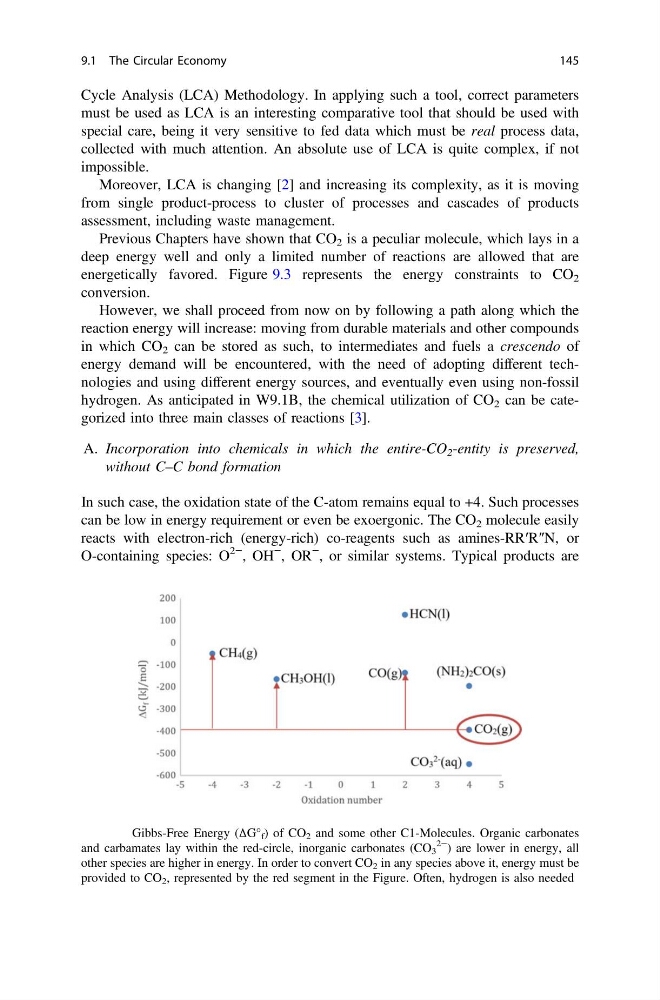
Previous Chapters have shown that CO 2 is a peculiar molecule, which lays in a
deep energy well and only a limited number of reactions are allowed that are
energetically favored. Figure 9.3 represents the energy constraints to CO 2
conversion.
However, we shall proceed from now on by following a path along which the
reaction energy will increase: moving from durable materials and other compounds
in which CO 2 can be stored as such, to intermediates and fuels a crescendo of
energy demand will be encountered, with the need of adopting different technologies and using different energy sources, and eventually even using non-fossil
hydrogen. As anticipated in W9.1B, the chemical utilization of CO 2 can be categorized into three main classes of reactions [3].
A. Incorporation into chemicals in which the entire-CO 2 -entity is preserved,
without C–C bond formation
In such case, the oxidation state of the C-atom remains equal to +4. Such processes
can be low in energy requirement or even be exoergonic. The CO 2 molecule easily
reacts with electron-rich (energy-rich) co-reagents such as amines-RR′R″N, or
O-containing species: O
2− , OH
− , OR
− , or similar systems. Typical products are
Fig. 9.3 Gibbs-Free Energy (ΔG° f ) of CO 2 and some other C1-Molecules. Organic carbonates
and carbamates lay within the red-circle, inorganic carbonates (CO 3
2−
) are lower in energy, all
other species are higher in energy. In order to convert CO 2 in any species above it, energy must be
provided to CO 2 , represented by the red segment in the Figure. Often, hydrogen is also needed
9.1 The Circular Economy
145
must be used as LCA is an interesting comparative tool that should be used with
special care, being it very sensitive to fed data which must be real process data,
collected with much attention. An absolute use of LCA is quite complex, if not
impossible.
Moreover, LCA is changing [2] and increasing its complexity, as it is moving
from single product-process to cluster of processes and cascades of products
assessment, including waste management.
Previous Chapters have shown that CO 2 is a peculiar molecule, which lays in a
deep energy well and only a limited number of reactions are allowed that are
energetically favored. Figure 9.3 represents the energy constraints to CO 2
conversion.
However, we shall proceed from now on by following a path along which the
reaction energy will increase: moving from durable materials and other compounds
in which CO 2 can be stored as such, to intermediates and fuels a crescendo of
energy demand will be encountered, with the need of adopting different technologies and using different energy sources, and eventually even using non-fossil
hydrogen. As anticipated in W9.1B, the chemical utilization of CO 2 can be categorized into three main classes of reactions [3].
A. Incorporation into chemicals in which the entire-CO 2 -entity is preserved,
without C–C bond formation
In such case, the oxidation state of the C-atom remains equal to +4. Such processes
can be low in energy requirement or even be exoergonic. The CO 2 molecule easily
reacts with electron-rich (energy-rich) co-reagents such as amines-RR′R″N, or
O-containing species: O
2− , OH
− , OR
− , or similar systems. Typical products are
Fig. 9.3 Gibbs-Free Energy (ΔG° f ) of CO 2 and some other C1-Molecules. Organic carbonates
and carbamates lay within the red-circle, inorganic carbonates (CO 3
2−
) are lower in energy, all
other species are higher in energy. In order to convert CO 2 in any species above it, energy must be
provided to CO 2 , represented by the red segment in the Figure. Often, hydrogen is also needed
9.1 The Circular Economy
145