

The recovered CO 2 can be used in chemical reactions and converted into a
variety of useful compounds (chemicals, materials, fuels) that have a value. The
utilization of CO 2 as building block, comonomer for polymers, or source of carbon
for fuels generates profit and can pay for the capture and conversion costs. CCU is,
thus, quite different from CCS also from the economic point of view. A comparison
of both is reported in Table 9.2.
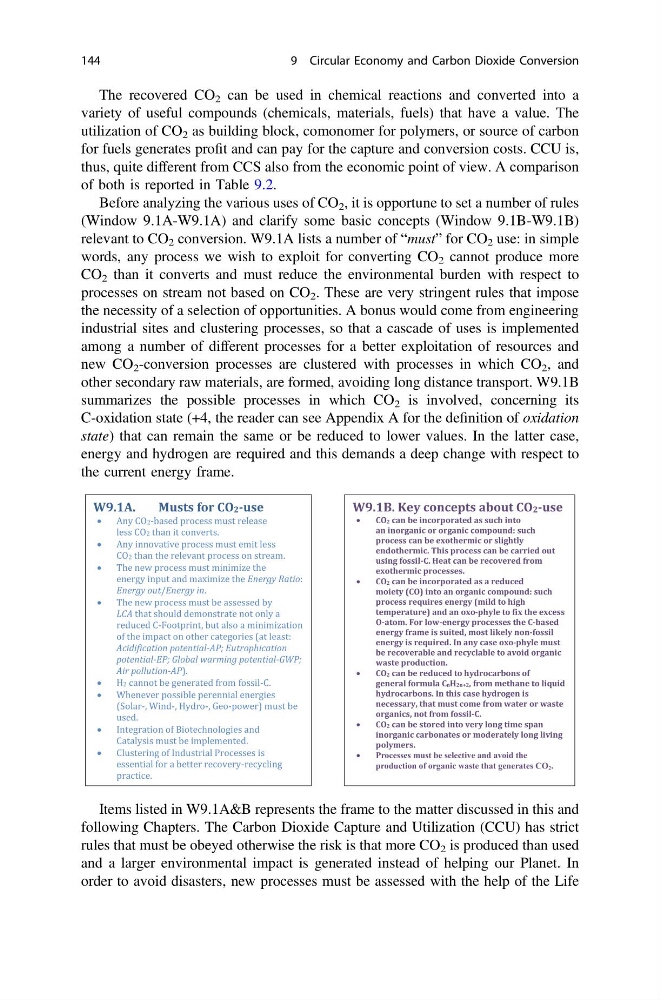
Before analyzing the various uses of CO 2 , it is opportune to set a number of rules
(Window 9.1A-W9.1A) and clarify some basic concepts (Window 9.1B-W9.1B)
relevant to CO 2 conversion. W9.1A lists a number of “must” for CO 2 use: in simple
words, any process we wish to exploit for converting CO 2 cannot produce more
CO 2 than it converts and must reduce the environmental burden with respect to
processes on stream not based on CO 2 . These are very stringent rules that impose
the necessity of a selection of opportunities. A bonus would come from engineering
industrial sites and clustering processes, so that a cascade of uses is implemented
among a number of different processes for a better exploitation of resources and
new CO 2 -conversion processes are clustered with processes in which CO 2 , and
other secondary raw materials, are formed, avoiding long distance transport. W9.1B
summarizes the possible processes in which CO 2 is involved, concerning its
C-oxidation state (+4, the reader can see Appendix A for the definition of oxidation
state) that can remain the same or be reduced to lower values. In the latter case,
energy and hydrogen are required and this demands a deep change with respect to
the current energy frame.
Items listed in W9.1A&B represents the frame to the matter discussed in this and
following Chapters. The Carbon Dioxide Capture and Utilization (CCU) has strict
rules that must be obeyed otherwise the risk is that more CO 2 is produced than used
and a larger environmental impact is generated instead of helping our Planet. In
order to avoid disasters, new processes must be assessed with the help of the Life
144
9 Circular Economy and Carbon Dioxide Conversion
variety of useful compounds (chemicals, materials, fuels) that have a value. The
utilization of CO 2 as building block, comonomer for polymers, or source of carbon
for fuels generates profit and can pay for the capture and conversion costs. CCU is,
thus, quite different from CCS also from the economic point of view. A comparison
of both is reported in Table 9.2.
Before analyzing the various uses of CO 2 , it is opportune to set a number of rules
(Window 9.1A-W9.1A) and clarify some basic concepts (Window 9.1B-W9.1B)
relevant to CO 2 conversion. W9.1A lists a number of “must” for CO 2 use: in simple
words, any process we wish to exploit for converting CO 2 cannot produce more
CO 2 than it converts and must reduce the environmental burden with respect to
processes on stream not based on CO 2 . These are very stringent rules that impose
the necessity of a selection of opportunities. A bonus would come from engineering
industrial sites and clustering processes, so that a cascade of uses is implemented
among a number of different processes for a better exploitation of resources and
new CO 2 -conversion processes are clustered with processes in which CO 2 , and
other secondary raw materials, are formed, avoiding long distance transport. W9.1B
summarizes the possible processes in which CO 2 is involved, concerning its
C-oxidation state (+4, the reader can see Appendix A for the definition of oxidation
state) that can remain the same or be reduced to lower values. In the latter case,
energy and hydrogen are required and this demands a deep change with respect to
the current energy frame.
Items listed in W9.1A&B represents the frame to the matter discussed in this and
following Chapters. The Carbon Dioxide Capture and Utilization (CCU) has strict
rules that must be obeyed otherwise the risk is that more CO 2 is produced than used
and a larger environmental impact is generated instead of helping our Planet. In
order to avoid disasters, new processes must be assessed with the help of the Life
144
9 Circular Economy and Carbon Dioxide Conversion