

today!) to recycle them in its cycles (see Chap. 3). Since middle 1950, the use of
plastics grew exponentially (today we use 360
+ Mt/y of various plastics) and the
throw-away attitude became global reaching industries, collective services, individuals. The production of “waste,” of any kind, started to grow at an unpredictable
rate causing often irreversible damages to Nature: physical world, vegetation, animals, humans. “Consumerism” has dominated our world in last few decades, based
on the false belief that the Earth resources were immense, inesaurible, enough for all.
In such view, even the timespan of goods became an unnecessary attribute:
short-living goods were privileged.
Misuse was encouraged, and profit became the god in all our activities. Maximizing profit at expenses of all other values has been the driver during last decades.
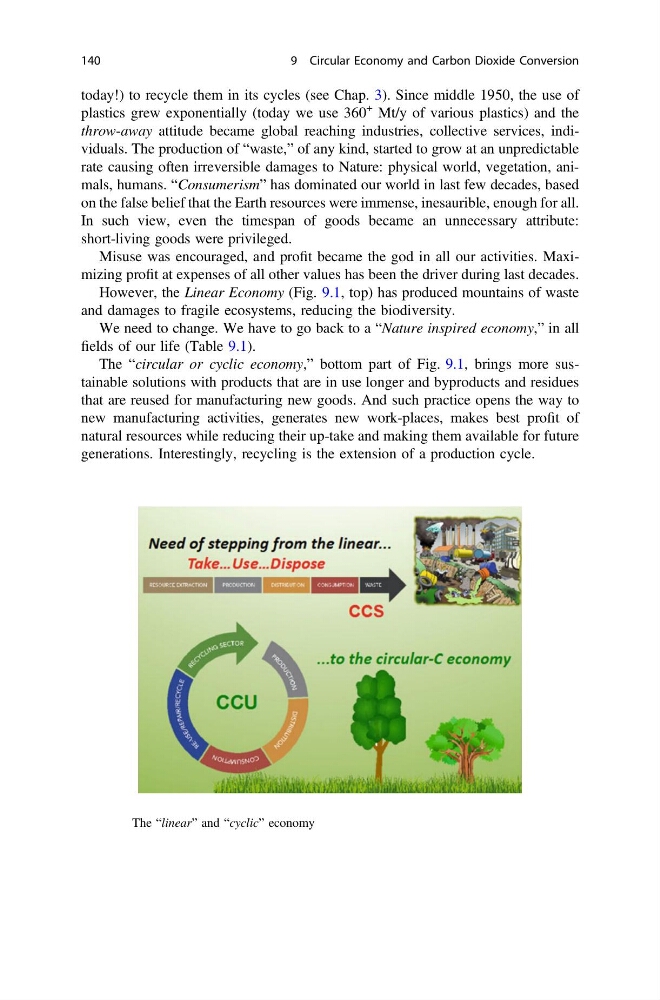
However, the Linear Economy (Fig. 9.1, top) has produced mountains of waste
and damages to fragile ecosystems, reducing the biodiversity.
We need to change. We have to go back to a “Nature inspired economy,” in all
fields of our life (Table 9.1).
The “circular or cyclic economy,” bottom part of Fig. 9.1, brings more sustainable solutions with products that are in use longer and byproducts and residues
that are reused for manufacturing new goods. And such practice opens the way to
new manufacturing activities, generates new work-places, makes best profit of
natural resources while reducing their up-take and making them available for future
generations. Interestingly, recycling is the extension of a production cycle.
Fig. 9.1 The “linear” and “cyclic” economy
140
9 Circular Economy and Carbon Dioxide Conversion
plastics grew exponentially (today we use 360
+ Mt/y of various plastics) and the
throw-away attitude became global reaching industries, collective services, individuals. The production of “waste,” of any kind, started to grow at an unpredictable
rate causing often irreversible damages to Nature: physical world, vegetation, animals, humans. “Consumerism” has dominated our world in last few decades, based
on the false belief that the Earth resources were immense, inesaurible, enough for all.
In such view, even the timespan of goods became an unnecessary attribute:
short-living goods were privileged.
Misuse was encouraged, and profit became the god in all our activities. Maximizing profit at expenses of all other values has been the driver during last decades.
However, the Linear Economy (Fig. 9.1, top) has produced mountains of waste
and damages to fragile ecosystems, reducing the biodiversity.
We need to change. We have to go back to a “Nature inspired economy,” in all
fields of our life (Table 9.1).
The “circular or cyclic economy,” bottom part of Fig. 9.1, brings more sustainable solutions with products that are in use longer and byproducts and residues
that are reused for manufacturing new goods. And such practice opens the way to
new manufacturing activities, generates new work-places, makes best profit of
natural resources while reducing their up-take and making them available for future
generations. Interestingly, recycling is the extension of a production cycle.
Fig. 9.1 The “linear” and “cyclic” economy
140
9 Circular Economy and Carbon Dioxide Conversion