

beverage industry as a propellant gas for emptying tanks and as a shielding gas for
preserving the drinks quality (exclusion of oxygen).
8.3.3 Extraction of Fragrances
Supercritical-CO 2 (SC-CO 2 ) (see Chap. 7) can be used as solvent for the extraction
of caffeine from coffee grains or flavors from plants, natural colors, essential oils,
active principles from pharmacopea crops. SC-CO 2 is contacted with the matrix
into a reactor at the wanted temperature (SC-CO 2 must be kept at a temperature
above 31 °C), then the fluid containing the extracted products (e.g., caffeine) is sent
to an expansion reactor where the extracted product (solid or liquid) is released and
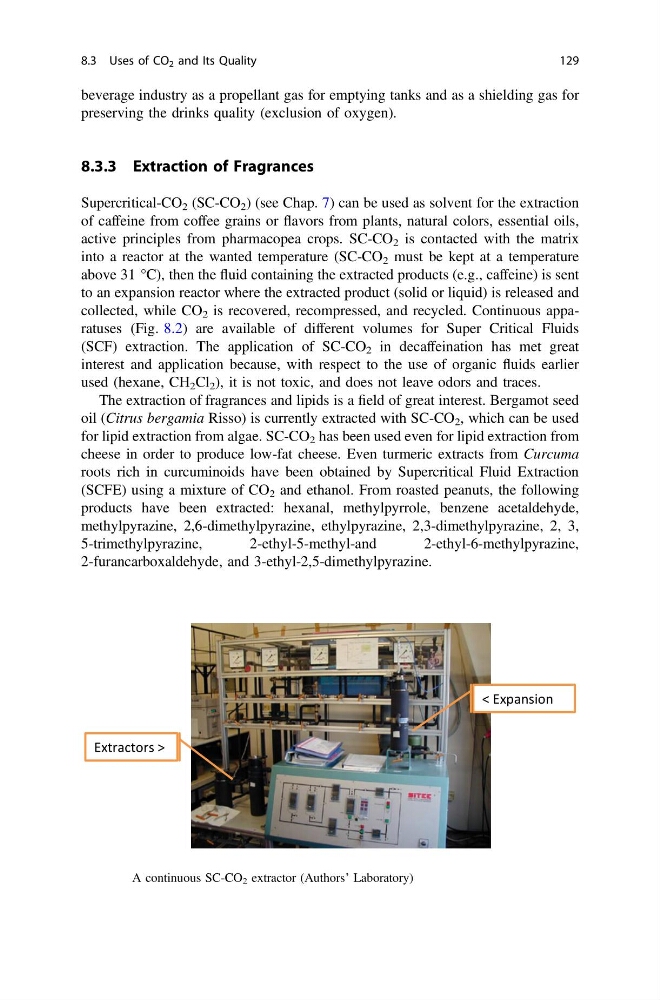
collected, while CO 2 is recovered, recompressed, and recycled. Continuous apparatuses (Fig. 8.2) are available of different volumes for Super Critical Fluids
(SCF) extraction. The application of SC-CO 2 in decaffeination has met great
interest and application because, with respect to the use of organic fluids earlier
used (hexane, CH 2 Cl 2 ), it is not toxic, and does not leave odors and traces.
The extraction of fragrances and lipids is a field of great interest. Bergamot seed
oil (Citrus bergamia Risso) is currently extracted with SC-CO 2 , which can be used
for lipid extraction from algae. SC-CO 2 has been used even for lipid extraction from
cheese in order to produce low-fat cheese. Even turmeric extracts from Curcuma
roots rich in curcuminoids have been obtained by Supercritical Fluid Extraction
(SCFE) using a mixture of CO 2 and ethanol. From roasted peanuts, the following
products have been extracted: hexanal, methylpyrrole, benzene acetaldehyde,
methylpyrazine, 2,6-dimethylpyrazine, ethylpyrazine, 2,3-dimethylpyrazine, 2, 3,
5-trimethylpyrazine,
2-ethyl-5-methyl-and
2-ethyl-6-methylpyrazine,
2-furancarboxaldehyde, and 3-ethyl-2,5-dimethylpyrazine.
Extractors >
< Expansion
Fig. 8.2 A continuous SC-CO 2 extractor (Authors’ Laboratory)
8.3 Uses of CO 2 and Its Quality
129
preserving the drinks quality (exclusion of oxygen).
8.3.3 Extraction of Fragrances
Supercritical-CO 2 (SC-CO 2 ) (see Chap. 7) can be used as solvent for the extraction
of caffeine from coffee grains or flavors from plants, natural colors, essential oils,
active principles from pharmacopea crops. SC-CO 2 is contacted with the matrix
into a reactor at the wanted temperature (SC-CO 2 must be kept at a temperature
above 31 °C), then the fluid containing the extracted products (e.g., caffeine) is sent
to an expansion reactor where the extracted product (solid or liquid) is released and
collected, while CO 2 is recovered, recompressed, and recycled. Continuous apparatuses (Fig. 8.2) are available of different volumes for Super Critical Fluids
(SCF) extraction. The application of SC-CO 2 in decaffeination has met great
interest and application because, with respect to the use of organic fluids earlier
used (hexane, CH 2 Cl 2 ), it is not toxic, and does not leave odors and traces.
The extraction of fragrances and lipids is a field of great interest. Bergamot seed
oil (Citrus bergamia Risso) is currently extracted with SC-CO 2 , which can be used
for lipid extraction from algae. SC-CO 2 has been used even for lipid extraction from
cheese in order to produce low-fat cheese. Even turmeric extracts from Curcuma
roots rich in curcuminoids have been obtained by Supercritical Fluid Extraction
(SCFE) using a mixture of CO 2 and ethanol. From roasted peanuts, the following
products have been extracted: hexanal, methylpyrrole, benzene acetaldehyde,
methylpyrazine, 2,6-dimethylpyrazine, ethylpyrazine, 2,3-dimethylpyrazine, 2, 3,
5-trimethylpyrazine,
2-ethyl-5-methyl-and
2-ethyl-6-methylpyrazine,
2-furancarboxaldehyde, and 3-ethyl-2,5-dimethylpyrazine.
Extractors >
< Expansion
Fig. 8.2 A continuous SC-CO 2 extractor (Authors’ Laboratory)
8.3 Uses of CO 2 and Its Quality
129