

8.3.2 Additive to Beverages
CO 2 (apolar molecule) is sparingly (0.027 g/L as free CO 2 at ambient conditions)
soluble in water (polar molecule) in which undergoes the equilibria discussed in
Chap. 6. Therefore, in water, CO 2 produces a slightly acidic solution (pH = 5.8–6)
and exists mainly in the form of hydrogencarbonate (see Fig. 6.9).
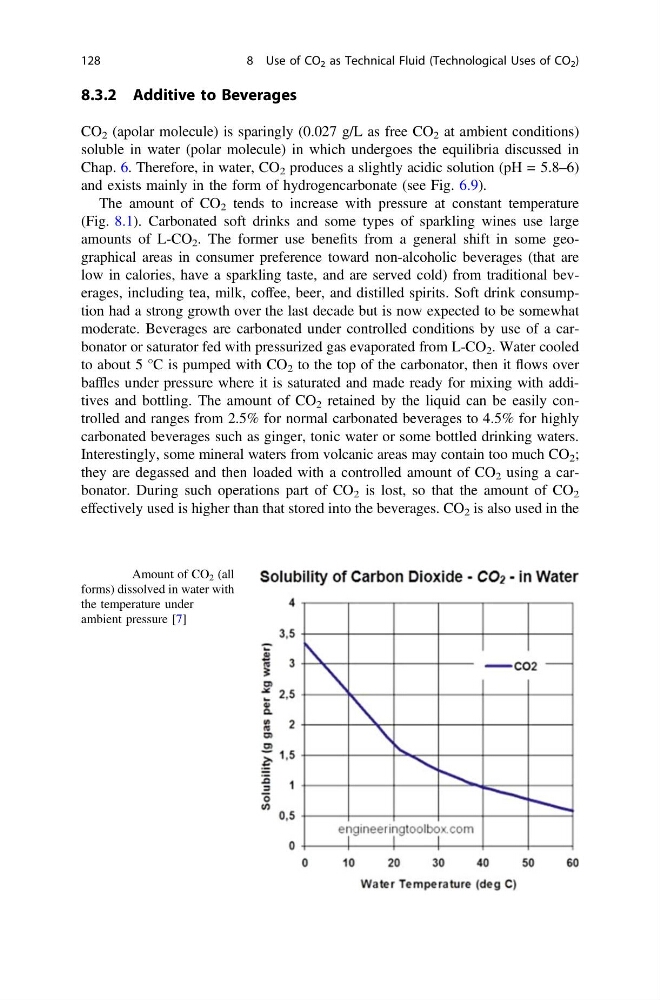
The amount of CO 2 tends to increase with pressure at constant temperature
(Fig. 8.1). Carbonated soft drinks and some types of sparkling wines use large
amounts of L-CO 2 . The former use benefits from a general shift in some geographical areas in consumer preference toward non-alcoholic beverages (that are
low in calories, have a sparkling taste, and are served cold) from traditional beverages, including tea, milk, coffee, beer, and distilled spirits. Soft drink consumption had a strong growth over the last decade but is now expected to be somewhat
moderate. Beverages are carbonated under controlled conditions by use of a carbonator or saturator fed with pressurized gas evaporated from L-CO 2 . Water cooled
to about 5 °C is pumped with CO 2 to the top of the carbonator, then it flows over
baffles under pressure where it is saturated and made ready for mixing with additives and bottling. The amount of CO 2 retained by the liquid can be easily controlled and ranges from 2.5% for normal carbonated beverages to 4.5% for highly
carbonated beverages such as ginger, tonic water or some bottled drinking waters.
Interestingly, some mineral waters from volcanic areas may contain too much CO 2 ;
they are degassed and then loaded with a controlled amount of CO 2 using a carbonator. During such operations part of CO 2 is lost, so that the amount of CO 2
effectively used is higher than that stored into the beverages. CO 2 is also used in the
Fig. 8.1 Amount of CO 2 (all
forms) dissolved in water with
the temperature under
ambient pressure [7]
128
8 Use of CO 2 as Technical Fluid (Technological Uses of CO 2 )
CO 2 (apolar molecule) is sparingly (0.027 g/L as free CO 2 at ambient conditions)
soluble in water (polar molecule) in which undergoes the equilibria discussed in
Chap. 6. Therefore, in water, CO 2 produces a slightly acidic solution (pH = 5.8–6)
and exists mainly in the form of hydrogencarbonate (see Fig. 6.9).
The amount of CO 2 tends to increase with pressure at constant temperature
(Fig. 8.1). Carbonated soft drinks and some types of sparkling wines use large
amounts of L-CO 2 . The former use benefits from a general shift in some geographical areas in consumer preference toward non-alcoholic beverages (that are
low in calories, have a sparkling taste, and are served cold) from traditional beverages, including tea, milk, coffee, beer, and distilled spirits. Soft drink consumption had a strong growth over the last decade but is now expected to be somewhat
moderate. Beverages are carbonated under controlled conditions by use of a carbonator or saturator fed with pressurized gas evaporated from L-CO 2 . Water cooled
to about 5 °C is pumped with CO 2 to the top of the carbonator, then it flows over
baffles under pressure where it is saturated and made ready for mixing with additives and bottling. The amount of CO 2 retained by the liquid can be easily controlled and ranges from 2.5% for normal carbonated beverages to 4.5% for highly
carbonated beverages such as ginger, tonic water or some bottled drinking waters.
Interestingly, some mineral waters from volcanic areas may contain too much CO 2 ;
they are degassed and then loaded with a controlled amount of CO 2 using a carbonator. During such operations part of CO 2 is lost, so that the amount of CO 2
effectively used is higher than that stored into the beverages. CO 2 is also used in the
Fig. 8.1 Amount of CO 2 (all
forms) dissolved in water with
the temperature under
ambient pressure [7]
128
8 Use of CO 2 as Technical Fluid (Technological Uses of CO 2 )