

7.2.3 Nuclear Magnetic Resonance (NMR) Spectroscopy
CO 2 dissolved in a nonpolar solvent, such as benzene or toluene, exhibits only one
13 C resonance around 124 ppm (with respect to tetramethylsilane (TMS)), which
moves to 125 ppm in aqueous solutions [40a]. Such resonance is strong enough to
be used for the quantification of free CO 2 . A water solution distinctly shows the
resonance of the hydrogencarbonate anion (HCO
À
3 , around 160 ppm) and of the
carbonate (CO
2À
3 , around 168 ppm) [40b].
13 C-NMR has proved to be a very useful tool for identifying the COO moiety
incorporated into a variety of compounds. The
13 C resonance of CO 2 shifts down
field upon fixation of the heterocumulene into organic products, such as carbamic
acids or carbamates (150–160 ppm), organic carbonates (145–165 ppm), organic
acids (160–180 ppm) or esters (160–170 ppm), or their metallo-organic analogs
(metallo-carbamates L n M(O 2 CNR 2 ), metallo-carbonates L n M(O 2 COR), metallocarboxylates L n M(O 2 CR), metallo-carboxylic acids L n M(CO 2 H), metallo-esters
L n M(CO 2 R).
13 C-NMR has been used with much benefit for the clarification of the
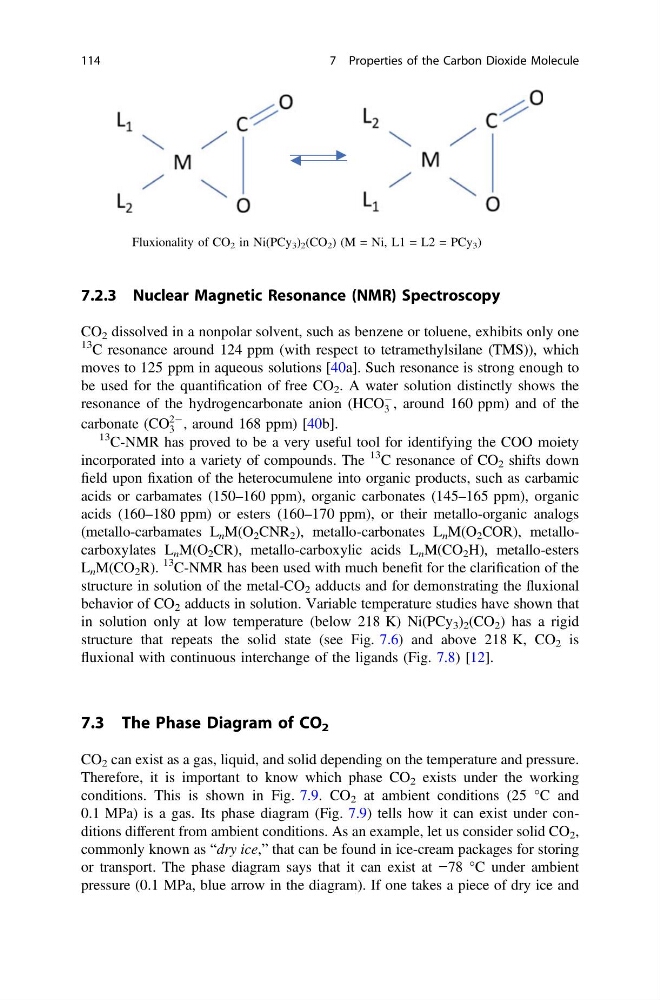
structure in solution of the metal-CO 2 adducts and for demonstrating the fluxional
behavior of CO 2 adducts in solution. Variable temperature studies have shown that
in solution only at low temperature (below 218 K) Ni(PCy 3 ) 2 (CO 2 ) has a rigid
structure that repeats the solid state (see Fig. 7.6) and above 218 K, CO 2 is
fluxional with continuous interchange of the ligands (Fig. 7.8) [12].
7.3 The Phase Diagram of CO 2
CO 2 can exist as a gas, liquid, and solid depending on the temperature and pressure.
Therefore, it is important to know which phase CO 2 exists under the working
conditions. This is shown in Fig. 7.9. CO 2 at ambient conditions (25 °C and
0.1 MPa) is a gas. Its phase diagram (Fig. 7.9) tells how it can exist under conditions different from ambient conditions. As an example, let us consider solid CO 2 ,
commonly known as “dry ice,” that can be found in ice-cream packages for storing
or transport. The phase diagram says that it can exist at −78 °C under ambient
pressure (0.1 MPa, blue arrow in the diagram). If one takes a piece of dry ice and
Fig. 7.8 Fluxionality of CO 2 in Ni(PCy 3 ) 2 (CO 2 ) (M = Ni, L1 = L2 = PCy 3 )
114
7 Properties of the Carbon Dioxide Molecule
CO 2 dissolved in a nonpolar solvent, such as benzene or toluene, exhibits only one
13 C resonance around 124 ppm (with respect to tetramethylsilane (TMS)), which
moves to 125 ppm in aqueous solutions [40a]. Such resonance is strong enough to
be used for the quantification of free CO 2 . A water solution distinctly shows the
resonance of the hydrogencarbonate anion (HCO
À
3 , around 160 ppm) and of the
carbonate (CO
2À
3 , around 168 ppm) [40b].
13 C-NMR has proved to be a very useful tool for identifying the COO moiety
incorporated into a variety of compounds. The
13 C resonance of CO 2 shifts down
field upon fixation of the heterocumulene into organic products, such as carbamic
acids or carbamates (150–160 ppm), organic carbonates (145–165 ppm), organic
acids (160–180 ppm) or esters (160–170 ppm), or their metallo-organic analogs
(metallo-carbamates L n M(O 2 CNR 2 ), metallo-carbonates L n M(O 2 COR), metallocarboxylates L n M(O 2 CR), metallo-carboxylic acids L n M(CO 2 H), metallo-esters
L n M(CO 2 R).
13 C-NMR has been used with much benefit for the clarification of the
structure in solution of the metal-CO 2 adducts and for demonstrating the fluxional
behavior of CO 2 adducts in solution. Variable temperature studies have shown that
in solution only at low temperature (below 218 K) Ni(PCy 3 ) 2 (CO 2 ) has a rigid
structure that repeats the solid state (see Fig. 7.6) and above 218 K, CO 2 is
fluxional with continuous interchange of the ligands (Fig. 7.8) [12].
7.3 The Phase Diagram of CO 2
CO 2 can exist as a gas, liquid, and solid depending on the temperature and pressure.
Therefore, it is important to know which phase CO 2 exists under the working
conditions. This is shown in Fig. 7.9. CO 2 at ambient conditions (25 °C and
0.1 MPa) is a gas. Its phase diagram (Fig. 7.9) tells how it can exist under conditions different from ambient conditions. As an example, let us consider solid CO 2 ,
commonly known as “dry ice,” that can be found in ice-cream packages for storing
or transport. The phase diagram says that it can exist at −78 °C under ambient
pressure (0.1 MPa, blue arrow in the diagram). If one takes a piece of dry ice and
Fig. 7.8 Fluxionality of CO 2 in Ni(PCy 3 ) 2 (CO 2 ) (M = Ni, L1 = L2 = PCy 3 )
114
7 Properties of the Carbon Dioxide Molecule