

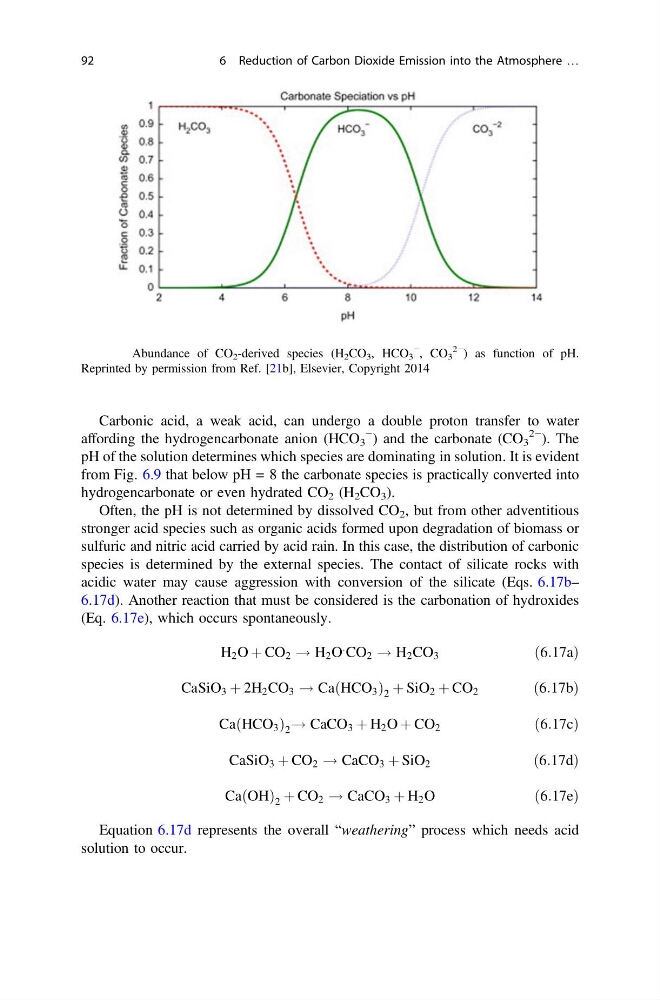
Carbonic acid, a weak acid, can undergo a double proton transfer to water
affording the hydrogencarbonate anion (HCO 3
− ) and the carbonate (CO 3
2− ). The
pH of the solution determines which species are dominating in solution. It is evident
from Fig. 6.9 that below pH = 8 the carbonate species is practically converted into
hydrogencarbonate or even hydrated CO 2 (H 2 CO 3 ).
Often, the pH is not determined by dissolved CO 2 , but from other adventitious
stronger acid species such as organic acids formed upon degradation of biomass or
sulfuric and nitric acid carried by acid rain. In this case, the distribution of carbonic
species is determined by the external species. The contact of silicate rocks with
acidic water may cause aggression with conversion of the silicate (Eqs. 6.17b–
6.17d). Another reaction that must be considered is the carbonation of hydroxides
(Eq. 6.17e), which occurs spontaneously.
H 2 O þ CO 2 ! H 2 O
: CO 2 ! H 2 CO 3
ð6:17aÞ
CaSiO 3 þ 2H 2 CO 3 ! Ca HCO 3
ð
Þ 2 þ SiO 2 þ CO 2
ð6:17bÞ
Ca HCO 3
ð
Þ 2 ! CaCO 3 þ H 2 O þ CO 2
ð6:17cÞ
CaSiO 3 þ CO 2 ! CaCO 3 þ SiO 2
ð6:17dÞ
Ca OH
ð Þ 2 þ CO 2 ! CaCO 3 þ H 2 O
ð6:17eÞ
Equation 6.17d represents the overall “weathering” process which needs acid
solution to occur.
Fig. 6.9 Abundance of CO 2 -derived species (H 2 CO 3 , HCO 3
−
, CO 3
2−
) as function of pH.
Reprinted by permission from Ref. [21b], Elsevier, Copyright 2014
92
6 Reduction of Carbon Dioxide Emission into the Atmosphere …
affording the hydrogencarbonate anion (HCO 3
− ) and the carbonate (CO 3
2− ). The
pH of the solution determines which species are dominating in solution. It is evident
from Fig. 6.9 that below pH = 8 the carbonate species is practically converted into
hydrogencarbonate or even hydrated CO 2 (H 2 CO 3 ).
Often, the pH is not determined by dissolved CO 2 , but from other adventitious
stronger acid species such as organic acids formed upon degradation of biomass or
sulfuric and nitric acid carried by acid rain. In this case, the distribution of carbonic
species is determined by the external species. The contact of silicate rocks with
acidic water may cause aggression with conversion of the silicate (Eqs. 6.17b–
6.17d). Another reaction that must be considered is the carbonation of hydroxides
(Eq. 6.17e), which occurs spontaneously.
H 2 O þ CO 2 ! H 2 O
: CO 2 ! H 2 CO 3
ð6:17aÞ
CaSiO 3 þ 2H 2 CO 3 ! Ca HCO 3
ð
Þ 2 þ SiO 2 þ CO 2
ð6:17bÞ
Ca HCO 3
ð
Þ 2 ! CaCO 3 þ H 2 O þ CO 2
ð6:17cÞ
CaSiO 3 þ CO 2 ! CaCO 3 þ SiO 2
ð6:17dÞ
Ca OH
ð Þ 2 þ CO 2 ! CaCO 3 þ H 2 O
ð6:17eÞ
Equation 6.17d represents the overall “weathering” process which needs acid
solution to occur.
Fig. 6.9 Abundance of CO 2 -derived species (H 2 CO 3 , HCO 3
−
, CO 3
2−
) as function of pH.
Reprinted by permission from Ref. [21b], Elsevier, Copyright 2014
92
6 Reduction of Carbon Dioxide Emission into the Atmosphere …