

DI6.2: Mineral Carbonation: Great Expectations and Bottlenecks. The
Potential Environmental Impact and Economic Cost
Mineral Carbonation (MC) is a scalable technology for long-term CO 2 sequestration, with the capacity to match the amount of CO 2 emitted from energy generation
and industrial activities. Minerals, incineration ash, concrete, and industrial slag are
sinks for anthropogenic CO 2 being a source of basic metal oxides, which can react
with CO 2 to form inorganic carbonates and bicarbonates, thermodynamically stable
and relatively inert at ambient conditions. If one looks at the abundance/availability
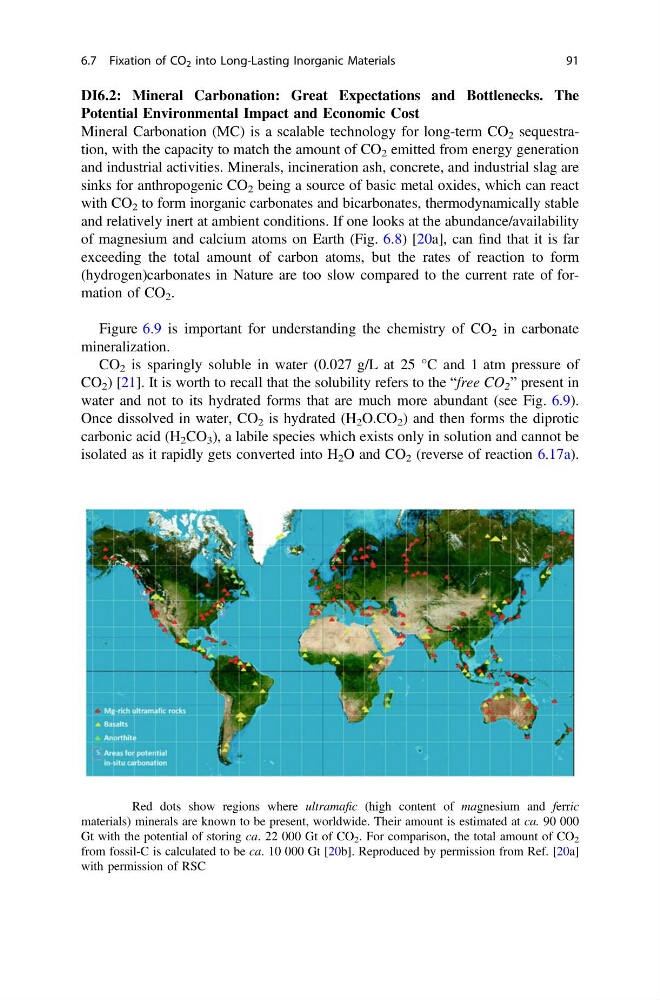
of magnesium and calcium atoms on Earth (Fig. 6.8) [20a], can find that it is far
exceeding the total amount of carbon atoms, but the rates of reaction to form
(hydrogen)carbonates in Nature are too slow compared to the current rate of formation of CO 2 .
Figure 6.9 is important for understanding the chemistry of CO 2 in carbonate
mineralization.
CO 2 is sparingly soluble in water (0.027 g/L at 25 °C and 1 atm pressure of
CO 2 ) [21]. It is worth to recall that the solubility refers to the “free CO 2 ” present in
water and not to its hydrated forms that are much more abundant (see Fig. 6.9).
Once dissolved in water, CO 2 is hydrated (H 2 O.CO 2 ) and then forms the diprotic
carbonic acid (H 2 CO 3 ), a labile species which exists only in solution and cannot be
isolated as it rapidly gets converted into H 2 O and CO 2 (reverse of reaction 6.17a).
Fig. 6.8 Red dots show regions where ultramafic (high content of magnesium and ferric
materials) minerals are known to be present, worldwide. Their amount is estimated at ca. 90 000
Gt with the potential of storing ca. 22 000 Gt of CO 2 . For comparison, the total amount of CO 2
from fossil-C is calculated to be ca. 10 000 Gt [20b]. Reproduced by permission from Ref. [20a]
with permission of RSC
6.7 Fixation of CO 2 into Long-Lasting Inorganic Materials
91
Potential Environmental Impact and Economic Cost
Mineral Carbonation (MC) is a scalable technology for long-term CO 2 sequestration, with the capacity to match the amount of CO 2 emitted from energy generation
and industrial activities. Minerals, incineration ash, concrete, and industrial slag are
sinks for anthropogenic CO 2 being a source of basic metal oxides, which can react
with CO 2 to form inorganic carbonates and bicarbonates, thermodynamically stable
and relatively inert at ambient conditions. If one looks at the abundance/availability
of magnesium and calcium atoms on Earth (Fig. 6.8) [20a], can find that it is far
exceeding the total amount of carbon atoms, but the rates of reaction to form
(hydrogen)carbonates in Nature are too slow compared to the current rate of formation of CO 2 .
Figure 6.9 is important for understanding the chemistry of CO 2 in carbonate
mineralization.
CO 2 is sparingly soluble in water (0.027 g/L at 25 °C and 1 atm pressure of
CO 2 ) [21]. It is worth to recall that the solubility refers to the “free CO 2 ” present in
water and not to its hydrated forms that are much more abundant (see Fig. 6.9).
Once dissolved in water, CO 2 is hydrated (H 2 O.CO 2 ) and then forms the diprotic
carbonic acid (H 2 CO 3 ), a labile species which exists only in solution and cannot be
isolated as it rapidly gets converted into H 2 O and CO 2 (reverse of reaction 6.17a).
Fig. 6.8 Red dots show regions where ultramafic (high content of magnesium and ferric
materials) minerals are known to be present, worldwide. Their amount is estimated at ca. 90 000
Gt with the potential of storing ca. 22 000 Gt of CO 2 . For comparison, the total amount of CO 2
from fossil-C is calculated to be ca. 10 000 Gt [20b]. Reproduced by permission from Ref. [20a]
with permission of RSC
6.7 Fixation of CO 2 into Long-Lasting Inorganic Materials
91