

274
22 Long-Term Public Health, Economic, and Societal Concerns
of more than 200 trained radiation safety professionals to perform dose assessments
on nearly 53,000 claimants over a period of nearly two decades [11].
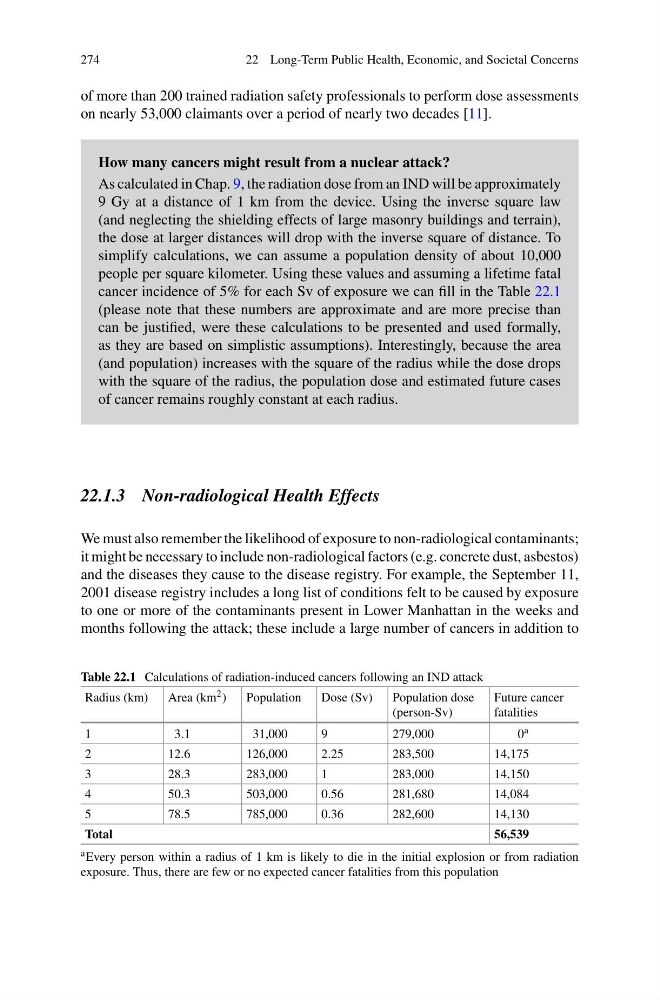
How many cancers might result from a nuclear attack?
As calculated in Chap. 9, the radiation dose from an IND will be approximately
9 Gy at a distance of 1 km from the device. Using the inverse square law
(and neglecting the shielding effects of large masonry buildings and terrain),
the dose at larger distances will drop with the inverse square of distance. To
simplify calculations, we can assume a population density of about 10,000
people per square kilometer. Using these values and assuming a lifetime fatal
cancer incidence of 5% for each Sv of exposure we can fill in the Table 22.1
(please note that these numbers are approximate and are more precise than
can be justified, were these calculations to be presented and used formally,
as they are based on simplistic assumptions). Interestingly, because the area
(and population) increases with the square of the radius while the dose drops
with the square of the radius, the population dose and estimated future cases
of cancer remains roughly constant at each radius.
22.1.3 Non-radiological Health Effects
We must also remember the likelihood of exposure to non-radiological contaminants;
it might be necessary to include non-radiological factors (e.g. concrete dust, asbestos)
and the diseases they cause to the disease registry. For example, the September 11,
2001 disease registry includes a long list of conditions felt to be caused by exposure
to one or more of the contaminants present in Lower Manhattan in the weeks and
months following the attack; these include a large number of cancers in addition to
Table 22.1 Calculations of radiation-induced cancers following an IND attack
Radius (km)
Area (km 2 )
Population
Dose (Sv)
Population dose
(person-Sv)
Future cancer
fatalities
1
3.1
31,000
9
279,000
0 a
2
12.6
126,000
2.25
283,500
14,175
3
28.3
283,000
1
283,000
14,150
4
50.3
503,000
0.56
281,680
14,084
5
78.5
785,000
0.36
282,600
14,130
Total
56,539
a Every person within a radius of 1 km is likely to die in the initial explosion or from radiation
exposure. Thus, there are few or no expected cancer fatalities from this population
22 Long-Term Public Health, Economic, and Societal Concerns
of more than 200 trained radiation safety professionals to perform dose assessments
on nearly 53,000 claimants over a period of nearly two decades [11].
How many cancers might result from a nuclear attack?
As calculated in Chap. 9, the radiation dose from an IND will be approximately
9 Gy at a distance of 1 km from the device. Using the inverse square law
(and neglecting the shielding effects of large masonry buildings and terrain),
the dose at larger distances will drop with the inverse square of distance. To
simplify calculations, we can assume a population density of about 10,000
people per square kilometer. Using these values and assuming a lifetime fatal
cancer incidence of 5% for each Sv of exposure we can fill in the Table 22.1
(please note that these numbers are approximate and are more precise than
can be justified, were these calculations to be presented and used formally,
as they are based on simplistic assumptions). Interestingly, because the area
(and population) increases with the square of the radius while the dose drops
with the square of the radius, the population dose and estimated future cases
of cancer remains roughly constant at each radius.
22.1.3 Non-radiological Health Effects
We must also remember the likelihood of exposure to non-radiological contaminants;
it might be necessary to include non-radiological factors (e.g. concrete dust, asbestos)
and the diseases they cause to the disease registry. For example, the September 11,
2001 disease registry includes a long list of conditions felt to be caused by exposure
to one or more of the contaminants present in Lower Manhattan in the weeks and
months following the attack; these include a large number of cancers in addition to
Table 22.1 Calculations of radiation-induced cancers following an IND attack
Radius (km)
Area (km 2 )
Population
Dose (Sv)
Population dose
(person-Sv)
Future cancer
fatalities
1
3.1
31,000
9
279,000
0 a
2
12.6
126,000
2.25
283,500
14,175
3
28.3
283,000
1
283,000
14,150
4
50.3
503,000
0.56
281,680
14,084
5
78.5
785,000
0.36
282,600
14,130
Total
56,539
a Every person within a radius of 1 km is likely to die in the initial explosion or from radiation
exposure. Thus, there are few or no expected cancer fatalities from this population