

17.6 Community Reception Centers
211
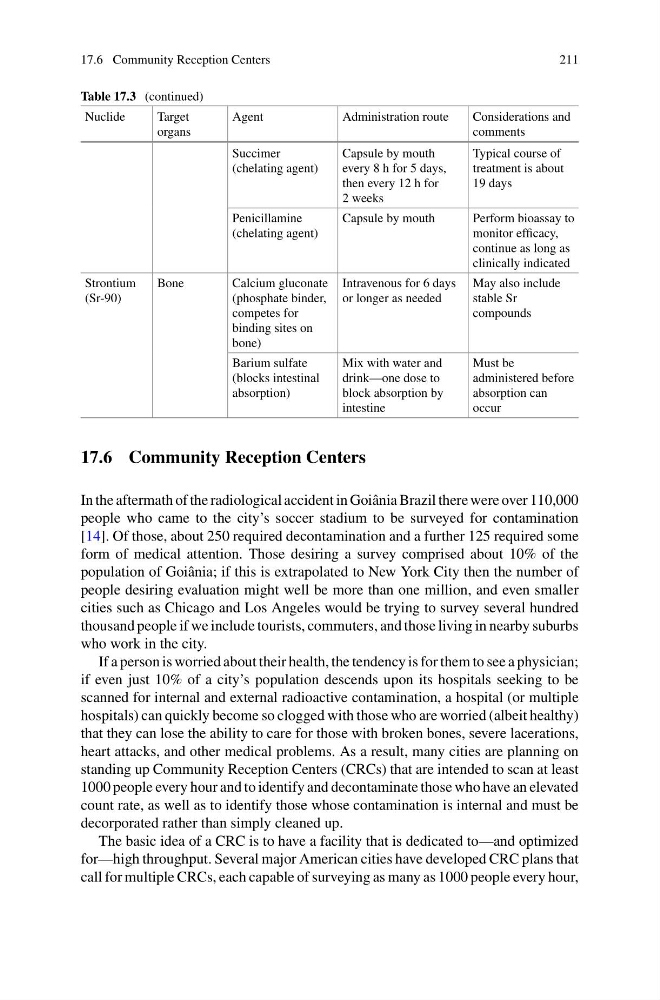
Table 17.3 (continued)
Nuclide
Target
organs
Agent
Administration route
Considerations and
comments
Succimer
(chelating agent)
Capsule by mouth
every 8 h for 5 days,
then every 12 h for
2 weeks
Typical course of
treatment is about
19 days
Penicillamine
(chelating agent)
Capsule by mouth
Perform bioassay to
monitor efficacy,
continue as long as
clinically indicated
Strontium
(Sr-90)
Bone
Calcium gluconate
(phosphate binder,
competes for
binding sites on
bone)
Intravenous for 6 days
or longer as needed
May also include
stable Sr
compounds
Barium sulfate
(blocks intestinal
absorption)
Mix with water and
drink—one dose to
block absorption by
intestine
Must be
administered before
absorption can
occur
17.6 Community Reception Centers
In the aftermath of the radiological accident in Goiânia Brazil there were over 110,000
people who came to the city’s soccer stadium to be surveyed for contamination
[14]. Of those, about 250 required decontamination and a further 125 required some
form of medical attention. Those desiring a survey comprised about 10% of the
population of Goiânia; if this is extrapolated to New York City then the number of
people desiring evaluation might well be more than one million, and even smaller
cities such as Chicago and Los Angeles would be trying to survey several hundred
thousand people if we include tourists, commuters, and those living in nearby suburbs
who work in the city.
If a person is worried about their health, the tendency is for them to see a physician;
if even just 10% of a city’s population descends upon its hospitals seeking to be
scanned for internal and external radioactive contamination, a hospital (or multiple
hospitals) can quickly become so clogged with those who are worried (albeit healthy)
that they can lose the ability to care for those with broken bones, severe lacerations,
heart attacks, and other medical problems. As a result, many cities are planning on
standing up Community Reception Centers (CRCs) that are intended to scan at least
1000 people every hour and to identify and decontaminate those who have an elevated
count rate, as well as to identify those whose contamination is internal and must be
decorporated rather than simply cleaned up.
The basic idea of a CRC is to have a facility that is dedicated to—and optimized
for—high throughput. Several major American cities have developed CRC plans that
call for multiple CRCs, each capable of surveying as many as 1000 people every hour,
211
Table 17.3 (continued)
Nuclide
Target
organs
Agent
Administration route
Considerations and
comments
Succimer
(chelating agent)
Capsule by mouth
every 8 h for 5 days,
then every 12 h for
2 weeks
Typical course of
treatment is about
19 days
Penicillamine
(chelating agent)
Capsule by mouth
Perform bioassay to
monitor efficacy,
continue as long as
clinically indicated
Strontium
(Sr-90)
Bone
Calcium gluconate
(phosphate binder,
competes for
binding sites on
bone)
Intravenous for 6 days
or longer as needed
May also include
stable Sr
compounds
Barium sulfate
(blocks intestinal
absorption)
Mix with water and
drink—one dose to
block absorption by
intestine
Must be
administered before
absorption can
occur
17.6 Community Reception Centers
In the aftermath of the radiological accident in Goiânia Brazil there were over 110,000
people who came to the city’s soccer stadium to be surveyed for contamination
[14]. Of those, about 250 required decontamination and a further 125 required some
form of medical attention. Those desiring a survey comprised about 10% of the
population of Goiânia; if this is extrapolated to New York City then the number of
people desiring evaluation might well be more than one million, and even smaller
cities such as Chicago and Los Angeles would be trying to survey several hundred
thousand people if we include tourists, commuters, and those living in nearby suburbs
who work in the city.
If a person is worried about their health, the tendency is for them to see a physician;
if even just 10% of a city’s population descends upon its hospitals seeking to be
scanned for internal and external radioactive contamination, a hospital (or multiple
hospitals) can quickly become so clogged with those who are worried (albeit healthy)
that they can lose the ability to care for those with broken bones, severe lacerations,
heart attacks, and other medical problems. As a result, many cities are planning on
standing up Community Reception Centers (CRCs) that are intended to scan at least
1000 people every hour and to identify and decontaminate those who have an elevated
count rate, as well as to identify those whose contamination is internal and must be
decorporated rather than simply cleaned up.
The basic idea of a CRC is to have a facility that is dedicated to—and optimized
for—high throughput. Several major American cities have developed CRC plans that
call for multiple CRCs, each capable of surveying as many as 1000 people every hour,