

210
17 Medical Response
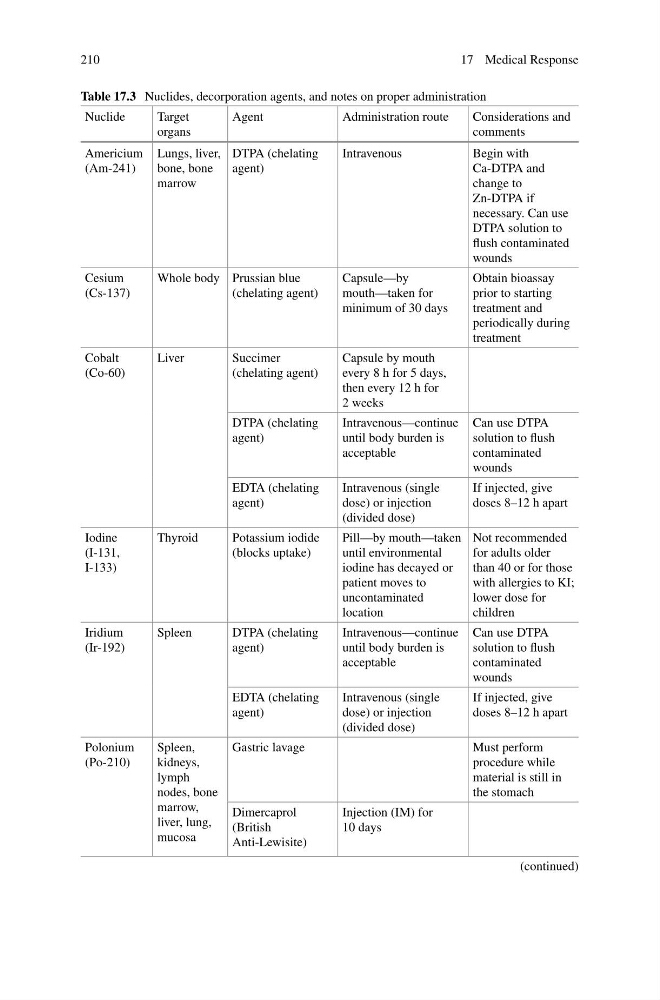
Table 17.3 Nuclides, decorporation agents, and notes on proper administration
Nuclide
Target
organs
Agent
Administration route
Considerations and
comments
Americium
(Am-241)
Lungs, liver,
bone, bone
marrow
DTPA (chelating
agent)
Intravenous
Begin with
Ca-DTPA and
change to
Zn-DTPA if
necessary. Can use
DTPA solution to
flush contaminated
wounds
Cesium
(Cs-137)
Whole body Prussian blue
(chelating agent)
Capsule—by
mouth—taken for
minimum of 30 days
Obtain bioassay
prior to starting
treatment and
periodically during
treatment
Cobalt
(Co-60)
Liver
Succimer
(chelating agent)
Capsule by mouth
every 8 h for 5 days,
then every 12 h for
2 weeks
DTPA (chelating
agent)
Intravenous—continue
until body burden is
acceptable
Can use DTPA
solution to flush
contaminated
wounds
EDTA (chelating
agent)
Intravenous (single
dose) or injection
(divided dose)
If injected, give
doses 8–12 h apart
Iodine
(I-131,
I-133)
Thyroid
Potassium iodide
(blocks uptake)
Pill—by mouth—taken
until environmental
iodine has decayed or
patient moves to
uncontaminated
location
Not recommended
for adults older
than 40 or for those
with allergies to KI;
lower dose for
children
Iridium
(Ir-192)
Spleen
DTPA (chelating
agent)
Intravenous—continue
until body burden is
acceptable
Can use DTPA
solution to flush
contaminated
wounds
EDTA (chelating
agent)
Intravenous (single
dose) or injection
(divided dose)
If injected, give
doses 8–12 h apart
Polonium
(Po-210)
Spleen,
kidneys,
lymph
nodes, bone
marrow,
liver, lung,
mucosa
Gastric lavage
Must perform
procedure while
material is still in
the stomach
Dimercaprol
(British
Anti-Lewisite)
Injection (IM) for
10 days
(continued)
17 Medical Response
Table 17.3 Nuclides, decorporation agents, and notes on proper administration
Nuclide
Target
organs
Agent
Administration route
Considerations and
comments
Americium
(Am-241)
Lungs, liver,
bone, bone
marrow
DTPA (chelating
agent)
Intravenous
Begin with
Ca-DTPA and
change to
Zn-DTPA if
necessary. Can use
DTPA solution to
flush contaminated
wounds
Cesium
(Cs-137)
Whole body Prussian blue
(chelating agent)
Capsule—by
mouth—taken for
minimum of 30 days
Obtain bioassay
prior to starting
treatment and
periodically during
treatment
Cobalt
(Co-60)
Liver
Succimer
(chelating agent)
Capsule by mouth
every 8 h for 5 days,
then every 12 h for
2 weeks
DTPA (chelating
agent)
Intravenous—continue
until body burden is
acceptable
Can use DTPA
solution to flush
contaminated
wounds
EDTA (chelating
agent)
Intravenous (single
dose) or injection
(divided dose)
If injected, give
doses 8–12 h apart
Iodine
(I-131,
I-133)
Thyroid
Potassium iodide
(blocks uptake)
Pill—by mouth—taken
until environmental
iodine has decayed or
patient moves to
uncontaminated
location
Not recommended
for adults older
than 40 or for those
with allergies to KI;
lower dose for
children
Iridium
(Ir-192)
Spleen
DTPA (chelating
agent)
Intravenous—continue
until body burden is
acceptable
Can use DTPA
solution to flush
contaminated
wounds
EDTA (chelating
agent)
Intravenous (single
dose) or injection
(divided dose)
If injected, give
doses 8–12 h apart
Polonium
(Po-210)
Spleen,
kidneys,
lymph
nodes, bone
marrow,
liver, lung,
mucosa
Gastric lavage
Must perform
procedure while
material is still in
the stomach
Dimercaprol
(British
Anti-Lewisite)
Injection (IM) for
10 days
(continued)