

154
14 Difficulties of Radiological and Nuclear Interdiction
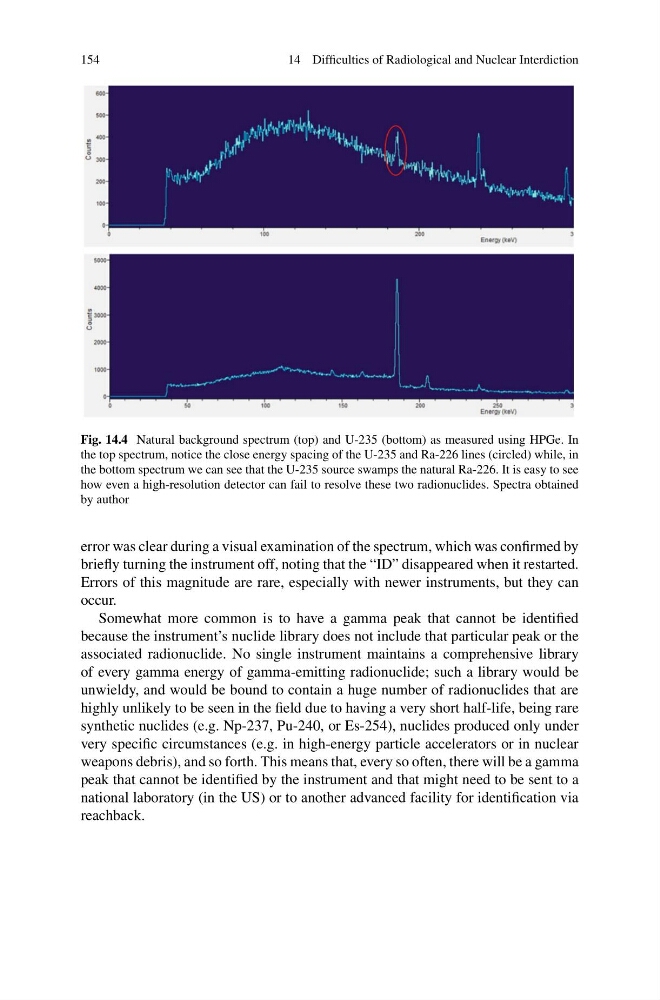
Fig. 14.4 Natural background spectrum (top) and U-235 (bottom) as measured using HPGe. In
the top spectrum, notice the close energy spacing of the U-235 and Ra-226 lines (circled) while, in
the bottom spectrum we can see that the U-235 source swamps the natural Ra-226. It is easy to see
how even a high-resolution detector can fail to resolve these two radionuclides. Spectra obtained
by author
error was clear during a visual examination of the spectrum, which was confirmed by
briefly turning the instrument off, noting that the “ID” disappeared when it restarted.
Errors of this magnitude are rare, especially with newer instruments, but they can
occur.
Somewhat more common is to have a gamma peak that cannot be identified
because the instrument’s nuclide library does not include that particular peak or the
associated radionuclide. No single instrument maintains a comprehensive library
of every gamma energy of gamma-emitting radionuclide; such a library would be
unwieldy, and would be bound to contain a huge number of radionuclides that are
highly unlikely to be seen in the field due to having a very short half-life, being rare
synthetic nuclides (e.g. Np-237, Pu-240, or Es-254), nuclides produced only under
very specific circumstances (e.g. in high-energy particle accelerators or in nuclear
weapons debris), and so forth. This means that, every so often, there will be a gamma
peak that cannot be identified by the instrument and that might need to be sent to a
national laboratory (in the US) or to another advanced facility for identification via
reachback.
14 Difficulties of Radiological and Nuclear Interdiction
Fig. 14.4 Natural background spectrum (top) and U-235 (bottom) as measured using HPGe. In
the top spectrum, notice the close energy spacing of the U-235 and Ra-226 lines (circled) while, in
the bottom spectrum we can see that the U-235 source swamps the natural Ra-226. It is easy to see
how even a high-resolution detector can fail to resolve these two radionuclides. Spectra obtained
by author
error was clear during a visual examination of the spectrum, which was confirmed by
briefly turning the instrument off, noting that the “ID” disappeared when it restarted.
Errors of this magnitude are rare, especially with newer instruments, but they can
occur.
Somewhat more common is to have a gamma peak that cannot be identified
because the instrument’s nuclide library does not include that particular peak or the
associated radionuclide. No single instrument maintains a comprehensive library
of every gamma energy of gamma-emitting radionuclide; such a library would be
unwieldy, and would be bound to contain a huge number of radionuclides that are
highly unlikely to be seen in the field due to having a very short half-life, being rare
synthetic nuclides (e.g. Np-237, Pu-240, or Es-254), nuclides produced only under
very specific circumstances (e.g. in high-energy particle accelerators or in nuclear
weapons debris), and so forth. This means that, every so often, there will be a gamma
peak that cannot be identified by the instrument and that might need to be sent to a
national laboratory (in the US) or to another advanced facility for identification via
reachback.