

14.1 Challenges to Radiological Interdiction
153
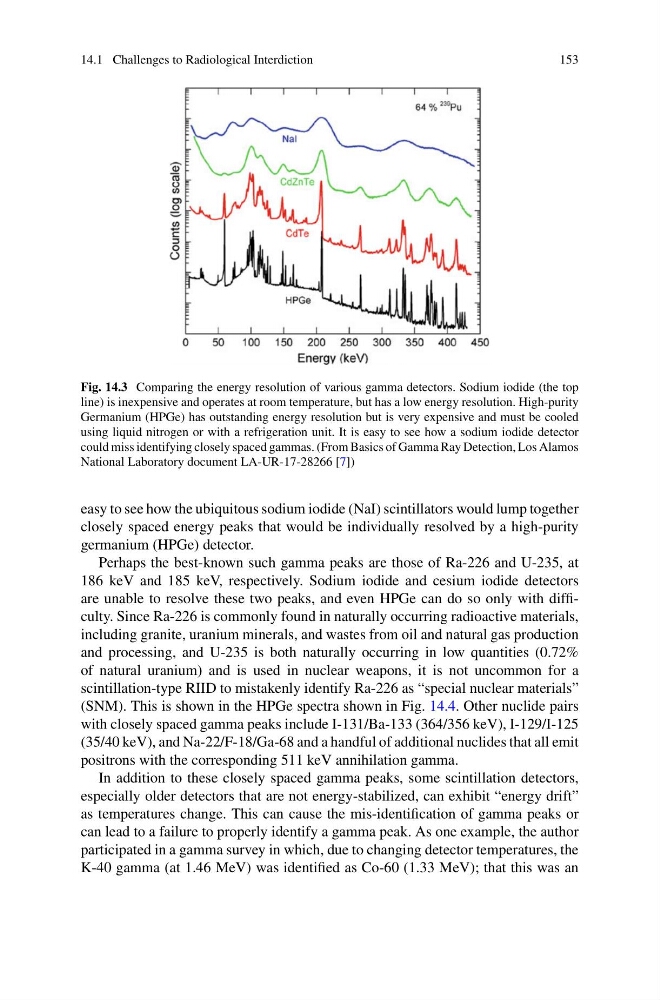
Fig. 14.3 Comparing the energy resolution of various gamma detectors. Sodium iodide (the top
line) is inexpensive and operates at room temperature, but has a low energy resolution. High-purity
Germanium (HPGe) has outstanding energy resolution but is very expensive and must be cooled
using liquid nitrogen or with a refrigeration unit. It is easy to see how a sodium iodide detector
could miss identifying closely spaced gammas. (From Basics of Gamma Ray Detection, Los Alamos
National Laboratory document LA-UR-17-28266 [7])
easy to see how the ubiquitous sodium iodide (NaI) scintillators would lump together
closely spaced energy peaks that would be individually resolved by a high-purity
germanium (HPGe) detector.
Perhaps the best-known such gamma peaks are those of Ra-226 and U-235, at
186 keV and 185 keV, respectively. Sodium iodide and cesium iodide detectors
are unable to resolve these two peaks, and even HPGe can do so only with difficulty. Since Ra-226 is commonly found in naturally occurring radioactive materials,
including granite, uranium minerals, and wastes from oil and natural gas production
and processing, and U-235 is both naturally occurring in low quantities (0.72%
of natural uranium) and is used in nuclear weapons, it is not uncommon for a
scintillation-type RIID to mistakenly identify Ra-226 as “special nuclear materials”
(SNM). This is shown in the HPGe spectra shown in Fig. 14.4. Other nuclide pairs
with closely spaced gamma peaks include I-131/Ba-133 (364/356 keV), I-129/I-125
(35/40 keV), and Na-22/F-18/Ga-68 and a handful of additional nuclides that all emit
positrons with the corresponding 511 keV annihilation gamma.
In addition to these closely spaced gamma peaks, some scintillation detectors,
especially older detectors that are not energy-stabilized, can exhibit “energy drift”
as temperatures change. This can cause the mis-identification of gamma peaks or
can lead to a failure to properly identify a gamma peak. As one example, the author
participated in a gamma survey in which, due to changing detector temperatures, the
K-40 gamma (at 1.46 MeV) was identified as Co-60 (1.33 MeV); that this was an
153
Fig. 14.3 Comparing the energy resolution of various gamma detectors. Sodium iodide (the top
line) is inexpensive and operates at room temperature, but has a low energy resolution. High-purity
Germanium (HPGe) has outstanding energy resolution but is very expensive and must be cooled
using liquid nitrogen or with a refrigeration unit. It is easy to see how a sodium iodide detector
could miss identifying closely spaced gammas. (From Basics of Gamma Ray Detection, Los Alamos
National Laboratory document LA-UR-17-28266 [7])
easy to see how the ubiquitous sodium iodide (NaI) scintillators would lump together
closely spaced energy peaks that would be individually resolved by a high-purity
germanium (HPGe) detector.
Perhaps the best-known such gamma peaks are those of Ra-226 and U-235, at
186 keV and 185 keV, respectively. Sodium iodide and cesium iodide detectors
are unable to resolve these two peaks, and even HPGe can do so only with difficulty. Since Ra-226 is commonly found in naturally occurring radioactive materials,
including granite, uranium minerals, and wastes from oil and natural gas production
and processing, and U-235 is both naturally occurring in low quantities (0.72%
of natural uranium) and is used in nuclear weapons, it is not uncommon for a
scintillation-type RIID to mistakenly identify Ra-226 as “special nuclear materials”
(SNM). This is shown in the HPGe spectra shown in Fig. 14.4. Other nuclide pairs
with closely spaced gamma peaks include I-131/Ba-133 (364/356 keV), I-129/I-125
(35/40 keV), and Na-22/F-18/Ga-68 and a handful of additional nuclides that all emit
positrons with the corresponding 511 keV annihilation gamma.
In addition to these closely spaced gamma peaks, some scintillation detectors,
especially older detectors that are not energy-stabilized, can exhibit “energy drift”
as temperatures change. This can cause the mis-identification of gamma peaks or
can lead to a failure to properly identify a gamma peak. As one example, the author
participated in a gamma survey in which, due to changing detector temperatures, the
K-40 gamma (at 1.46 MeV) was identified as Co-60 (1.33 MeV); that this was an