

134
13 Developing a Radiological and Nuclear Interdiction Network
had been divided into multiple smaller sources that were being sent to attack
a variety of targets. As they “caught” the vehicles transporting these sources
the question that quickly arose was “Have we accounted for all of the stolen
radioactivity or is there more out there?”
The first “hit” called in was from a helicopter, and the instrument operator
reporting a dose rate of 0.27 mGy hr
−1 while hovering directly above the
vehicle with the source at an altitude of 50 m.
Using the inverse-square law we can easily determine that the dose rate at a
distance of 1 m will be 50 × 50 = 2500 times as high as the dose rate measured
by the helicopter; 0.27 × 2500 = 675 mGy hr
−1 .
The gamma constant for Co-60 is 8.53 × 10
−17 Gy s
−1 Bq
−1 at a distance
of 1 m. Dividing the calculated dose rate at 1 m by the gamma constant and
doing appropriate unit conversions (e.g. 3600 s in one hour, 1000 mGy in one
Gy, and 10
12 Bq per TBq) shows us that the detected source has an activity of
2.2 TBq, assuming the source is unshielded. Thus, while this is a substantial
source, it represents only a fraction of the missing radioactivity.
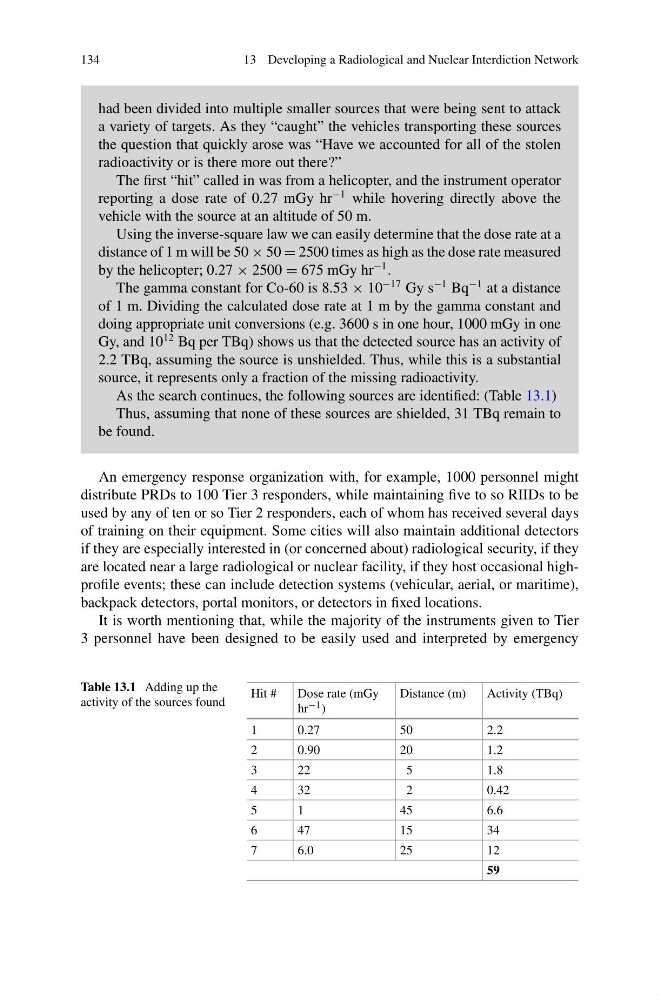
As the search continues, the following sources are identified: (Table 13.1)
Thus, assuming that none of these sources are shielded, 31 TBq remain to
be found.
An emergency response organization with, for example, 1000 personnel might
distribute PRDs to 100 Tier 3 responders, while maintaining five to so RIIDs to be
used by any of ten or so Tier 2 responders, each of whom has received several days
of training on their equipment. Some cities will also maintain additional detectors
if they are especially interested in (or concerned about) radiological security, if they
are located near a large radiological or nuclear facility, if they host occasional highprofile events; these can include detection systems (vehicular, aerial, or maritime),
backpack detectors, portal monitors, or detectors in fixed locations.
It is worth mentioning that, while the majority of the instruments given to Tier
3 personnel have been designed to be easily used and interpreted by emergency
Table 13.1 Adding up the
activity of the sources found
Hit #
Dose rate (mGy
hr −1 )
Distance (m)
Activity (TBq)
1
0.27
50
2.2
2
0.90
20
1.2
3
22
5
1.8
4
32
2
0.42
5
1
45
6.6
6
47
15
34
7
6.0
25
12
59
13 Developing a Radiological and Nuclear Interdiction Network
had been divided into multiple smaller sources that were being sent to attack
a variety of targets. As they “caught” the vehicles transporting these sources
the question that quickly arose was “Have we accounted for all of the stolen
radioactivity or is there more out there?”
The first “hit” called in was from a helicopter, and the instrument operator
reporting a dose rate of 0.27 mGy hr
−1 while hovering directly above the
vehicle with the source at an altitude of 50 m.
Using the inverse-square law we can easily determine that the dose rate at a
distance of 1 m will be 50 × 50 = 2500 times as high as the dose rate measured
by the helicopter; 0.27 × 2500 = 675 mGy hr
−1 .
The gamma constant for Co-60 is 8.53 × 10
−17 Gy s
−1 Bq
−1 at a distance
of 1 m. Dividing the calculated dose rate at 1 m by the gamma constant and
doing appropriate unit conversions (e.g. 3600 s in one hour, 1000 mGy in one
Gy, and 10
12 Bq per TBq) shows us that the detected source has an activity of
2.2 TBq, assuming the source is unshielded. Thus, while this is a substantial
source, it represents only a fraction of the missing radioactivity.
As the search continues, the following sources are identified: (Table 13.1)
Thus, assuming that none of these sources are shielded, 31 TBq remain to
be found.
An emergency response organization with, for example, 1000 personnel might
distribute PRDs to 100 Tier 3 responders, while maintaining five to so RIIDs to be
used by any of ten or so Tier 2 responders, each of whom has received several days
of training on their equipment. Some cities will also maintain additional detectors
if they are especially interested in (or concerned about) radiological security, if they
are located near a large radiological or nuclear facility, if they host occasional highprofile events; these can include detection systems (vehicular, aerial, or maritime),
backpack detectors, portal monitors, or detectors in fixed locations.
It is worth mentioning that, while the majority of the instruments given to Tier
3 personnel have been designed to be easily used and interpreted by emergency
Table 13.1 Adding up the
activity of the sources found
Hit #
Dose rate (mGy
hr −1 )
Distance (m)
Activity (TBq)
1
0.27
50
2.2
2
0.90
20
1.2
3
22
5
1.8
4
32
2
0.42
5
1
45
6.6
6
47
15
34
7
6.0
25
12
59