

13.2 Devices Originating Inside Versus Outside of the City
131
in advance how various incidents will be addressed. In addition, local law enforcement agencies can conduct exercises with facility security personnel to practice
working together, and can carefully select locations best suited for fixed monitors,
mobile systems, observation posts (if appropriate), and other monitoring and security
capabilities.
In the case of Singapore (as well as many other major cities) there are only a
limited number of access points; any high-activity source coming into the city will
have to come across one of two bridges or by boat, and the size and weight of the
shielding will limit the number of places along the shore to those close to highways.
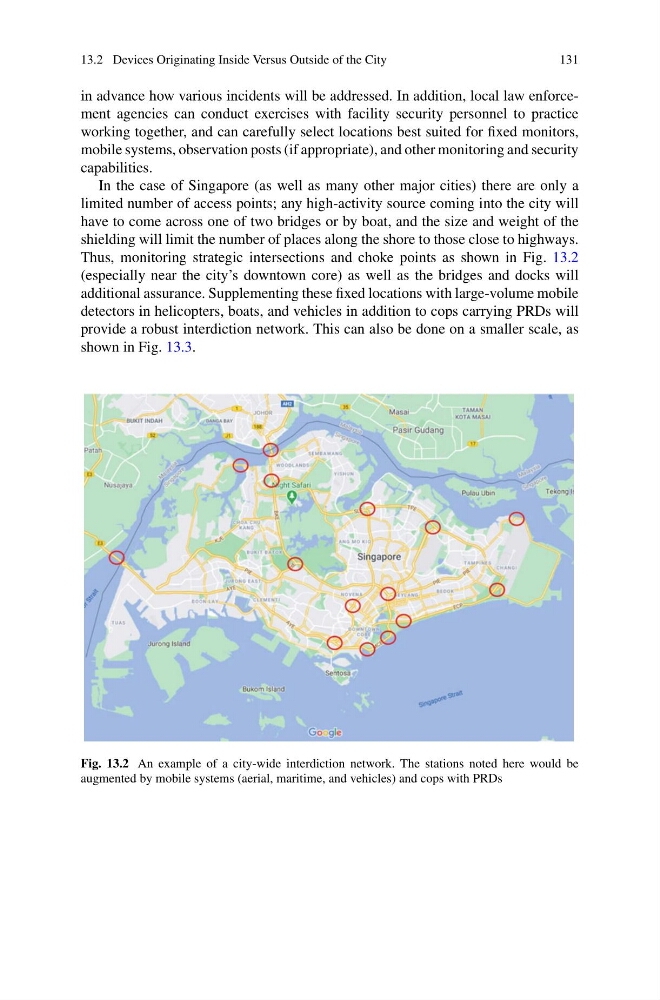
Thus, monitoring strategic intersections and choke points as shown in Fig. 13.2
(especially near the city’s downtown core) as well as the bridges and docks will
additional assurance. Supplementing these fixed locations with large-volume mobile
detectors in helicopters, boats, and vehicles in addition to cops carrying PRDs will
provide a robust interdiction network. This can also be done on a smaller scale, as
shown in Fig. 13.3.
Fig. 13.2 An example of a city-wide interdiction network. The stations noted here would be
augmented by mobile systems (aerial, maritime, and vehicles) and cops with PRDs
131
in advance how various incidents will be addressed. In addition, local law enforcement agencies can conduct exercises with facility security personnel to practice
working together, and can carefully select locations best suited for fixed monitors,
mobile systems, observation posts (if appropriate), and other monitoring and security
capabilities.
In the case of Singapore (as well as many other major cities) there are only a
limited number of access points; any high-activity source coming into the city will
have to come across one of two bridges or by boat, and the size and weight of the
shielding will limit the number of places along the shore to those close to highways.
Thus, monitoring strategic intersections and choke points as shown in Fig. 13.2
(especially near the city’s downtown core) as well as the bridges and docks will
additional assurance. Supplementing these fixed locations with large-volume mobile
detectors in helicopters, boats, and vehicles in addition to cops carrying PRDs will
provide a robust interdiction network. This can also be done on a smaller scale, as
shown in Fig. 13.3.
Fig. 13.2 An example of a city-wide interdiction network. The stations noted here would be
augmented by mobile systems (aerial, maritime, and vehicles) and cops with PRDs