

13.2 Devices Originating Inside Versus Outside of the City
127
13.2 Devices Originating Inside Versus Outside of the City
In 2010 this author joined a class of counterterrorism police from New York City
in attending a training course on radiological terrorism in Oak Ridge Tennessee;
the course was developed for police and security officers and it concentrated on
responding to attempts to steal high-activity radioactive sources from various settings.
At what distance can a source be detected?
When developing an interdiction network one consideration is how close
together one must place instruments in order to detect a radioactive source of a
given activity—the “mesh size” needed for one’s interdiction “net.” Answering
this question is one of the key factors in determining how many detectors will
be needed to secure a given event (or a given city) and how much the system
will cost to install and maintain. For the purposes of this example, we will
assume that background radiation levels are about 0.1 µGy hr
−1 and that a
“detection” occurs when an instrument detects a sustained dose rate of at least
two times this level (0.2 µGy hr
−1 ).
Let’s assume that our goal is to detect a 500 GBq Ir-192 industrial radiography source. The gamma constant for Ir-192 is 0.0015 mGy hr
−1 MBq
−1 at a
distance of 30 cm, so a 500 GBq source would produce a dose rate of 750 mGy
hr
−1 at a distance of 30 cm.
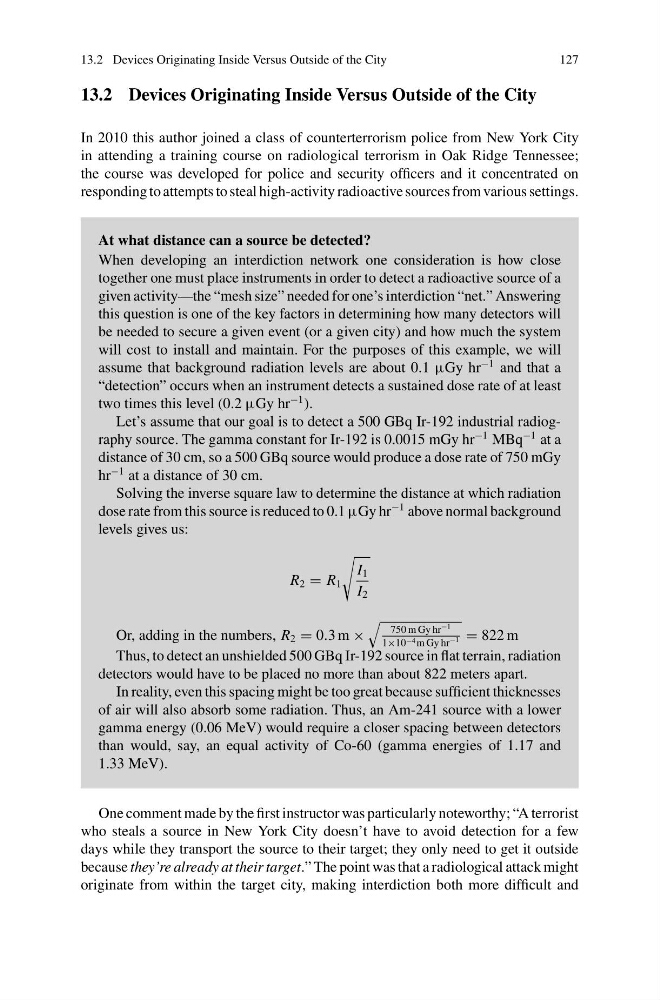
Solving the inverse square law to determine the distance at which radiation
dose rate from this source is reduced to 0.1 µGy hr
−1 above normal background
levels gives us:
R 2 = R 1
I 1
I 2
Or, adding in the numbers, R 2 = 0.3 m ×
750 m Gy hr
−1
1×10 −4 m Gy hr
−1 = 822 m
Thus, to detect an unshielded 500 GBq Ir-192 source in flat terrain, radiation
detectors would have to be placed no more than about 822 meters apart.
In reality, even this spacing might be too great because sufficient thicknesses
of air will also absorb some radiation. Thus, an Am-241 source with a lower
gamma energy (0.06 MeV) would require a closer spacing between detectors
than would, say, an equal activity of Co-60 (gamma energies of 1.17 and
1.33 MeV).
One comment made by the first instructor was particularly noteworthy; “A terrorist
who steals a source in New York City doesn’t have to avoid detection for a few
days while they transport the source to their target; they only need to get it outside
because they’re already at their target.” The point was that a radiological attack might
originate from within the target city, making interdiction both more difficult and
127
13.2 Devices Originating Inside Versus Outside of the City
In 2010 this author joined a class of counterterrorism police from New York City
in attending a training course on radiological terrorism in Oak Ridge Tennessee;
the course was developed for police and security officers and it concentrated on
responding to attempts to steal high-activity radioactive sources from various settings.
At what distance can a source be detected?
When developing an interdiction network one consideration is how close
together one must place instruments in order to detect a radioactive source of a
given activity—the “mesh size” needed for one’s interdiction “net.” Answering
this question is one of the key factors in determining how many detectors will
be needed to secure a given event (or a given city) and how much the system
will cost to install and maintain. For the purposes of this example, we will
assume that background radiation levels are about 0.1 µGy hr
−1 and that a
“detection” occurs when an instrument detects a sustained dose rate of at least
two times this level (0.2 µGy hr
−1 ).
Let’s assume that our goal is to detect a 500 GBq Ir-192 industrial radiography source. The gamma constant for Ir-192 is 0.0015 mGy hr
−1 MBq
−1 at a
distance of 30 cm, so a 500 GBq source would produce a dose rate of 750 mGy
hr
−1 at a distance of 30 cm.
Solving the inverse square law to determine the distance at which radiation
dose rate from this source is reduced to 0.1 µGy hr
−1 above normal background
levels gives us:
R 2 = R 1
I 1
I 2
Or, adding in the numbers, R 2 = 0.3 m ×
750 m Gy hr
−1
1×10 −4 m Gy hr
−1 = 822 m
Thus, to detect an unshielded 500 GBq Ir-192 source in flat terrain, radiation
detectors would have to be placed no more than about 822 meters apart.
In reality, even this spacing might be too great because sufficient thicknesses
of air will also absorb some radiation. Thus, an Am-241 source with a lower
gamma energy (0.06 MeV) would require a closer spacing between detectors
than would, say, an equal activity of Co-60 (gamma energies of 1.17 and
1.33 MeV).
One comment made by the first instructor was particularly noteworthy; “A terrorist
who steals a source in New York City doesn’t have to avoid detection for a few
days while they transport the source to their target; they only need to get it outside
because they’re already at their target.” The point was that a radiological attack might
originate from within the target city, making interdiction both more difficult and