

10.1 Characteristics of a Nuclear Explosion
95
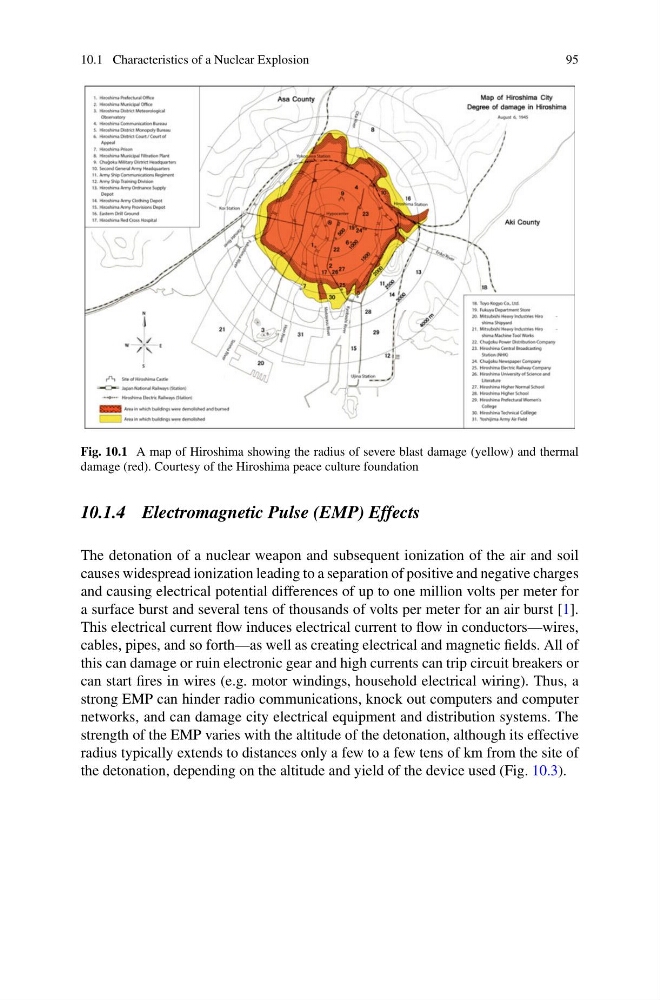
Fig. 10.1 A map of Hiroshima showing the radius of severe blast damage (yellow) and thermal
damage (red). Courtesy of the Hiroshima peace culture foundation
10.1.4 Electromagnetic Pulse (EMP) Effects
The detonation of a nuclear weapon and subsequent ionization of the air and soil
causes widespread ionization leading to a separation of positive and negative charges
and causing electrical potential differences of up to one million volts per meter for
a surface burst and several tens of thousands of volts per meter for an air burst [1].
This electrical current flow induces electrical current to flow in conductors—wires,
cables, pipes, and so forth—as well as creating electrical and magnetic fields. All of
this can damage or ruin electronic gear and high currents can trip circuit breakers or
can start fires in wires (e.g. motor windings, household electrical wiring). Thus, a
strong EMP can hinder radio communications, knock out computers and computer
networks, and can damage city electrical equipment and distribution systems. The
strength of the EMP varies with the altitude of the detonation, although its effective
radius typically extends to distances only a few to a few tens of km from the site of
the detonation, depending on the altitude and yield of the device used (Fig. 10.3).
95
Fig. 10.1 A map of Hiroshima showing the radius of severe blast damage (yellow) and thermal
damage (red). Courtesy of the Hiroshima peace culture foundation
10.1.4 Electromagnetic Pulse (EMP) Effects
The detonation of a nuclear weapon and subsequent ionization of the air and soil
causes widespread ionization leading to a separation of positive and negative charges
and causing electrical potential differences of up to one million volts per meter for
a surface burst and several tens of thousands of volts per meter for an air burst [1].
This electrical current flow induces electrical current to flow in conductors—wires,
cables, pipes, and so forth—as well as creating electrical and magnetic fields. All of
this can damage or ruin electronic gear and high currents can trip circuit breakers or
can start fires in wires (e.g. motor windings, household electrical wiring). Thus, a
strong EMP can hinder radio communications, knock out computers and computer
networks, and can damage city electrical equipment and distribution systems. The
strength of the EMP varies with the altitude of the detonation, although its effective
radius typically extends to distances only a few to a few tens of km from the site of
the detonation, depending on the altitude and yield of the device used (Fig. 10.3).