

2.8 Smooth Min- and Max-Entropy
27
H
ε
min (A|B) ρ ≤ H
ε
min (A|B
) (1 A ⊗E B )ρ
(2.65)
H
ε
max (A|B) ρ ≤ H
ε
max (A|B
) (1 A ⊗E B )ρ .
(2.66)
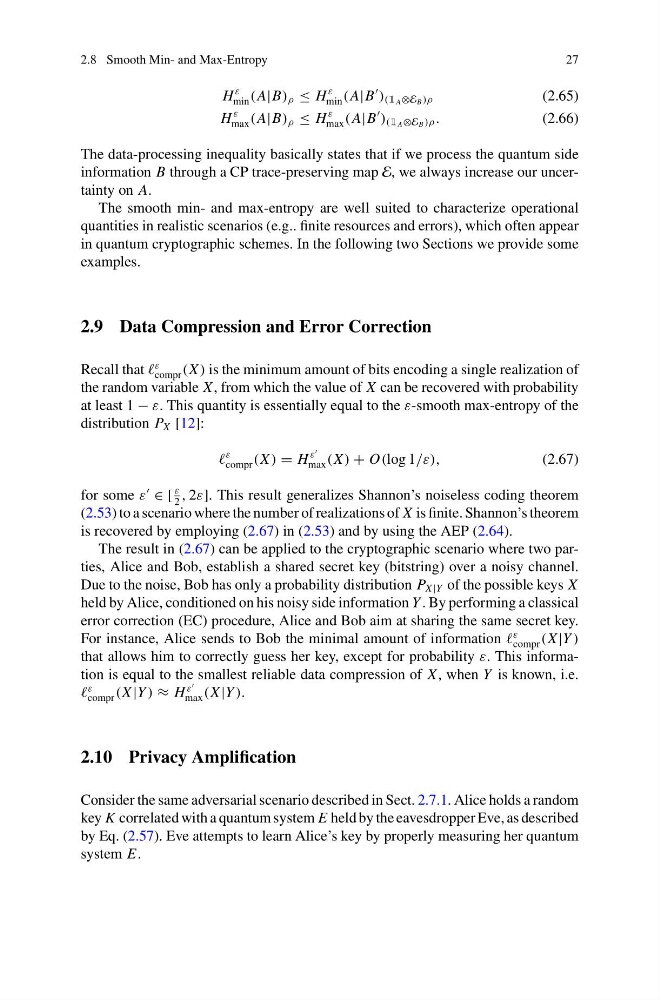
The data-processing inequality basically states that if we process the quantum side
information B through a CP trace-preserving map E, we always increase our uncertainty on A.
The smooth min- and max-entropy are well suited to characterize operational
quantities in realistic scenarios (e.g.. finite resources and errors), which often appear
in quantum cryptographic schemes. In the following two Sections we provide some
examples.
2.9 Data Compression and Error Correction
Recall that
ε
compr (X ) is the minimum amount of bits encoding a single realization of
the random variable X , from which the value of X can be recovered with probability
at least 1 − ε. This quantity is essentially equal to the ε-smooth max-entropy of the
distribution P X [12]:
ε
compr (X ) = H
ε
max (X ) + O(log 1/ε),
(2.67)
for some ε
∈ [
ε
2
, 2ε]. This result generalizes Shannon’s noiseless coding theorem
(2.53) to a scenario where the number of realizations of X is finite. Shannon’s theorem
is recovered by employing (2.67) in (2.53) and by using the AEP (2.64).
The result in (2.67) can be applied to the cryptographic scenario where two parties, Alice and Bob, establish a shared secret key (bitstring) over a noisy channel.
Due to the noise, Bob has only a probability distribution P X |Y of the possible keys X
held by Alice, conditioned on his noisy side information Y . By performing a classical
error correction (EC) procedure, Alice and Bob aim at sharing the same secret key.
For instance, Alice sends to Bob the minimal amount of information
ε
compr (X |Y )
that allows him to correctly guess her key, except for probability ε. This information is equal to the smallest reliable data compression of X , when Y is known, i.e.
ε
compr (X |Y ) ≈ H
ε
max (X |Y ).
2.10 Privacy Amplification
Consider the same adversarial scenario described in Sect. 2.7.1. Alice holds a random
key K correlated with a quantum system E held by the eavesdropper Eve, as described
by Eq. (2.57). Eve attempts to learn Alice’s key by properly measuring her quantum
system E.
27
H
ε
min (A|B) ρ ≤ H
ε
min (A|B
) (1 A ⊗E B )ρ
(2.65)
H
ε
max (A|B) ρ ≤ H
ε
max (A|B
) (1 A ⊗E B )ρ .
(2.66)
The data-processing inequality basically states that if we process the quantum side
information B through a CP trace-preserving map E, we always increase our uncertainty on A.
The smooth min- and max-entropy are well suited to characterize operational
quantities in realistic scenarios (e.g.. finite resources and errors), which often appear
in quantum cryptographic schemes. In the following two Sections we provide some
examples.
2.9 Data Compression and Error Correction
Recall that
ε
compr (X ) is the minimum amount of bits encoding a single realization of
the random variable X , from which the value of X can be recovered with probability
at least 1 − ε. This quantity is essentially equal to the ε-smooth max-entropy of the
distribution P X [12]:
ε
compr (X ) = H
ε
max (X ) + O(log 1/ε),
(2.67)
for some ε
∈ [
ε
2
, 2ε]. This result generalizes Shannon’s noiseless coding theorem
(2.53) to a scenario where the number of realizations of X is finite. Shannon’s theorem
is recovered by employing (2.67) in (2.53) and by using the AEP (2.64).
The result in (2.67) can be applied to the cryptographic scenario where two parties, Alice and Bob, establish a shared secret key (bitstring) over a noisy channel.
Due to the noise, Bob has only a probability distribution P X |Y of the possible keys X
held by Alice, conditioned on his noisy side information Y . By performing a classical
error correction (EC) procedure, Alice and Bob aim at sharing the same secret key.
For instance, Alice sends to Bob the minimal amount of information
ε
compr (X |Y )
that allows him to correctly guess her key, except for probability ε. This information is equal to the smallest reliable data compression of X , when Y is known, i.e.
ε
compr (X |Y ) ≈ H
ε
max (X |Y ).
2.10 Privacy Amplification
Consider the same adversarial scenario described in Sect. 2.7.1. Alice holds a random
key K correlated with a quantum system E held by the eavesdropper Eve, as described
by Eq. (2.57). Eve attempts to learn Alice’s key by properly measuring her quantum
system E.