

26
2 Elements of Quantum Information Theory
correct guesses, i.e. the number of keys n g guessed by Eve over the total number of
keys n. Then the min-entropy is just given by: H min (K |E) ρ = log n − log n g . That
is, it represents the difference between the total number of bits composing each of
the n possible keys and the number of bits encoding the guessed keys. Therefore
the min-entropy quantifies, in bits, the average amount of information of each key
which is not learned by Eve and is thus secret. With this information, Alice applies a
privacy amplification procedure and distils a “completely” secret key from her initial
key K (see Sect. 2.10).
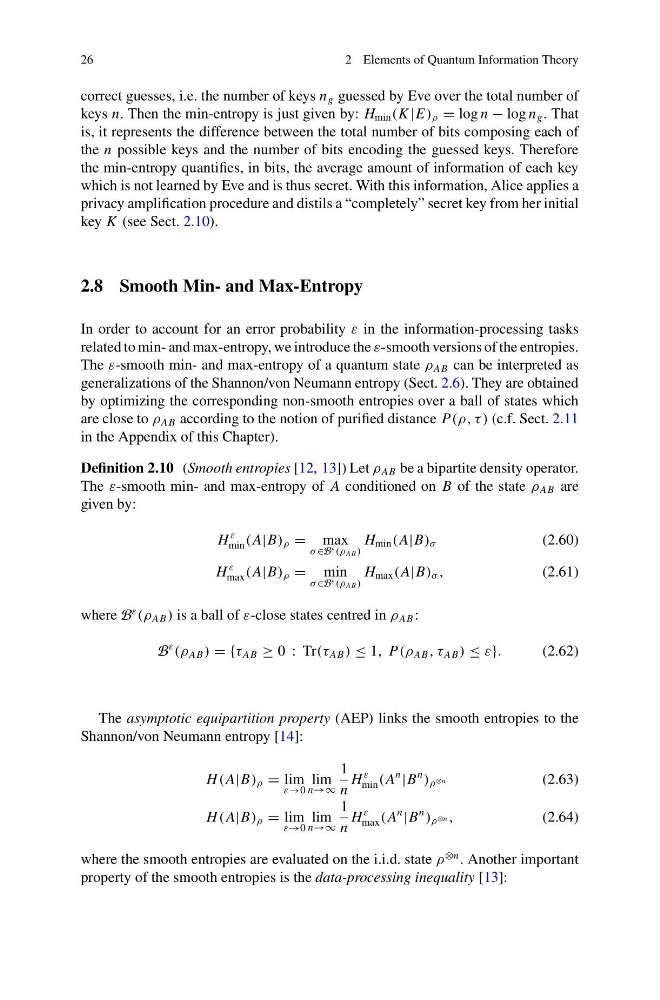
2.8 Smooth Min- and Max-Entropy
In order to account for an error probability ε in the information-processing tasks
related to min- and max-entropy, we introduce the ε-smooth versions of the entropies.
The ε-smooth min- and max-entropy of a quantum state ρ AB can be interpreted as
generalizations of the Shannon/von Neumann entropy (Sect. 2.6). They are obtained
by optimizing the corresponding non-smooth entropies over a ball of states which
are close to ρ AB according to the notion of purified distance P(ρ, τ ) (c.f. Sect. 2.11
in the Appendix of this Chapter).
Definition 2.10 (Smooth entropies [12, 13]) Let ρ AB be a bipartite density operator.
The ε-smooth min- and max-entropy of A conditioned on B of the state ρ AB are
given by:
H
ε
min (A|B) ρ = max
σ ∈B ε (ρ AB )
H min (A|B) σ
(2.60)
H
ε
max (A|B) ρ = min
σ ∈B ε (ρ AB )
H max (A|B) σ ,
(2.61)
where B
ε
(ρ AB ) is a ball of ε-close states centred in ρ AB :
B
ε
(ρ AB ) = {τ AB ≥ 0 : Tr(τ AB ) ≤ 1, P(ρ AB , τ AB ) ≤ ε}.
(2.62)
The asymptotic equipartition property (AEP) links the smooth entropies to the
Shannon/von Neumann entropy [14]:
H (A|B) ρ = lim
ε→0
lim
n→∞
1
n
H
ε
min (A
n
|B
n
) ρ ⊗n
(2.63)
H (A|B) ρ = lim
ε→0
lim
n→∞
1
n
H
ε
max (A
n
|B
n
) ρ ⊗n ,
(2.64)
where the smooth entropies are evaluated on the i.i.d. state ρ
⊗n . Another important
property of the smooth entropies is the data-processing inequality [13]:
2 Elements of Quantum Information Theory
correct guesses, i.e. the number of keys n g guessed by Eve over the total number of
keys n. Then the min-entropy is just given by: H min (K |E) ρ = log n − log n g . That
is, it represents the difference between the total number of bits composing each of
the n possible keys and the number of bits encoding the guessed keys. Therefore
the min-entropy quantifies, in bits, the average amount of information of each key
which is not learned by Eve and is thus secret. With this information, Alice applies a
privacy amplification procedure and distils a “completely” secret key from her initial
key K (see Sect. 2.10).
2.8 Smooth Min- and Max-Entropy
In order to account for an error probability ε in the information-processing tasks
related to min- and max-entropy, we introduce the ε-smooth versions of the entropies.
The ε-smooth min- and max-entropy of a quantum state ρ AB can be interpreted as
generalizations of the Shannon/von Neumann entropy (Sect. 2.6). They are obtained
by optimizing the corresponding non-smooth entropies over a ball of states which
are close to ρ AB according to the notion of purified distance P(ρ, τ ) (c.f. Sect. 2.11
in the Appendix of this Chapter).
Definition 2.10 (Smooth entropies [12, 13]) Let ρ AB be a bipartite density operator.
The ε-smooth min- and max-entropy of A conditioned on B of the state ρ AB are
given by:
H
ε
min (A|B) ρ = max
σ ∈B ε (ρ AB )
H min (A|B) σ
(2.60)
H
ε
max (A|B) ρ = min
σ ∈B ε (ρ AB )
H max (A|B) σ ,
(2.61)
where B
ε
(ρ AB ) is a ball of ε-close states centred in ρ AB :
B
ε
(ρ AB ) = {τ AB ≥ 0 : Tr(τ AB ) ≤ 1, P(ρ AB , τ AB ) ≤ ε}.
(2.62)
The asymptotic equipartition property (AEP) links the smooth entropies to the
Shannon/von Neumann entropy [14]:
H (A|B) ρ = lim
ε→0
lim
n→∞
1
n
H
ε
min (A
n
|B
n
) ρ ⊗n
(2.63)
H (A|B) ρ = lim
ε→0
lim
n→∞
1
n
H
ε
max (A
n
|B
n
) ρ ⊗n ,
(2.64)
where the smooth entropies are evaluated on the i.i.d. state ρ
⊗n . Another important
property of the smooth entropies is the data-processing inequality [13]: