

122
7 Device-Independent Quantum Cryptography
ρ
α,a
E =
⎡
⎢
⎢
⎢
⎢
⎣
λ
α
00
0 (−1)
a
λ
α
00 λ
α
01 cos ϕ (−1)
a+1
λ
α
00 λ
α
11 i sin ϕ
λ
α
10 (−1)
a
λ
α
10 λ
α
01 i sin ϕ (−1)
a+1
λ
α
10 λ
α
11 cos ϕ
λ
α
01
0
λ
α
11
⎤
⎥
⎥
⎥
⎥
⎦
,
(7.43)
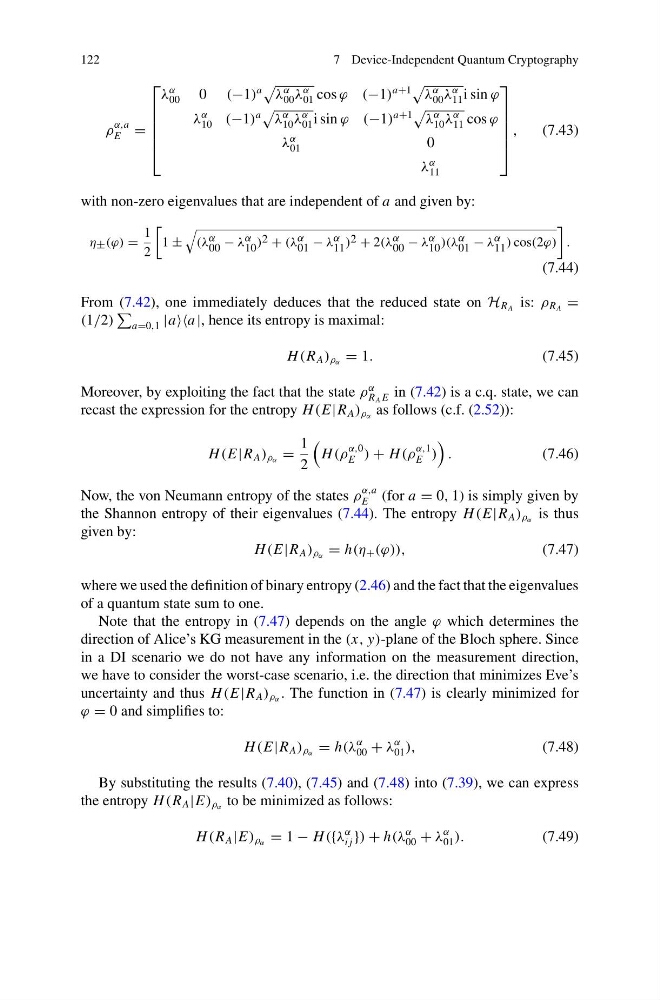
with non-zero eigenvalues that are independent of a and given by:
η ± (ϕ) =
1
2
1 ±
(λ α
00 − λ α
10 ) 2 + (λ α
01 − λ α
11 ) 2 + 2(λ α
00 − λ α
10 )(λ α
01 − λ α
11 ) cos(2ϕ)
.
(7.44)
From (7.42), one immediately deduces that the reduced state on H R A is: ρ R A =
(1/2)
a=0,1 |aa |, hence its entropy is maximal:
H (R A ) ρ α = 1.
(7.45)
Moreover, by exploiting the fact that the state ρ
α
R A E in (7.42) is a c.q. state, we can
recast the expression for the entropy H (E|R A ) ρ α as follows (c.f. (2.52)):
H (E|R A ) ρ α =
1
2
H (ρ
α,0
E ) + H (ρ
α,1
E )
.
(7.46)
Now, the von Neumann entropy of the states ρ
α,a
E (for a = 0, 1) is simply given by
the Shannon entropy of their eigenvalues (7.44). The entropy H (E|R A ) ρ α is thus
given by:
H (E|R A ) ρ α = h(η + (ϕ)),
(7.47)
where we used the definition of binary entropy (2.46) and the fact that the eigenvalues
of a quantum state sum to one.
Note that the entropy in (7.47) depends on the angle ϕ which determines the
direction of Alice’s KG measurement in the (x, y)-plane of the Bloch sphere. Since
in a DI scenario we do not have any information on the measurement direction,
we have to consider the worst-case scenario, i.e. the direction that minimizes Eve’s
uncertainty and thus H (E|R A ) ρ α . The function in (7.47) is clearly minimized for
ϕ = 0 and simplifies to:
H (E|R A ) ρ α = h(λ
α
00 + λ
α
01 ),
(7.48)
By substituting the results (7.40), (7.45) and (7.48) into (7.39), we can express
the entropy H (R A |E) ρ α to be minimized as follows:
H (R A |E) ρ α = 1 − H ({λ
α
i j }) + h(λ
α
00 + λ
α
01 ).
(7.49)
7 Device-Independent Quantum Cryptography
ρ
α,a
E =
⎡
⎢
⎢
⎢
⎢
⎣
λ
α
00
0 (−1)
a
λ
α
00 λ
α
01 cos ϕ (−1)
a+1
λ
α
00 λ
α
11 i sin ϕ
λ
α
10 (−1)
a
λ
α
10 λ
α
01 i sin ϕ (−1)
a+1
λ
α
10 λ
α
11 cos ϕ
λ
α
01
0
λ
α
11
⎤
⎥
⎥
⎥
⎥
⎦
,
(7.43)
with non-zero eigenvalues that are independent of a and given by:
η ± (ϕ) =
1
2
1 ±
(λ α
00 − λ α
10 ) 2 + (λ α
01 − λ α
11 ) 2 + 2(λ α
00 − λ α
10 )(λ α
01 − λ α
11 ) cos(2ϕ)
.
(7.44)
From (7.42), one immediately deduces that the reduced state on H R A is: ρ R A =
(1/2)
a=0,1 |aa |, hence its entropy is maximal:
H (R A ) ρ α = 1.
(7.45)
Moreover, by exploiting the fact that the state ρ
α
R A E in (7.42) is a c.q. state, we can
recast the expression for the entropy H (E|R A ) ρ α as follows (c.f. (2.52)):
H (E|R A ) ρ α =
1
2
H (ρ
α,0
E ) + H (ρ
α,1
E )
.
(7.46)
Now, the von Neumann entropy of the states ρ
α,a
E (for a = 0, 1) is simply given by
the Shannon entropy of their eigenvalues (7.44). The entropy H (E|R A ) ρ α is thus
given by:
H (E|R A ) ρ α = h(η + (ϕ)),
(7.47)
where we used the definition of binary entropy (2.46) and the fact that the eigenvalues
of a quantum state sum to one.
Note that the entropy in (7.47) depends on the angle ϕ which determines the
direction of Alice’s KG measurement in the (x, y)-plane of the Bloch sphere. Since
in a DI scenario we do not have any information on the measurement direction,
we have to consider the worst-case scenario, i.e. the direction that minimizes Eve’s
uncertainty and thus H (E|R A ) ρ α . The function in (7.47) is clearly minimized for
ϕ = 0 and simplifies to:
H (E|R A ) ρ α = h(λ
α
00 + λ
α
01 ),
(7.48)
By substituting the results (7.40), (7.45) and (7.48) into (7.39), we can express
the entropy H (R A |E) ρ α to be minimized as follows:
H (R A |E) ρ α = 1 − H ({λ
α
i j }) + h(λ
α
00 + λ
α
01 ).
(7.49)