

110
7 Device-Independent Quantum Cryptography
Notably, the last expression decomposes the projector on the state |
+
as a sum
over all the stabilizer operators of the state |
+
. An operator O is a stabilizer of a
state |ψ if O|ψ = |ψ, i.e. if the state is an eigenstate of O with eigenvalue one.
In this setting, we describe Alice’s (Bob’s) measurement on her (his) qubit as a
binary projective measurement represented by the observable A x (B y ), corresponding
to input x (y). The generic form of A x (B y ) is given by A x = α
(x)
· σ (B y = β
(y)
· σ ),
where σ is the vector of Pauli operators: σ 1 = X , σ 2 = Y and σ 3 = Z and where
α
(x)
=
β
(y)
= 1.
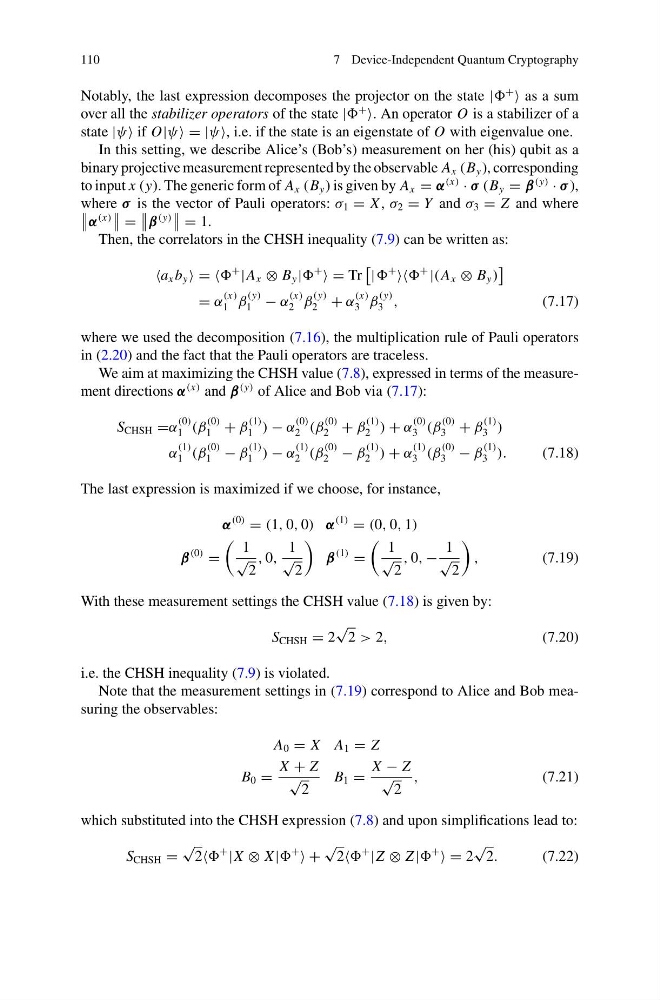
Then, the correlators in the CHSH inequality (7.9) can be written as:
a x b y = =
+
|A x ⊗ B y |
+
= Tr
|
+
+
|(A x ⊗ B y )
= α
(x)
1 β
(y)
1 − α
(x)
2 β
(y)
2 + α
(x)
3 β
(y)
3 ,
(7.17)
where we used the decomposition (7.16), the multiplication rule of Pauli operators
in (2.20) and the fact that the Pauli operators are traceless.
We aim at maximizing the CHSH value (7.8), expressed in terms of the measurement directions α
(x) and β
(y) of Alice and Bob via (7.17):
S CHSH =α
(0)
1 (β
(0)
1 + β
(1)
1 ) − α
(0)
2 (β
(0)
2 + β
(1)
2 ) + α
(0)
3 (β
(0)
3 + β
(1)
3 )
α
(1)
1 (β
(0)
1 − β
(1)
1 ) − α
(1)
2 (β
(0)
2 − β
(1)
2 ) + α
(1)
3 (β
(0)
3 − β
(1)
3 ).
(7.18)
The last expression is maximized if we choose, for instance,
α
(0)
= (1, 0, 0) α
(1)
= (0, 0, 1)
β
(0)
=
1
√
2
, 0,
1
√
2
β
(1)
=
1
√
2
, 0, −
1
√
2
,
(7.19)
With these measurement settings the CHSH value (7.18) is given by:
S CHSH = 2
√
2 > 2,
(7.20)
i.e. the CHSH inequality (7.9) is violated.
Note that the measurement settings in (7.19) correspond to Alice and Bob measuring the observables:
A 0 = X A 1 = Z
B 0 =
X + Z
√
2
B 1 =
X − Z
√
2
,
(7.21)
which substituted into the CHSH expression (7.8) and upon simplifications lead to:
S CHSH =
√
2
+
|X ⊗ X |
+
+
√
2
+
|Z ⊗ Z |
+
= 2
√
2.
(7.22)
7 Device-Independent Quantum Cryptography
Notably, the last expression decomposes the projector on the state |
+
as a sum
over all the stabilizer operators of the state |
+
. An operator O is a stabilizer of a
state |ψ if O|ψ = |ψ, i.e. if the state is an eigenstate of O with eigenvalue one.
In this setting, we describe Alice’s (Bob’s) measurement on her (his) qubit as a
binary projective measurement represented by the observable A x (B y ), corresponding
to input x (y). The generic form of A x (B y ) is given by A x = α
(x)
· σ (B y = β
(y)
· σ ),
where σ is the vector of Pauli operators: σ 1 = X , σ 2 = Y and σ 3 = Z and where
α
(x)
=
β
(y)
= 1.
Then, the correlators in the CHSH inequality (7.9) can be written as:
a x b y = =
+
|A x ⊗ B y |
+
= Tr
|
+
+
|(A x ⊗ B y )
= α
(x)
1 β
(y)
1 − α
(x)
2 β
(y)
2 + α
(x)
3 β
(y)
3 ,
(7.17)
where we used the decomposition (7.16), the multiplication rule of Pauli operators
in (2.20) and the fact that the Pauli operators are traceless.
We aim at maximizing the CHSH value (7.8), expressed in terms of the measurement directions α
(x) and β
(y) of Alice and Bob via (7.17):
S CHSH =α
(0)
1 (β
(0)
1 + β
(1)
1 ) − α
(0)
2 (β
(0)
2 + β
(1)
2 ) + α
(0)
3 (β
(0)
3 + β
(1)
3 )
α
(1)
1 (β
(0)
1 − β
(1)
1 ) − α
(1)
2 (β
(0)
2 − β
(1)
2 ) + α
(1)
3 (β
(0)
3 − β
(1)
3 ).
(7.18)
The last expression is maximized if we choose, for instance,
α
(0)
= (1, 0, 0) α
(1)
= (0, 0, 1)
β
(0)
=
1
√
2
, 0,
1
√
2
β
(1)
=
1
√
2
, 0, −
1
√
2
,
(7.19)
With these measurement settings the CHSH value (7.18) is given by:
S CHSH = 2
√
2 > 2,
(7.20)
i.e. the CHSH inequality (7.9) is violated.
Note that the measurement settings in (7.19) correspond to Alice and Bob measuring the observables:
A 0 = X A 1 = Z
B 0 =
X + Z
√
2
B 1 =
X − Z
√
2
,
(7.21)
which substituted into the CHSH expression (7.8) and upon simplifications lead to:
S CHSH =
√
2
+
|X ⊗ X |
+
+
√
2
+
|Z ⊗ Z |
+
= 2
√
2.
(7.22)