

102
6 Beyond Point-to-Point Quantum Key Distribution
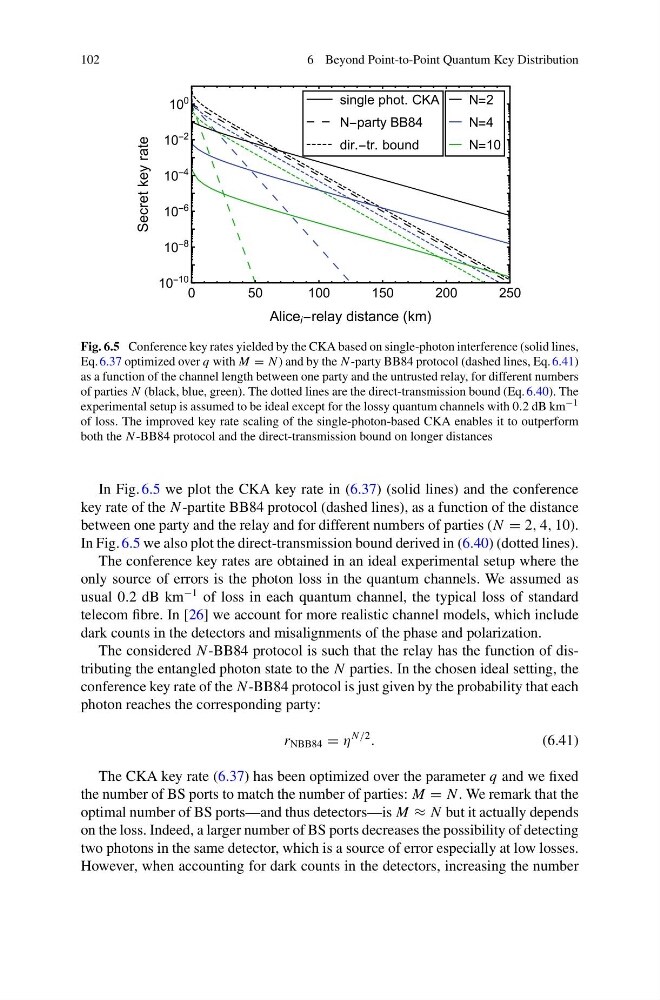
Fig. 6.5 Conference key rates yielded by the CKA based on single-photon interference (solid lines,
Eq. 6.37 optimized over q with M = N ) and by the N -party BB84 protocol (dashed lines, Eq. 6.41)
as a function of the channel length between one party and the untrusted relay, for different numbers
of parties N (black, blue, green). The dotted lines are the direct-transmission bound (Eq. 6.40). The
experimental setup is assumed to be ideal except for the lossy quantum channels with 0.2 dB km −1
of loss. The improved key rate scaling of the single-photon-based CKA enables it to outperform
both the N -BB84 protocol and the direct-transmission bound on longer distances
In Fig. 6.5 we plot the CKA key rate in (6.37) (solid lines) and the conference
key rate of the N -partite BB84 protocol (dashed lines), as a function of the distance
between one party and the relay and for different numbers of parties (N = 2, 4, 10).
In Fig. 6.5 we also plot the direct-transmission bound derived in (6.40) (dotted lines).
The conference key rates are obtained in an ideal experimental setup where the
only source of errors is the photon loss in the quantum channels. We assumed as
usual 0.2 dB km
−1 of loss in each quantum channel, the typical loss of standard
telecom fibre. In [26] we account for more realistic channel models, which include
dark counts in the detectors and misalignments of the phase and polarization.
The considered N -BB84 protocol is such that the relay has the function of distributing the entangled photon state to the N parties. In the chosen ideal setting, the
conference key rate of the N -BB84 protocol is just given by the probability that each
photon reaches the corresponding party:
r NBB84 = η
N /2
.
(6.41)
The CKA key rate (6.37) has been optimized over the parameter q and we fixed
the number of BS ports to match the number of parties: M = N . We remark that the
optimal number of BS ports—and thus detectors—is M ≈ N but it actually depends
on the loss. Indeed, a larger number of BS ports decreases the possibility of detecting
two photons in the same detector, which is a source of error especially at low losses.
However, when accounting for dark counts in the detectors, increasing the number
6 Beyond Point-to-Point Quantum Key Distribution
Fig. 6.5 Conference key rates yielded by the CKA based on single-photon interference (solid lines,
Eq. 6.37 optimized over q with M = N ) and by the N -party BB84 protocol (dashed lines, Eq. 6.41)
as a function of the channel length between one party and the untrusted relay, for different numbers
of parties N (black, blue, green). The dotted lines are the direct-transmission bound (Eq. 6.40). The
experimental setup is assumed to be ideal except for the lossy quantum channels with 0.2 dB km −1
of loss. The improved key rate scaling of the single-photon-based CKA enables it to outperform
both the N -BB84 protocol and the direct-transmission bound on longer distances
In Fig. 6.5 we plot the CKA key rate in (6.37) (solid lines) and the conference
key rate of the N -partite BB84 protocol (dashed lines), as a function of the distance
between one party and the relay and for different numbers of parties (N = 2, 4, 10).
In Fig. 6.5 we also plot the direct-transmission bound derived in (6.40) (dotted lines).
The conference key rates are obtained in an ideal experimental setup where the
only source of errors is the photon loss in the quantum channels. We assumed as
usual 0.2 dB km
−1 of loss in each quantum channel, the typical loss of standard
telecom fibre. In [26] we account for more realistic channel models, which include
dark counts in the detectors and misalignments of the phase and polarization.
The considered N -BB84 protocol is such that the relay has the function of distributing the entangled photon state to the N parties. In the chosen ideal setting, the
conference key rate of the N -BB84 protocol is just given by the probability that each
photon reaches the corresponding party:
r NBB84 = η
N /2
.
(6.41)
The CKA key rate (6.37) has been optimized over the parameter q and we fixed
the number of BS ports to match the number of parties: M = N . We remark that the
optimal number of BS ports—and thus detectors—is M ≈ N but it actually depends
on the loss. Indeed, a larger number of BS ports decreases the possibility of detecting
two photons in the same detector, which is a source of error especially at low losses.
However, when accounting for dark counts in the detectors, increasing the number