

6.5 Conference Key Agreement with Single Photon Interference
97
6.5 Conference Key Agreement with Single Photon
Interference
The founding idea of TF-QKD, elucidated in Sect. 6.3.1, can also be generalized with
some adjustments to the multiparty scenario. Indeed, in [26] we devise a conference
key agreement (CKA) where N parties simultaneously distil a secret conference key
through single-photon interference occurring at an untrusted relay.
In particular, parties Alice 1 , Alice 2 , …, Alice N establish the conference key by
sending optical pulses to the relay and by performing suitable measurements on their
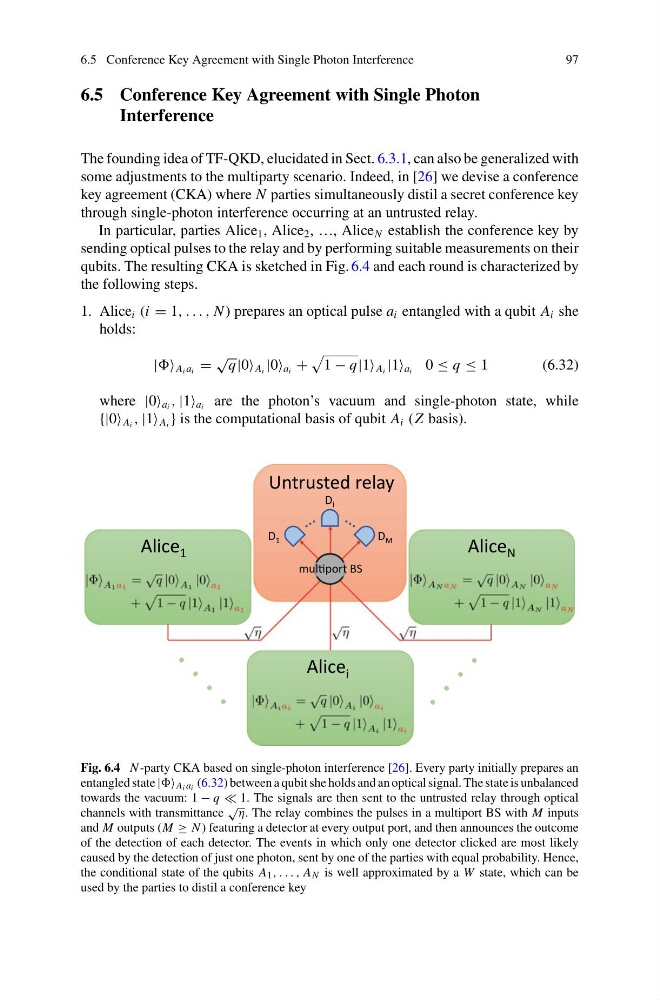
qubits. The resulting CKA is sketched in Fig. 6.4 and each round is characterized by
the following steps.
1. Alice i (i = 1, . . . , N ) prepares an optical pulse a i entangled with a qubit A i she
holds:
| A i a i =
√
q|0 A i |0 a i +
1 − q|1 A i |1 a i 0 ≤ q ≤ 1
(6.32)
where |0 a i , |1 a i are the photon’s vacuum and single-photon state, while
{|0 A i , |1 A i } is the computational basis of qubit A i (Z basis).
Alice 1
Untrusted relay
D M
D 1
D i
Alice N
Alice i
mulƟport BS
Fig. 6.4 N -party CKA based on single-photon interference [26]. Every party initially prepares an
entangled state | A i a i (6.32) between a qubit she holds and an optical signal. The state is unbalanced
towards the vacuum: 1 − q 1. The signals are then sent to the untrusted relay through optical
channels with transmittance
√
η. The relay combines the pulses in a multiport BS with M inputs
and M outputs (M ≥ N ) featuring a detector at every output port, and then announces the outcome
of the detection of each detector. The events in which only one detector clicked are most likely
caused by the detection of just one photon, sent by one of the parties with equal probability. Hence,
the conditional state of the qubits A 1 , . . . , A N is well approximated by a W state, which can be
used by the parties to distil a conference key
97
6.5 Conference Key Agreement with Single Photon
Interference
The founding idea of TF-QKD, elucidated in Sect. 6.3.1, can also be generalized with
some adjustments to the multiparty scenario. Indeed, in [26] we devise a conference
key agreement (CKA) where N parties simultaneously distil a secret conference key
through single-photon interference occurring at an untrusted relay.
In particular, parties Alice 1 , Alice 2 , …, Alice N establish the conference key by
sending optical pulses to the relay and by performing suitable measurements on their
qubits. The resulting CKA is sketched in Fig. 6.4 and each round is characterized by
the following steps.
1. Alice i (i = 1, . . . , N ) prepares an optical pulse a i entangled with a qubit A i she
holds:
| A i a i =
√
q|0 A i |0 a i +
1 − q|1 A i |1 a i 0 ≤ q ≤ 1
(6.32)
where |0 a i , |1 a i are the photon’s vacuum and single-photon state, while
{|0 A i , |1 A i } is the computational basis of qubit A i (Z basis).
Alice 1
Untrusted relay
D M
D 1
D i
Alice N
Alice i
mulƟport BS
Fig. 6.4 N -party CKA based on single-photon interference [26]. Every party initially prepares an
entangled state | A i a i (6.32) between a qubit she holds and an optical signal. The state is unbalanced
towards the vacuum: 1 − q 1. The signals are then sent to the untrusted relay through optical
channels with transmittance
√
η. The relay combines the pulses in a multiport BS with M inputs
and M outputs (M ≥ N ) featuring a detector at every output port, and then announces the outcome
of the detection of each detector. The events in which only one detector clicked are most likely
caused by the detection of just one photon, sent by one of the parties with equal probability. Hence,
the conditional state of the qubits A 1 , . . . , A N is well approximated by a W state, which can be
used by the parties to distil a conference key