

6.4 Twin-Field QKD with Finite Decoys and Asymmetric Channels
95
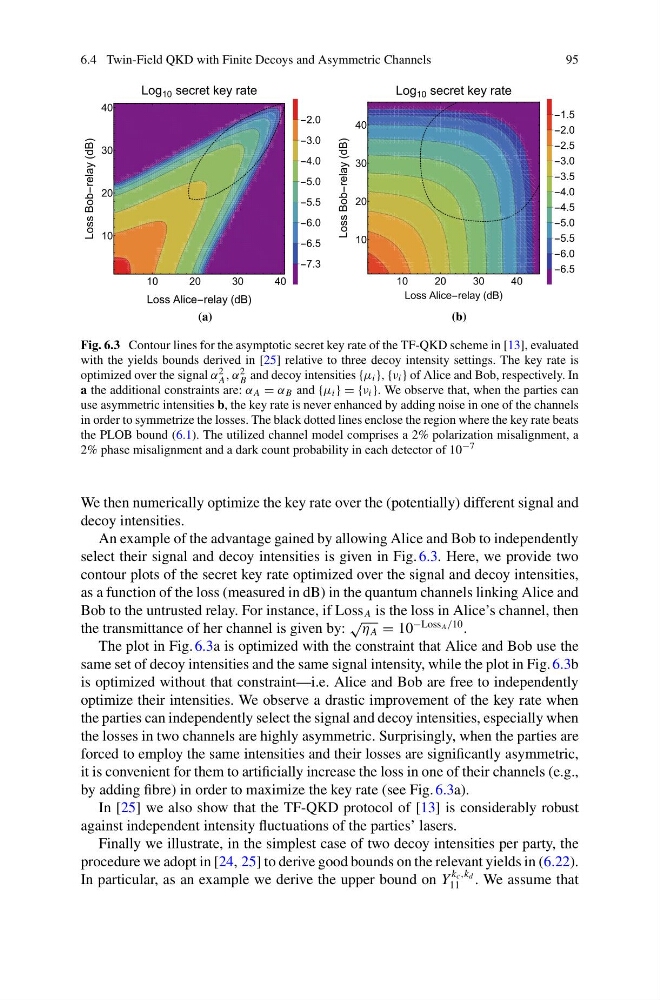
Fig. 6.3 Contour lines for the asymptotic secret key rate of the TF-QKD scheme in [13], evaluated
with the yields bounds derived in [25] relative to three decoy intensity settings. The key rate is
optimized over the signal α 2
A , α 2
B and decoy intensities {μ i }, {ν i } of Alice and Bob, respectively. In
a the additional constraints are: α A = α B and {μ i } = {ν i }. We observe that, when the parties can
use asymmetric intensities b, the key rate is never enhanced by adding noise in one of the channels
in order to symmetrize the losses. The black dotted lines enclose the region where the key rate beats
the PLOB bound (6.1). The utilized channel model comprises a 2% polarization misalignment, a
2% phase misalignment and a dark count probability in each detector of 10 −7
We then numerically optimize the key rate over the (potentially) different signal and
decoy intensities.
An example of the advantage gained by allowing Alice and Bob to independently
select their signal and decoy intensities is given in Fig. 6.3. Here, we provide two
contour plots of the secret key rate optimized over the signal and decoy intensities,
as a function of the loss (measured in dB) in the quantum channels linking Alice and
Bob to the untrusted relay. For instance, if Loss A is the loss in Alice’s channel, then
the transmittance of her channel is given by:
√ η A = 10
−Loss A /10 .
The plot in Fig. 6.3a is optimized with the constraint that Alice and Bob use the
same set of decoy intensities and the same signal intensity, while the plot in Fig. 6.3b
is optimized without that constraint—i.e. Alice and Bob are free to independently
optimize their intensities. We observe a drastic improvement of the key rate when
the parties can independently select the signal and decoy intensities, especially when
the losses in two channels are highly asymmetric. Surprisingly, when the parties are
forced to employ the same intensities and their losses are significantly asymmetric,
it is convenient for them to artificially increase the loss in one of their channels (e.g.,
by adding fibre) in order to maximize the key rate (see Fig. 6.3a).
In [25] we also show that the TF-QKD protocol of [13] is considerably robust
against independent intensity fluctuations of the parties’ lasers.
Finally we illustrate, in the simplest case of two decoy intensities per party, the
procedure we adopt in [24, 25] to derive good bounds on the relevant yields in (6.22).
In particular, as an example we derive the upper bound on Y
k c ,k d
11 . We assume that
95
Fig. 6.3 Contour lines for the asymptotic secret key rate of the TF-QKD scheme in [13], evaluated
with the yields bounds derived in [25] relative to three decoy intensity settings. The key rate is
optimized over the signal α 2
A , α 2
B and decoy intensities {μ i }, {ν i } of Alice and Bob, respectively. In
a the additional constraints are: α A = α B and {μ i } = {ν i }. We observe that, when the parties can
use asymmetric intensities b, the key rate is never enhanced by adding noise in one of the channels
in order to symmetrize the losses. The black dotted lines enclose the region where the key rate beats
the PLOB bound (6.1). The utilized channel model comprises a 2% polarization misalignment, a
2% phase misalignment and a dark count probability in each detector of 10 −7
We then numerically optimize the key rate over the (potentially) different signal and
decoy intensities.
An example of the advantage gained by allowing Alice and Bob to independently
select their signal and decoy intensities is given in Fig. 6.3. Here, we provide two
contour plots of the secret key rate optimized over the signal and decoy intensities,
as a function of the loss (measured in dB) in the quantum channels linking Alice and
Bob to the untrusted relay. For instance, if Loss A is the loss in Alice’s channel, then
the transmittance of her channel is given by:
√ η A = 10
−Loss A /10 .
The plot in Fig. 6.3a is optimized with the constraint that Alice and Bob use the
same set of decoy intensities and the same signal intensity, while the plot in Fig. 6.3b
is optimized without that constraint—i.e. Alice and Bob are free to independently
optimize their intensities. We observe a drastic improvement of the key rate when
the parties can independently select the signal and decoy intensities, especially when
the losses in two channels are highly asymmetric. Surprisingly, when the parties are
forced to employ the same intensities and their losses are significantly asymmetric,
it is convenient for them to artificially increase the loss in one of their channels (e.g.,
by adding fibre) in order to maximize the key rate (see Fig. 6.3a).
In [25] we also show that the TF-QKD protocol of [13] is considerably robust
against independent intensity fluctuations of the parties’ lasers.
Finally we illustrate, in the simplest case of two decoy intensities per party, the
procedure we adopt in [24, 25] to derive good bounds on the relevant yields in (6.22).
In particular, as an example we derive the upper bound on Y
k c ,k d
11 . We assume that