

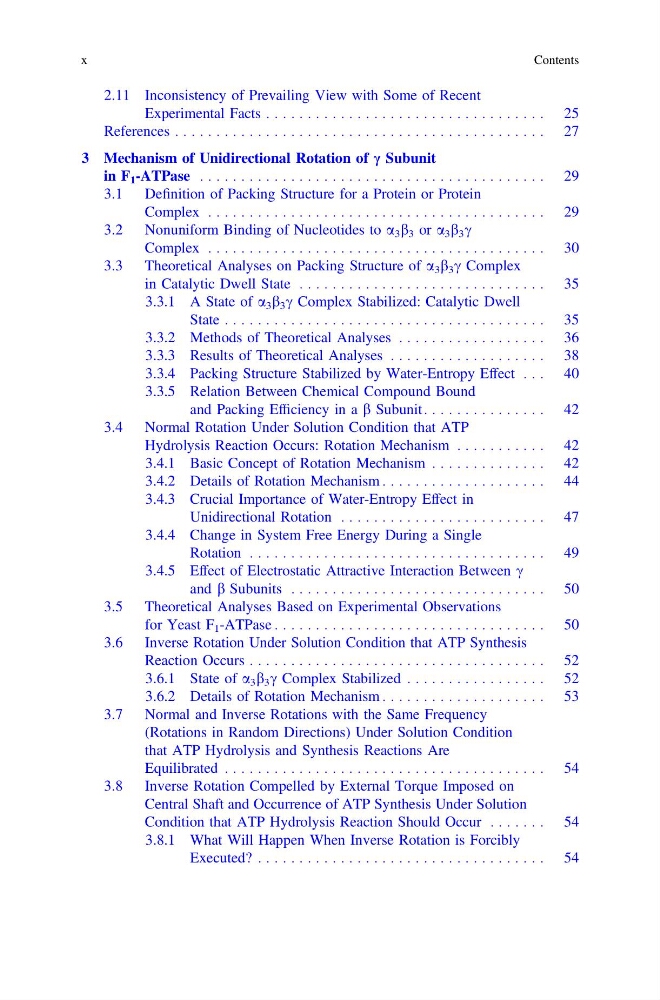
2.11 Inconsistency of Prevailing View with Some of Recent
Experimental Facts . . . . . . . . . . . . . . . . . . . . . . . . . . . . . . . . . . 25
References . . . . . . . . . . . . . . . . . . . . . . . . . . . . . . . . . . . . . . . . . . . . . 27
3 Mechanism of Unidirectional Rotation of c Subunit
in F 1 -ATPase . . . . . . . . . . . . . . . . . . . . . . . . . . . . . . . . . . . . . . . . . . 29
3.1 Definition of Packing Structure for a Protein or Protein
Complex . . . . . . . . . . . . . . . . . . . . . . . . . . . . . . . . . . . . . . . . . 29
3.2 Nonuniform Binding of Nucleotides to a 3 b 3 or a 3 b 3 c
Complex . . . . . . . . . . . . . . . . . . . . . . . . . . . . . . . . . . . . . . . . . 30
3.3 Theoretical Analyses on Packing Structure of a 3 b 3 c Complex
in Catalytic Dwell State . . . . . . . . . . . . . . . . . . . . . . . . . . . . . . 35
3.3.1 A State of a 3 b 3 c Complex Stabilized: Catalytic Dwell
State . . . . . . . . . . . . . . . . . . . . . . . . . . . . . . . . . . . . . . . 35
3.3.2 Methods of Theoretical Analyses . . . . . . . . . . . . . . . . . . 36
3.3.3 Results of Theoretical Analyses . . . . . . . . . . . . . . . . . . . 38
3.3.4 Packing Structure Stabilized by Water-Entropy Effect . . . 40
3.3.5 Relation Between Chemical Compound Bound
and Packing Efficiency in a b Subunit . . . . . . . . . . . . . . . 42
3.4 Normal Rotation Under Solution Condition that ATP
Hydrolysis Reaction Occurs: Rotation Mechanism . . . . . . . . . . . 42
3.4.1 Basic Concept of Rotation Mechanism . . . . . . . . . . . . . . 42
3.4.2 Details of Rotation Mechanism . . . . . . . . . . . . . . . . . . . . 44
3.4.3 Crucial Importance of Water-Entropy Effect in
Unidirectional Rotation . . . . . . . . . . . . . . . . . . . . . . . . . 47
3.4.4 Change in System Free Energy During a Single
Rotation . . . . . . . . . . . . . . . . . . . . . . . . . . . . . . . . . . . . 49
3.4.5 Effect of Electrostatic Attractive Interaction Between c
and b Subunits . . . . . . . . . . . . . . . . . . . . . . . . . . . . . . . 50
3.5 Theoretical Analyses Based on Experimental Observations
for Yeast F 1 -ATPase . . . . . . . . . . . . . . . . . . . . . . . . . . . . . . . . . 50
3.6 Inverse Rotation Under Solution Condition that ATP Synthesis
Reaction Occurs . . . . . . . . . . . . . . . . . . . . . . . . . . . . . . . . . . . . 52
3.6.1 State of a 3 b 3 c Complex Stabilized . . . . . . . . . . . . . . . . . 52
3.6.2 Details of Rotation Mechanism . . . . . . . . . . . . . . . . . . . . 53
3.7 Normal and Inverse Rotations with the Same Frequency
(Rotations in Random Directions) Under Solution Condition
that ATP Hydrolysis and Synthesis Reactions Are
Equilibrated . . . . . . . . . . . . . . . . . . . . . . . . . . . . . . . . . . . . . . . 54
3.8 Inverse Rotation Compelled by External Torque Imposed on
Central Shaft and Occurrence of ATP Synthesis Under Solution
Condition that ATP Hydrolysis Reaction Should Occur . . . . . . . 54
3.8.1 What Will Happen When Inverse Rotation is Forcibly
Executed? . . . . . . . . . . . . . . . . . . . . . . . . . . . . . . . . . . . 54
x
Contents
Experimental Facts . . . . . . . . . . . . . . . . . . . . . . . . . . . . . . . . . . 25
References . . . . . . . . . . . . . . . . . . . . . . . . . . . . . . . . . . . . . . . . . . . . . 27
3 Mechanism of Unidirectional Rotation of c Subunit
in F 1 -ATPase . . . . . . . . . . . . . . . . . . . . . . . . . . . . . . . . . . . . . . . . . . 29
3.1 Definition of Packing Structure for a Protein or Protein
Complex . . . . . . . . . . . . . . . . . . . . . . . . . . . . . . . . . . . . . . . . . 29
3.2 Nonuniform Binding of Nucleotides to a 3 b 3 or a 3 b 3 c
Complex . . . . . . . . . . . . . . . . . . . . . . . . . . . . . . . . . . . . . . . . . 30
3.3 Theoretical Analyses on Packing Structure of a 3 b 3 c Complex
in Catalytic Dwell State . . . . . . . . . . . . . . . . . . . . . . . . . . . . . . 35
3.3.1 A State of a 3 b 3 c Complex Stabilized: Catalytic Dwell
State . . . . . . . . . . . . . . . . . . . . . . . . . . . . . . . . . . . . . . . 35
3.3.2 Methods of Theoretical Analyses . . . . . . . . . . . . . . . . . . 36
3.3.3 Results of Theoretical Analyses . . . . . . . . . . . . . . . . . . . 38
3.3.4 Packing Structure Stabilized by Water-Entropy Effect . . . 40
3.3.5 Relation Between Chemical Compound Bound
and Packing Efficiency in a b Subunit . . . . . . . . . . . . . . . 42
3.4 Normal Rotation Under Solution Condition that ATP
Hydrolysis Reaction Occurs: Rotation Mechanism . . . . . . . . . . . 42
3.4.1 Basic Concept of Rotation Mechanism . . . . . . . . . . . . . . 42
3.4.2 Details of Rotation Mechanism . . . . . . . . . . . . . . . . . . . . 44
3.4.3 Crucial Importance of Water-Entropy Effect in
Unidirectional Rotation . . . . . . . . . . . . . . . . . . . . . . . . . 47
3.4.4 Change in System Free Energy During a Single
Rotation . . . . . . . . . . . . . . . . . . . . . . . . . . . . . . . . . . . . 49
3.4.5 Effect of Electrostatic Attractive Interaction Between c
and b Subunits . . . . . . . . . . . . . . . . . . . . . . . . . . . . . . . 50
3.5 Theoretical Analyses Based on Experimental Observations
for Yeast F 1 -ATPase . . . . . . . . . . . . . . . . . . . . . . . . . . . . . . . . . 50
3.6 Inverse Rotation Under Solution Condition that ATP Synthesis
Reaction Occurs . . . . . . . . . . . . . . . . . . . . . . . . . . . . . . . . . . . . 52
3.6.1 State of a 3 b 3 c Complex Stabilized . . . . . . . . . . . . . . . . . 52
3.6.2 Details of Rotation Mechanism . . . . . . . . . . . . . . . . . . . . 53
3.7 Normal and Inverse Rotations with the Same Frequency
(Rotations in Random Directions) Under Solution Condition
that ATP Hydrolysis and Synthesis Reactions Are
Equilibrated . . . . . . . . . . . . . . . . . . . . . . . . . . . . . . . . . . . . . . . 54
3.8 Inverse Rotation Compelled by External Torque Imposed on
Central Shaft and Occurrence of ATP Synthesis Under Solution
Condition that ATP Hydrolysis Reaction Should Occur . . . . . . . 54
3.8.1 What Will Happen When Inverse Rotation is Forcibly
Executed? . . . . . . . . . . . . . . . . . . . . . . . . . . . . . . . . . . . 54
x
Contents