

5 Appendix 1: Angle-Dependent Integral Equation Theory
73
The hydration entropy of a polyatomic solute in process 1 can be calculated with
sufficient accuracy and very high speed by the ADIE theory combined with the
morphometric approach [11–13] (see Chap. 6).
In the ADIE theory [2–6], the dependences of interaction potential and a correlation function on the orientations of water molecules are explicitly taken into account.
As a molecular model for water, a multipolar model [3] is the most conveniently
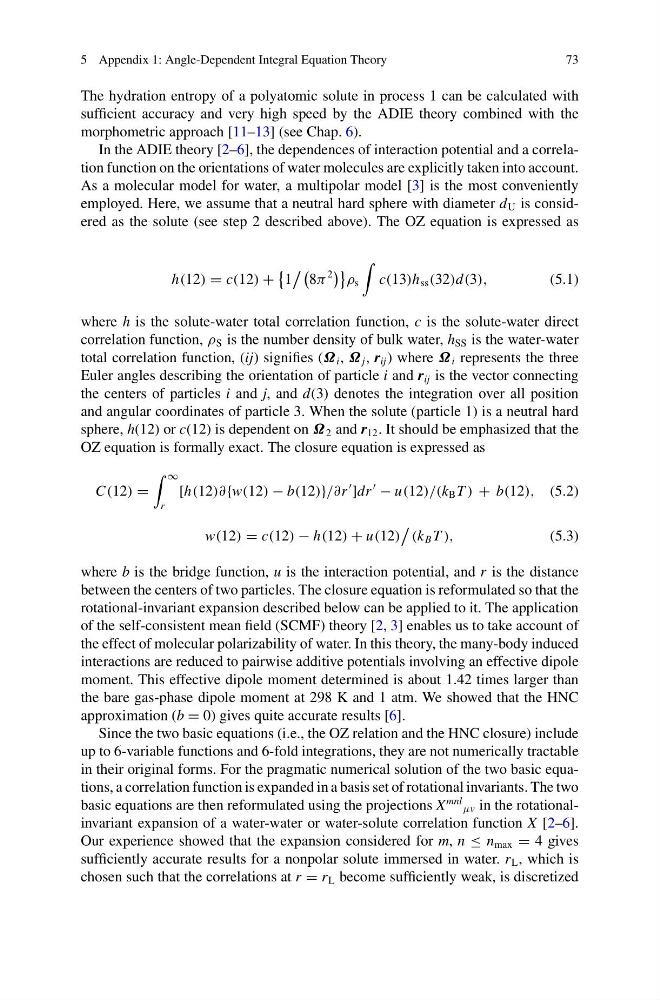
employed. Here, we assume that a neutral hard sphere with diameter d U is considered as the solute (see step 2 described above). The OZ equation is expressed as
h(12) = c(12) +
1
8π
2
ρ s
c(13)h ss (32)d(3),
(5.1)
where h is the solute-water total correlation function, c is the solute-water direct
correlation function, ρ S is the number density of bulk water, h SS is the water-water
total correlation function, (ij) signifies (Ω i , Ω j , r ij ) where Ω i represents the three
Euler angles describing the orientation of particle i and r ij is the vector connecting
the centers of particles i and j, and d(3) denotes the integration over all position
and angular coordinates of particle 3. When the solute (particle 1) is a neutral hard
sphere, h(12) or c(12) is dependent on Ω 2 and r 12 . It should be emphasized that the
OZ equation is formally exact. The closure equation is expressed as
C(12) =
∞
r
[h(12)∂{w(12) − b(12)}/∂r
]dr
− u(12)/(k B T ) + b(12), (5.2)
w(12) = c(12) − h(12) + u(12)
(k B T ),
(5.3)
where b is the bridge function, u is the interaction potential, and r is the distance
between the centers of two particles. The closure equation is reformulated so that the
rotational-invariant expansion described below can be applied to it. The application
of the self-consistent mean field (SCMF) theory [2, 3] enables us to take account of
the effect of molecular polarizability of water. In this theory, the many-body induced
interactions are reduced to pairwise additive potentials involving an effective dipole
moment. This effective dipole moment determined is about 1.42 times larger than
the bare gas-phase dipole moment at 298 K and 1 atm. We showed that the HNC
approximation (b = 0) gives quite accurate results [6].
Since the two basic equations (i.e., the OZ relation and the HNC closure) include
up to 6-variable functions and 6-fold integrations, they are not numerically tractable
in their original forms. For the pragmatic numerical solution of the two basic equations, a correlation function is expanded in a basis set of rotational invariants. The two
basic equations are then reformulated using the projections X
mnl μv in the rotationalinvariant expansion of a water-water or water-solute correlation function X [2–6].
Our experience showed that the expansion considered for m, n ≤ n max = 4 gives
sufficiently accurate results for a nonpolar solute immersed in water. r L , which is
chosen such that the correlations at r = r L become sufficiently weak, is discretized
73
The hydration entropy of a polyatomic solute in process 1 can be calculated with
sufficient accuracy and very high speed by the ADIE theory combined with the
morphometric approach [11–13] (see Chap. 6).
In the ADIE theory [2–6], the dependences of interaction potential and a correlation function on the orientations of water molecules are explicitly taken into account.
As a molecular model for water, a multipolar model [3] is the most conveniently
employed. Here, we assume that a neutral hard sphere with diameter d U is considered as the solute (see step 2 described above). The OZ equation is expressed as
h(12) = c(12) +
1
8π
2
ρ s
c(13)h ss (32)d(3),
(5.1)
where h is the solute-water total correlation function, c is the solute-water direct
correlation function, ρ S is the number density of bulk water, h SS is the water-water
total correlation function, (ij) signifies (Ω i , Ω j , r ij ) where Ω i represents the three
Euler angles describing the orientation of particle i and r ij is the vector connecting
the centers of particles i and j, and d(3) denotes the integration over all position
and angular coordinates of particle 3. When the solute (particle 1) is a neutral hard
sphere, h(12) or c(12) is dependent on Ω 2 and r 12 . It should be emphasized that the
OZ equation is formally exact. The closure equation is expressed as
C(12) =
∞
r
[h(12)∂{w(12) − b(12)}/∂r
]dr
− u(12)/(k B T ) + b(12), (5.2)
w(12) = c(12) − h(12) + u(12)
(k B T ),
(5.3)
where b is the bridge function, u is the interaction potential, and r is the distance
between the centers of two particles. The closure equation is reformulated so that the
rotational-invariant expansion described below can be applied to it. The application
of the self-consistent mean field (SCMF) theory [2, 3] enables us to take account of
the effect of molecular polarizability of water. In this theory, the many-body induced
interactions are reduced to pairwise additive potentials involving an effective dipole
moment. This effective dipole moment determined is about 1.42 times larger than
the bare gas-phase dipole moment at 298 K and 1 atm. We showed that the HNC
approximation (b = 0) gives quite accurate results [6].
Since the two basic equations (i.e., the OZ relation and the HNC closure) include
up to 6-variable functions and 6-fold integrations, they are not numerically tractable
in their original forms. For the pragmatic numerical solution of the two basic equations, a correlation function is expanded in a basis set of rotational invariants. The two
basic equations are then reformulated using the projections X
mnl μv in the rotationalinvariant expansion of a water-water or water-solute correlation function X [2–6].
Our experience showed that the expansion considered for m, n ≤ n max = 4 gives
sufficiently accurate results for a nonpolar solute immersed in water. r L , which is
chosen such that the correlations at r = r L become sufficiently weak, is discretized