

72
5 Appendix 1: Angle-Dependent Integral Equation Theory
Process
2-ES
Process 1
Process
2-vdW
Polyatomic Solute
Water Molecules
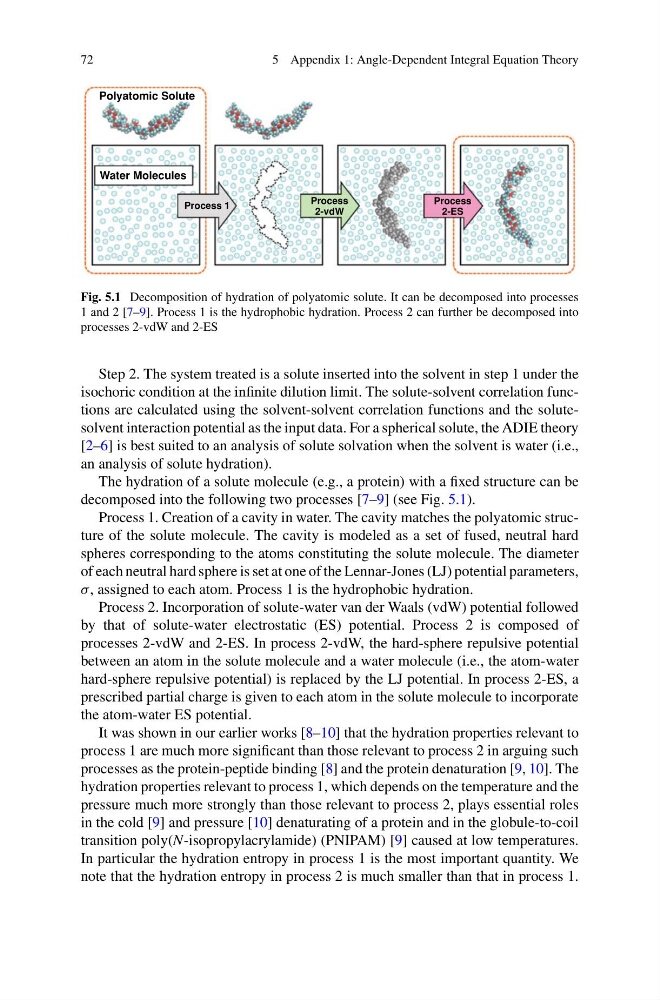
Fig. 5.1 Decomposition of hydration of polyatomic solute. It can be decomposed into processes
1 and 2 [7–9]. Process 1 is the hydrophobic hydration. Process 2 can further be decomposed into
processes 2-vdW and 2-ES
Step 2. The system treated is a solute inserted into the solvent in step 1 under the
isochoric condition at the infinite dilution limit. The solute-solvent correlation functions are calculated using the solvent-solvent correlation functions and the solutesolvent interaction potential as the input data. For a spherical solute, the ADIE theory
[2–6] is best suited to an analysis of solute solvation when the solvent is water (i.e.,
an analysis of solute hydration).
The hydration of a solute molecule (e.g., a protein) with a fixed structure can be
decomposed into the following two processes [7–9] (see Fig. 5.1).
Process 1. Creation of a cavity in water. The cavity matches the polyatomic structure of the solute molecule. The cavity is modeled as a set of fused, neutral hard
spheres corresponding to the atoms constituting the solute molecule. The diameter
of each neutral hard sphere is set at one of the Lennar-Jones (LJ) potential parameters,
σ, assigned to each atom. Process 1 is the hydrophobic hydration.
Process 2. Incorporation of solute-water van der Waals (vdW) potential followed
by that of solute-water electrostatic (ES) potential. Process 2 is composed of
processes 2-vdW and 2-ES. In process 2-vdW, the hard-sphere repulsive potential
between an atom in the solute molecule and a water molecule (i.e., the atom-water
hard-sphere repulsive potential) is replaced by the LJ potential. In process 2-ES, a
prescribed partial charge is given to each atom in the solute molecule to incorporate
the atom-water ES potential.
It was shown in our earlier works [8–10] that the hydration properties relevant to
process 1 are much more significant than those relevant to process 2 in arguing such
processes as the protein-peptide binding [8] and the protein denaturation [9, 10]. The
hydration properties relevant to process 1, which depends on the temperature and the
pressure much more strongly than those relevant to process 2, plays essential roles
in the cold [9] and pressure [10] denaturating of a protein and in the globule-to-coil
transition poly(N-isopropylacrylamide) (PNIPAM) [9] caused at low temperatures.
In particular the hydration entropy in process 1 is the most important quantity. We
note that the hydration entropy in process 2 is much smaller than that in process 1.
5 Appendix 1: Angle-Dependent Integral Equation Theory
Process
2-ES
Process 1
Process
2-vdW
Polyatomic Solute
Water Molecules
Fig. 5.1 Decomposition of hydration of polyatomic solute. It can be decomposed into processes
1 and 2 [7–9]. Process 1 is the hydrophobic hydration. Process 2 can further be decomposed into
processes 2-vdW and 2-ES
Step 2. The system treated is a solute inserted into the solvent in step 1 under the
isochoric condition at the infinite dilution limit. The solute-solvent correlation functions are calculated using the solvent-solvent correlation functions and the solutesolvent interaction potential as the input data. For a spherical solute, the ADIE theory
[2–6] is best suited to an analysis of solute solvation when the solvent is water (i.e.,
an analysis of solute hydration).
The hydration of a solute molecule (e.g., a protein) with a fixed structure can be
decomposed into the following two processes [7–9] (see Fig. 5.1).
Process 1. Creation of a cavity in water. The cavity matches the polyatomic structure of the solute molecule. The cavity is modeled as a set of fused, neutral hard
spheres corresponding to the atoms constituting the solute molecule. The diameter
of each neutral hard sphere is set at one of the Lennar-Jones (LJ) potential parameters,
σ, assigned to each atom. Process 1 is the hydrophobic hydration.
Process 2. Incorporation of solute-water van der Waals (vdW) potential followed
by that of solute-water electrostatic (ES) potential. Process 2 is composed of
processes 2-vdW and 2-ES. In process 2-vdW, the hard-sphere repulsive potential
between an atom in the solute molecule and a water molecule (i.e., the atom-water
hard-sphere repulsive potential) is replaced by the LJ potential. In process 2-ES, a
prescribed partial charge is given to each atom in the solute molecule to incorporate
the atom-water ES potential.
It was shown in our earlier works [8–10] that the hydration properties relevant to
process 1 are much more significant than those relevant to process 2 in arguing such
processes as the protein-peptide binding [8] and the protein denaturation [9, 10]. The
hydration properties relevant to process 1, which depends on the temperature and the
pressure much more strongly than those relevant to process 2, plays essential roles
in the cold [9] and pressure [10] denaturating of a protein and in the globule-to-coil
transition poly(N-isopropylacrylamide) (PNIPAM) [9] caused at low temperatures.
In particular the hydration entropy in process 1 is the most important quantity. We
note that the hydration entropy in process 2 is much smaller than that in process 1.