

4.1 Functional Rotation of AcrB
65
AcrB: Homotrimer
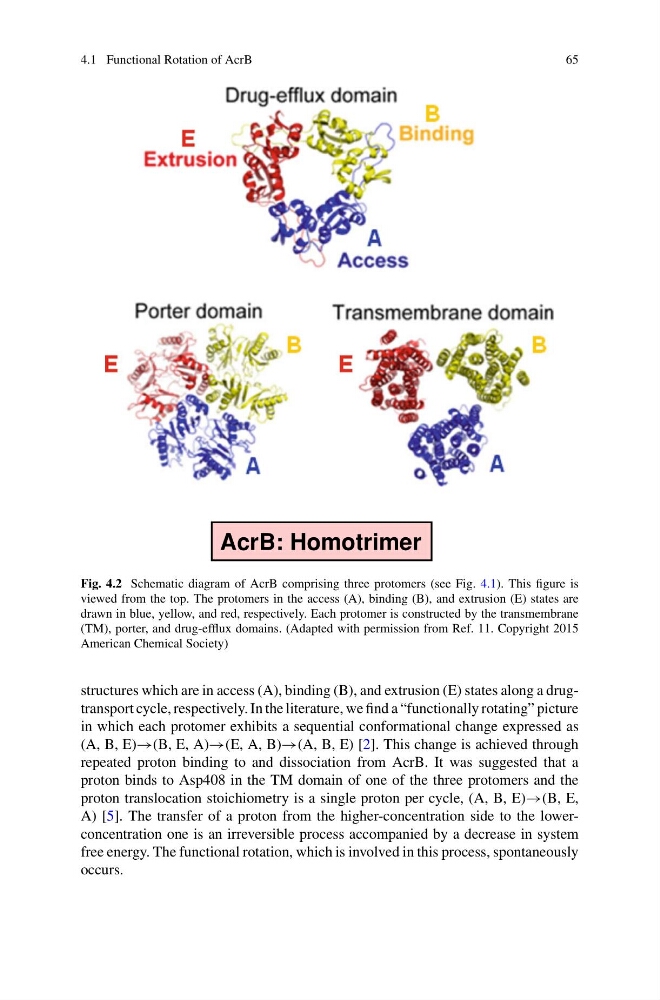
Fig. 4.2 Schematic diagram of AcrB comprising three protomers (see Fig. 4.1). This figure is
viewed from the top. The protomers in the access (A), binding (B), and extrusion (E) states are
drawn in blue, yellow, and red, respectively. Each protomer is constructed by the transmembrane
(TM), porter, and drug-efflux domains. (Adapted with permission from Ref. 11. Copyright 2015
American Chemical Society)
structures which are in access (A), binding (B), and extrusion (E) states along a drugtransport cycle, respectively. In the literature, we find a “functionally rotating” picture
in which each protomer exhibits a sequential conformational change expressed as
(A, B, E)→(B, E, A)→(E, A, B)→(A, B, E) [2]. This change is achieved through
repeated proton binding to and dissociation from AcrB. It was suggested that a
proton binds to Asp408 in the TM domain of one of the three protomers and the
proton translocation stoichiometry is a single proton per cycle, (A, B, E)→(B, E,
A) [5]. The transfer of a proton from the higher-concentration side to the lowerconcentration one is an irreversible process accompanied by a decrease in system
free energy. The functional rotation, which is involved in this process, spontaneously
occurs.
65
AcrB: Homotrimer
Fig. 4.2 Schematic diagram of AcrB comprising three protomers (see Fig. 4.1). This figure is
viewed from the top. The protomers in the access (A), binding (B), and extrusion (E) states are
drawn in blue, yellow, and red, respectively. Each protomer is constructed by the transmembrane
(TM), porter, and drug-efflux domains. (Adapted with permission from Ref. 11. Copyright 2015
American Chemical Society)
structures which are in access (A), binding (B), and extrusion (E) states along a drugtransport cycle, respectively. In the literature, we find a “functionally rotating” picture
in which each protomer exhibits a sequential conformational change expressed as
(A, B, E)→(B, E, A)→(E, A, B)→(A, B, E) [2]. This change is achieved through
repeated proton binding to and dissociation from AcrB. It was suggested that a
proton binds to Asp408 in the TM domain of one of the three protomers and the
proton translocation stoichiometry is a single proton per cycle, (A, B, E)→(B, E,
A) [5]. The transfer of a proton from the higher-concentration side to the lowerconcentration one is an irreversible process accompanied by a decrease in system
free energy. The functional rotation, which is involved in this process, spontaneously
occurs.