

64
4 Concluding Remarks
There is another class of proteins or protein complexes utilizing the proton motive
force characterized by the repeated transfer of a proton from the higher-concentration
side to the lower-concentration one. A paradigmatic example is the drug efflux pump,
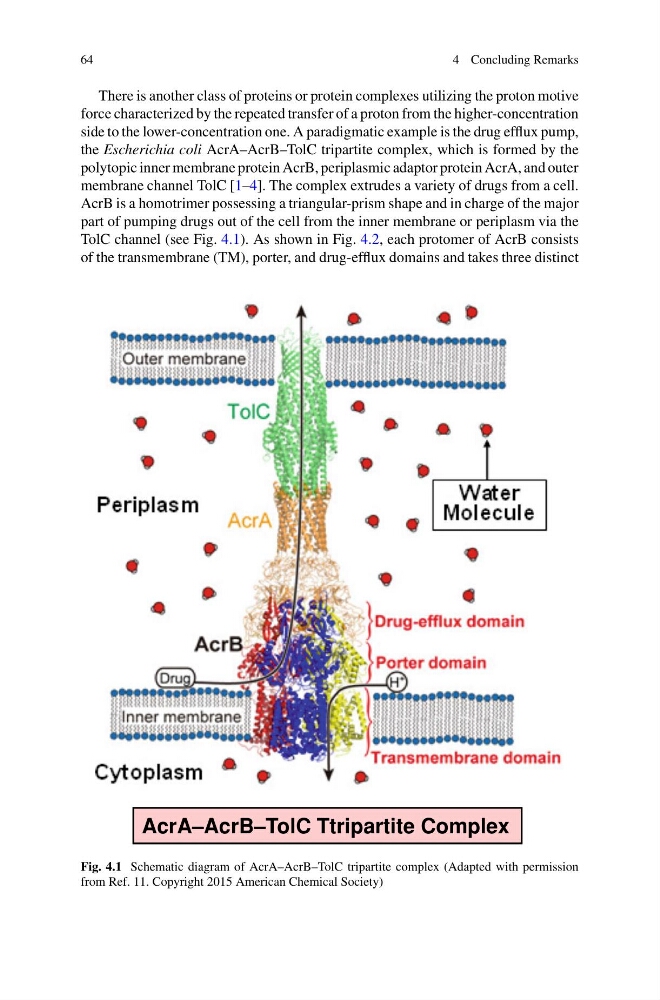
the Escherichia coli AcrA–AcrB–TolC tripartite complex, which is formed by the
polytopic inner membrane protein AcrB, periplasmic adaptor protein AcrA, and outer
membrane channel TolC [1–4]. The complex extrudes a variety of drugs from a cell.
AcrB is a homotrimer possessing a triangular-prism shape and in charge of the major
part of pumping drugs out of the cell from the inner membrane or periplasm via the
TolC channel (see Fig. 4.1). As shown in Fig. 4.2, each protomer of AcrB consists
of the transmembrane (TM), porter, and drug-efflux domains and takes three distinct
AcrA–AcrB–TolC Ttripartite Complex
Fig. 4.1 Schematic diagram of AcrA–AcrB–TolC tripartite complex (Adapted with permission
from Ref. 11. Copyright 2015 American Chemical Society)
4 Concluding Remarks
There is another class of proteins or protein complexes utilizing the proton motive
force characterized by the repeated transfer of a proton from the higher-concentration
side to the lower-concentration one. A paradigmatic example is the drug efflux pump,
the Escherichia coli AcrA–AcrB–TolC tripartite complex, which is formed by the
polytopic inner membrane protein AcrB, periplasmic adaptor protein AcrA, and outer
membrane channel TolC [1–4]. The complex extrudes a variety of drugs from a cell.
AcrB is a homotrimer possessing a triangular-prism shape and in charge of the major
part of pumping drugs out of the cell from the inner membrane or periplasm via the
TolC channel (see Fig. 4.1). As shown in Fig. 4.2, each protomer of AcrB consists
of the transmembrane (TM), porter, and drug-efflux domains and takes three distinct
AcrA–AcrB–TolC Ttripartite Complex
Fig. 4.1 Schematic diagram of AcrA–AcrB–TolC tripartite complex (Adapted with permission
from Ref. 11. Copyright 2015 American Chemical Society)