

3.8 Inverse Rotation Compelled by External Torque Imposed …
57
β β DP in (a)
β TP in (b)
β E in (b)
Dissociation of ATP followed by Pi binding
ADP binding followed by ATP synthesis
β TP in (a)
β E in (a)
β DP in (b)A
Change of ATP H 2 O toward ATP
ATP
ATP H 2 O
Pi
ATP
Pi
ATP H 2 O
ADP, Pi
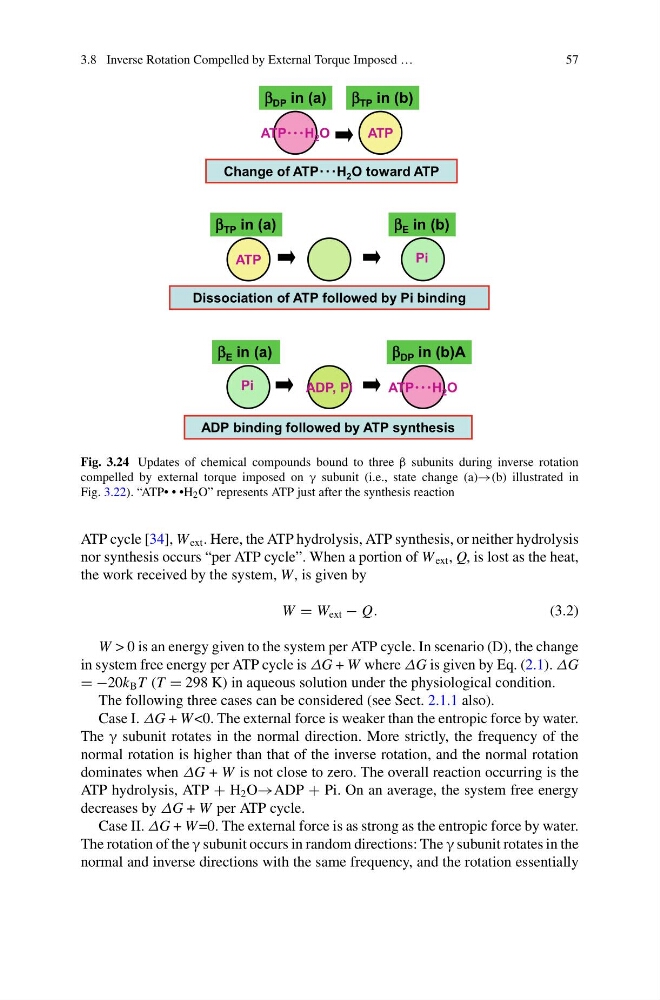
Fig. 3.24 Updates of chemical compounds bound to three β subunits during inverse rotation
compelled by external torque imposed on γ subunit (i.e., state change (a)→(b) illustrated in
Fig. 3.22). “ATP• • •H 2 O” represents ATP just after the synthesis reaction
ATP cycle [34], W ext . Here, the ATP hydrolysis, ATP synthesis, or neither hydrolysis
nor synthesis occurs “per ATP cycle”. When a portion of W ext , Q, is lost as the heat,
the work received by the system, W, is given by
W = W ext − Q.
(3.2)
W > 0 is an energy given to the system per ATP cycle. In scenario (D), the change
in system free energy per ATP cycle is ΔG + W where ΔG is given by Eq. (2.1). ΔG
= −20k B T (T = 298 K) in aqueous solution under the physiological condition.
The following three cases can be considered (see Sect. 2.1.1 also).
Case I. ΔG + W <0. The external force is weaker than the entropic force by water.
The γ subunit rotates in the normal direction. More strictly, the frequency of the
normal rotation is higher than that of the inverse rotation, and the normal rotation
dominates when ΔG + W is not close to zero. The overall reaction occurring is the
ATP hydrolysis, ATP + H 2 O→ADP + Pi. On an average, the system free energy
decreases by ΔG + W per ATP cycle.
Case II. ΔG + W =0. The external force is as strong as the entropic force by water.
The rotation of the γ subunit occurs in random directions: The γ subunit rotates in the
normal and inverse directions with the same frequency, and the rotation essentially
57
β β DP in (a)
β TP in (b)
β E in (b)
Dissociation of ATP followed by Pi binding
ADP binding followed by ATP synthesis
β TP in (a)
β E in (a)
β DP in (b)A
Change of ATP H 2 O toward ATP
ATP
ATP H 2 O
Pi
ATP
Pi
ATP H 2 O
ADP, Pi
Fig. 3.24 Updates of chemical compounds bound to three β subunits during inverse rotation
compelled by external torque imposed on γ subunit (i.e., state change (a)→(b) illustrated in
Fig. 3.22). “ATP• • •H 2 O” represents ATP just after the synthesis reaction
ATP cycle [34], W ext . Here, the ATP hydrolysis, ATP synthesis, or neither hydrolysis
nor synthesis occurs “per ATP cycle”. When a portion of W ext , Q, is lost as the heat,
the work received by the system, W, is given by
W = W ext − Q.
(3.2)
W > 0 is an energy given to the system per ATP cycle. In scenario (D), the change
in system free energy per ATP cycle is ΔG + W where ΔG is given by Eq. (2.1). ΔG
= −20k B T (T = 298 K) in aqueous solution under the physiological condition.
The following three cases can be considered (see Sect. 2.1.1 also).
Case I. ΔG + W <0. The external force is weaker than the entropic force by water.
The γ subunit rotates in the normal direction. More strictly, the frequency of the
normal rotation is higher than that of the inverse rotation, and the normal rotation
dominates when ΔG + W is not close to zero. The overall reaction occurring is the
ATP hydrolysis, ATP + H 2 O→ADP + Pi. On an average, the system free energy
decreases by ΔG + W per ATP cycle.
Case II. ΔG + W =0. The external force is as strong as the entropic force by water.
The rotation of the γ subunit occurs in random directions: The γ subunit rotates in the
normal and inverse directions with the same frequency, and the rotation essentially